UNITED STATES
SECURITIES AND EXCHANGE COMMISSION
Washington, D.C. 20549
FORM
(Mark One)
For the fiscal year ended
OR
For the transition period from to
Commission file number:
(Exact name of registrant as specified in its charter)
| (State or other jurisdiction of incorporation or organization) | (I.R.S. Employer Identification No.) |
| (Address of principal executive offices) | (Zip Code) |
Registrant’s telephone number, including
area code:
Securities registered pursuant to Section 12(b) of the Act:
| Title of each Class | Trading Symbol | Name of Exchange on Which Registered | ||
(Nasdaq Capital Market) |
Securities registered pursuant to Section 12(g) of the Act: None
Indicate by check mark if the registrant is a
well-known seasoned issuer, as defined in Rule 405 of the Securities Act. Yes ☐
Indicate by check mark if the registrant is not
required to file reports pursuant to Section 13 or Section 15(d) of the Act. Yes ☐
Indicate by check mark whether the registrant
(1) has filed all reports required to be filed by Section 13 or 15(d) of the Securities Exchange Act of 1934 during the preceding 12
months (or for such shorter period that the registrant was required to file such reports), and (2) has been subject to such filing requirements
for the past 90 days.
Indicate by check mark whether the registrant
has submitted electronically every Interactive Data File required to be submitted pursuant to Rule 405 of Regulation S-T (§232.405
of this chapter) during the preceding 12 months (or for such shorter period that the registrant was required to submit such files).
Indicate by check mark whether the registrant is a large accelerated filer, an accelerated filer, a non-accelerated filer, a smaller reporting company, or an emerging growth company. See the definitions of “large accelerated filer,” “accelerated filer,” “smaller reporting company,” and “emerging growth company” in Rule 12b-2 of the Exchange Act.
| Large accelerated filer ☐ | |
| Non-accelerated filer ☐ | Smaller reporting company |
| Emerging growth company |
If an emerging growth company, indicate by check mark if the registrant has elected not to use the extended transition period for complying with any new or revised financial accounting standards provided pursuant to Section 13(a) of the Exchange Act. ☐
Indicate by check mark whether the registrant
has filed a report on and attestation to its management’s assessment of the effectiveness of its internal control over financial
reporting under Section 404(b) of the Sarbanes-Oxley Act (15 U.S.C. 7262(b)) by the registered public accounting firm that prepared or
issued its audit report.
If securities are registered pursuant to Section
12(b) of the Act, indicate by check mark whether the financial statements of the registrant included in the filing reflect the correction
of an error to previously issued financial statements.
Indicate by check mark whether any of those error corrections are restatements that required a recovery analysis of incentive-based compensation received by any of the registrant’s executive officers during the relevant recovery period pursuant to §240.10D-1(b). ☐
Indicate by check mark whether the registrant
is a shell company (as defined in Rule 12b-2 of the Act). Yes ☐ No
The aggregate market value of the voting and
non-voting common equity held by nonaffiliates of the registrant computed by reference to the closing sale price of such stock, was approximately
$
As of March 12, 2026, there were
DOCUMENTS INCORPORATED BY REFERENCE:
The information required by Part III of this Report, to the extent not set forth herein, is incorporated herein by reference from the registrant’s definitive Proxy Statement relating to the 2026 Annual Meeting of Stockholders (“Proxy Statement”), which definitive Proxy Statement shall be filed with the Securities and Exchange Commission within 120 days after the end of the fiscal year to which this Report relates.
TABLE OF CONTENTS
-i-
CAUTIONARY STATEMENT
All statements included or incorporated by reference in this Annual Report on Form 10-K, other than statements or characterizations of historical fact, are forward-looking statements. Examples of forward-looking statements include, but are not limited to, statements concerning projected net sales, costs and expenses, and margins; the expected timing, cost and effects of our capital improvement projects, and other strategic and business initiatives; expectations surrounding our repairs and maintenance activities and their timing, costs and effects; our business outlook and expected performance in future periods; the sufficiency of our liquidity and capital resources; our ability to continue as a going concern; our accounting estimates, assumptions and judgments; the demand for specialty alcohols and essential ingredients; the competitive nature of and anticipated growth in our industry; production capacity and goals; our ability to consummate acquisitions, if any, and integrate their operations successfully; and our prospective needs for additional capital. These forward-looking statements are based on our current expectations, estimates, approximations and projections about our industry and business, management’s beliefs, and certain assumptions made by us, all of which are subject to change. Forward-looking statements can often be identified by words such as “anticipates,” “expects,” “intends,” “plans,” “predicts,” “believes,” “seeks,” “estimates,” “may,” “will,” “should,” “would,” “could,” “potential,” “continue,” “ongoing,” similar expressions and variations or negatives of these words. These statements are not guarantees of future performance and are subject to risks, uncertainties and assumptions that are difficult to predict. Therefore, our actual results could differ materially and adversely from those expressed in any forward-looking statements as a result of various factors, some of which are listed under “Risk Factors” in Item 1A of this report. These forward-looking statements speak only as of the date of this report. We undertake no obligation to revise or update publicly any forward-looking statement for any reason, except as otherwise required by law.
-ii-
PART I
Item 1. Business.
Business Overview
We are a leading producer and distributor of specialty alcohols, renewable fuels and essential ingredients in the United States.
We operate five alcohol production facilities. Three of our production facilities are located in Illinois, one is located in Oregon, and another is located in Idaho. We have an annual alcohol production capacity of 330 million gallons, including both renewable fuels and specialty alcohols ranging from industrial-, pharmaceutical-, and high-quality food- and beverage-grade alcohols. Of this amount, we can produce up to 110 million gallons annually of specialty alcohols, depending on our product mix among high-quality beverage-grade alcohol and other quality specification alcohols. We market and distribute all of the alcohols produced at our facilities as well as alcohols produced by third parties. In 2025, we marketed and distributed approximately 350 million gallons combined of our own produced alcohols as well as fuel-grade ethanol produced by third parties, and over 1.2 million tons of essential ingredients.
We also own and operate a liquid carbon dioxide, or CO2, production facility adjacent to our plant in Oregon for the offtake of CO2 gas from the plant for conversion to liquid CO2 and subsequent sale. In addition, we break bulk and distribute specialty alcohols, produced by us and third parties.
We report our financial and operating performance in three distinct segments:
| ● | Pekin production, which includes the production and sale of alcohols and other products we refer to as “essential ingredients” described below, produced at our three production facilities located in Pekin, Illinois, which we refer to as our Pekin Campus; |
| ● | Marketing and distribution, which includes marketing and merchant trading for company-produced alcohols and essential ingredients on an aggregated basis, and sales of fuel-grade ethanol sourced from third parties; and |
| ● | Western production, which includes the production and sale of renewable fuels and essential ingredients produced at our Western production facilities, including our liquid CO2 plant, on an aggregated basis, none of which are individually so significant as to be considered a separately reportable segment. |
Our mission is to produce the highest quality, sustainable ingredients that make everyday products better. We intend to accomplish this goal in part by investing in our specialized and higher value specialty alcohol production and distribution infrastructure, expanding production in high-demand essential ingredients, expanding and extending the sale of our products into new regional and international markets, building efficiencies and economies of scale and by capturing a greater portion of the value stream.
-1-
Production Segments
We produce specialty alcohols, renewable fuels and essential ingredients, focusing on five key markets: Health, Home & Beauty; Food & Beverage; Industry & Agriculture; Essential Ingredients; and Renewable Fuels. Products for Health, Home & Beauty markets include specialty alcohols used in mouthwash, cosmetics, pharmaceuticals, hand sanitizers, disinfectants and cleaners. Products for Food & Beverage markets include grain neutral spirits used in alcoholic beverages and vinegar, as well as corn germ used for corn oils. Products for Industry & Agriculture markets include alcohols and other products for paint applications, inks, vehicle fluids and fertilizers. Products for Essential Ingredients markets include dried yeast, corn protein meal, corn protein feed, corn germ, distillers grains, gas and liquid CO2 and liquid feed used in commercial animal feed and pet foods. We also sell yeast and gas and liquid CO2 for human consumption. Our products for the Renewable Fuels markets include fuel-grade ethanol and distillers corn oil used as a feedstock for renewable diesel and biodiesel fuels. Our specialty alcohols for the Industry & Agriculture, Food & Beverage and Health, Home & Beauty markets represented approximately 11%, 6% and 2%, respectively, of our sales in 2025 to customers in these three markets.
We produce our alcohols and essential ingredients at our facilities described below. Our production facilities located in Illinois are in the heart of the Corn Belt, benefit from relatively low-cost and abundant feedstock and enjoy logistical advantages that enable us to provide our products to both domestic and international markets via truck, rail or barge. Our production facilities located in Oregon and Idaho are near their respective fuel and feed customers, offering significant timing, product transportation cost and logistical advantages.
All of our production facilities, other than our Magic Valley plant, were operating for all of 2025, other than for scheduled and unscheduled downtimes to address facility repair and maintenance.
In January 2024, we temporarily hot-idled our Magic Valley facility to minimize losses from negative regional crush margins and to expedite the installation of additional equipment to achieve the intended production rate, quality and consistency from our corn oil and high protein system at the facility. We restarted our Magic Valley facility in July 2024 and by October 2024, the facility consistently achieved average ethanol production rates at full capacity, the protein content yield from the plant reached 50% or greater, and we were able to expand our corn oil yields. Increases in regional corn basis and declining market prices for protein and corn oil resulted in overall margin compression, outweighing the economic benefits of our plant improvements. As a consequence, we cold-idled our Magic Valley facility for all of 2025 and through the filing of this report to minimize financial losses. We continue to provide ethanol terminaling services at the plant and may resume operations at the facility if the economic environment in the region sustainably improves.
As market conditions change, we may increase, decrease or idle production at one or more operating facilities or resume operations at any idled facility.
Marketing and Distribution Segment
We market and distribute all the alcohols and essential ingredients we produce at our facilities. We also market and distribute alcohols produced by third parties.
We have extensive and long-standing customer relationships, both domestic and international, for our specialty alcohols, renewable fuels and essential ingredients. These customers include producers and distributors of ingredients for cosmetics, sanitizers and related products, distilled spirits producers, food products manufacturers, producers of personal health/consumer health and personal care hygiene products, and global trading firms.
Our renewable fuel customers are located throughout the Western and Midwestern United States and consist of integrated oil companies and gasoline marketers who blend fuel-grade ethanol into gasoline. Our customers depend on us to provide a reliable supply of fuel-grade ethanol and manage the logistics and timing of delivery. Our customers collectively require fuel-grade ethanol volumes in excess of the supplies we produce at our facilities. We secure additional fuel-grade ethanol supplies from third-party ethanol producers. We arrange for transportation, storage and delivery of fuel-grade ethanol purchased by our customers through our agreements with third-party service providers in the Western United States as well as in the Midwest from a variety of sources.
-2-
We market food-grade essential ingredients to human and pet food markets, our feed products (such as distillers grains) primarily to export markets from our Pekin Campus, and other feed products to dairies and feedlots, in many cases located near our production facilities. These customers use our feed products for livestock as a substitute for corn and other sources of starch and protein. We sell our corn oil to poultry, renewable diesel and biodiesel customers.
See “Note 5 – Segments” to our Notes to Consolidated Financial Statements included elsewhere in this report for financial information about our business segments.
Company History
We are a Delaware corporation formed in 2005. Our common stock trades on The Nasdaq Capital Market under the symbol “ALTO.” Our Internet website address is http://www.altoingredients.com. Information contained on our website is not part of this Annual Report on Form 10-K. Our Annual Reports on Form 10-K, Quarterly Reports on Form 10-Q, Current Reports on Form 8-K and any amendments to such reports filed with or furnished to the Securities and Exchange Commission and other Securities and Exchange Commission filings are available free of charge through our website as soon as reasonably practicable after the reports are electronically filed with, or furnished to, the Securities and Exchange Commission.
Business Strategy
The key elements of our business and growth strategy include:
| ● | Pursue further carbon strategies. The Inflation Reduction Act of 2022, taken together with more recent changes made under the One Big Beautiful Bill Act increased the carbon capture tax credit to $85 per metric ton, providing enhanced section 45Q incentives for carbon capture, utilization, and storage projects, or CCUS. Additionally, section 45Z low carbon fuel tax credits offer significant advantages for facilities like ours by directly incentivizing the production of fuels with reduced lifecycle greenhouse gas emissions. The section 45Z tax credit rewards producers for each gallon of qualifying low carbon fuel sold, making projects that lower the carbon intensity of their products more financially attractive. |
| ● | At our Columbia facility, we produce over 120,000 metric tons of CO2 gas per year. Currently, we sell approximately 57,000 tons per year to our customers and we are exploring ways to enhance CO2 capture during truck loading and expand production through increased storage capacity at our liquid CO2 plant. |
| ● | At our Pekin Campus, we produce over 600,000 metric tons of CO2 gas per year. Currently, we sell approximately 190,000 tons of CO2 annually with capacity for further growth, positioning us to optimize tax advantages and improve project economics. We are assessing large scale CO2 utilization and sequestration opportunities and developing plans to capture more value for our CO2. |
We believe leveraging these incentives not only enhances project returns but also helps secure long-term market competitiveness as clean fuel standards become more prevalent. By prioritizing CCUS initiatives, we can further reduce our carbon footprint, strengthen our leadership in sustainable fuel production, and generate new revenue streams that support ongoing innovation and growth. We believe the financial benefits under the Inflation Reduction Act and the One Big Beautiful Bill Act and the substantial additional economic benefits of the environmental attributes associated with low carbon ethanol will result in excellent returns on investment.
| ● | Focus on our customer relationships. Our primary business focus is to expand the production and sale of specialty alcohols and essential ingredients. We are service-oriented and focus our efforts on specialty products that yield premium prices compared to commodity products that yield predominantly passive, market-driven prices. We strive to make our business ever more customer-centric to enable our premium services to support premium prices and new differentiated and higher-margin products. |
-3-
| ● | Expand product offerings. We are pursuing initiatives to broaden our product offerings to appeal to a wider range of customers and uses in our key markets. For example, in 2025, we acquired a liquid CO2 production facility located adjacent to our Oregon plant and now offer liquid CO2 for sale. Our liquid CO2 facility and our food-grade yeast plant are both FSSC 22000 certified, meeting the Global Food Safety Initiative (GFSI) benchmarking requirements. In addition, we maintain ISO 9001, ICH Q7 and EXCiPACT certifications for the facilities and quality systems used to produce all United States Pharmacopeia, or USP, grade alcohol products. These certifications appeal to customers with stringent quality demands and enable us to offer alcohol certified for use as an active pharmaceutical ingredient, or API, and as an excipient—an inactive component of a drug or medication, such as solvents, carriers or tinctures—in the pharmaceutical industry. All ingredients we produce for use in beverages, human and pet foods are third-party certified for ISO 9001 and Hazard Analysis and Critical Control Points (HACCP). In addition, all of our animal feed production, including at our Oregon and Idaho facilities, has undergone third-party Food Safety Modernization Act (FSMA) auditing. We are reviewing additional certifications and product positioning within our key markets to expand the range of customers we serve and the uses our products support. |
| ● | Implement new equipment and technologies. We are evaluating and plan to implement new equipment and technologies to increase our production yields, improve our operating efficiencies and reliability, reduce our overall carbon footprint, diversify our products and revenues, and increase our profitability as financial resources and market conditions justify these investments. |
Competitive Strengths
We believe that our competitive strengths include:
| ● | Strong customer and supplier relationships. We have strong, extensive and long-standing close customer and supplier relationships, both domestic and international, for our specialty alcohols, renewable fuels and essential ingredients. We have an excellent reputation for developing specialty alcohols under stringent quality control standards. Our quality management systems are supported by ISO 9001, FSSC 22000, ICH Q7 and EXCiPACT certifications, which are viewed by our customers as important attestations of our quality control. |
| ● | Diverse product mix. We offer a wide range of specialty alcohols, essential ingredients and other products to meet customer demand. We offer multiple alcohol quality grades ranging from industrial-grade alcohol to the highest beverage grade low moisture 200 proof alcohol available. In addition, we offer renewable fuel, including International Sustainability and Carbon Certification, or ISCC, fuel-grade ethanol for export to Europe. We also offer a wide variety of essential ingredients and other products for food, feed and other markets. |
| ● | Barriers to entry. Our production facilities use specialized equipment, technologies and processes to achieve stringent quality controls, higher yields and efficient production of alcohols and essential ingredients. Our specialized equipment, technologies and processes, together with our quality management certifications, strict regulatory requirements, and close customer and supplier relationships create significant barriers to entry to new market participants. |
| ● | Our experienced management. Our senior management team has a proven track record with significant operational and financial expertise and many years of experience in the alcohol production industry. Our senior executives have successfully navigated a wide variety of business and industry-specific challenges and deeply understand the business of successfully producing and marketing specialty alcohols, renewable fuels and essential ingredients. |
-4-
| ● | The strategic location of our Midwest production facilities. We operate three distinct but integrated production facilities at our Pekin Campus in the Midwest. We are able to participate from that location in the largest regional specialty alcohol market in the United States as well as international markets. |
| ● | We believe that our Midwest location enhances our overall hedging opportunities with a greater correlation to the highly liquid physical and paper markets in Chicago. |
| ● | Our Midwest location provides excellent logistical access via rail, truck and barge. In particular, barge access via the Illinois River to the Mississippi River enables us to efficiently bring our products to international markets. |
| ● | The relatively unique wet milling process at one of our production facilities at our Pekin Campus allows us to extract the highest use and value from each component of the corn kernel. As a result, the wet milling process generates a higher level of cost recovery from corn than that produced at a dry mill. |
| ● | Our Midwest location allows us deep market insight and engagement in major specialty alcohol, fuel-grade ethanol, pet food and feed markets, thereby improving pricing opportunities. |
Overview of Our Key Markets and Market Opportunity
We produce specialty alcohols, renewable fuels and essential ingredients, focusing on five key markets: Health, Home & Beauty; Food & Beverage; Industry & Agriculture; Essential Ingredients; and Renewable Fuels.
Health, Home & Beauty
Our products for the health, home and beauty markets include specialty alcohols used in mouthwash, cosmetics, pharmaceuticals, hand sanitizers, disinfectants and cleaners. We offer a variety of specialty alcohols for the health, home and beauty markets, depending on usage and regulatory requirements, including API-grade or USP-grade ethyl alcohols, and industrial-grade ethyl alcohol.
We have ISO 9001, FSSC 22000, ICH Q7 and EXCiPACT certifications, all of which are viewed as important attestations of quality control standards. In particular, our ICH Q7 certification qualifies our specialty alcohols for use as an API, and our EXCiPACT certification qualifies our specialty alcohols for use as an excipient in the pharmaceutical industry. These certifications enable us to offer products to a wider group of customers and generally at more profitable margins.
Food & Beverage
Our products for the food and beverage market include specialty alcohols used in alcoholic beverages, flavor extracts and vinegar as well as corn germ used for corn oil and CO2 gas used for beverage carbonation and dry ice. We offer grain neutral spirits, or GNS, as our primary specialty alcohol for beverage-grade products. In addition, we sell FCC 190 and USP 190 Ultra into vinegar markets. We also sell high-quality 192 proof and low-moisture 200 proof GNS products to customers in the beverage, food, flavor and personal care industries.
We believe the key drivers in the food and beverage market include consumer preferences for the social currency of brand authenticity and heritage; consumers seeking unique and personalized experiences; improved consumer access to spirits products; and the ability to meet wide-ranging consumer preferences through a broad diversity of spirits categories and cocktails.
-5-
Industry & Agriculture
Our products for the industry and agriculture market include alcohols and other products for paint applications, inks, vehicle fluids and fertilizers.
Essential Ingredients
Our essential ingredients include dried yeast, corn protein meal, corn protein feed, and distillers grains and liquid feed used in commercial animal feed and pet foods. In addition, we sell yeast for human consumption. We also produce and sell gas and liquid CO2. The raw materials for our essential ingredients are generated as co-products from our production of alcohols. These co-products are further manufactured, altered and refined into our essential ingredients, including for special customer applications.
Many of our essential ingredients are used in a variety of food products to affect their nutrition, including protein and fat content, as well as other product attributes such as taste, texture, palatability and stability. Our high quality and high purity manufacturing enables our customers to use some of our essential ingredients in human foods while others are used solely in pet foods and animal feed.
We expect the essential ingredients market to grow significantly due to global demand for higher-grade protein feed, such as feed used in fisheries and other applications for plant-based proteins.
Renewable Fuels
Our renewable fuels products include fuel-grade ethanol primarily used as a transportation fuel additive and distillers corn oil used as a renewable diesel and biodiesel feedstock. Our renewable fuels business is supported by our own production of fuel-grade ethanol as well as fuel-grade ethanol produced by third parties. Our renewable fuel products also include ISCC fuel-grade ethanol for export to Europe.
Renewable fuels, primarily fuel-grade ethanol, are used for a variety of purposes, including as octane enhancers for premium gasoline and to enable refiners to produce greater quantities of lower octane blend stock; for fuel blending to extend fuel supplies and reduce reliance on crude oil and refined products; and to comply with a variety of governmental programs, in particular, the national Renewable Fuel Standard, or RFS, enacted to promote alternatives to fossil fuels. Under the RFS, the mandated use of all renewable fuels rose incrementally and peaked at 36.0 billion gallons in 2022, of which production of 15.0 billion gallons was required from conventional, or corn-based, ethanol. The RFS allows the Environmental Protection Agency, or EPA, to adjust the annual requirement based on certain facts and circumstances. The EPA set its annual requirement for conventional ethanol to 15.0 billion gallons for 2025. The EPA has proposed annual requirements for conventional ethanol of 15.0 billion gallons for each of 2026 and 2027. See “—Governmental Regulation.”
According to the Renewable Fuels Association, the domestic fuel-grade ethanol industry produced approximately 16.4 billion gallons of ethanol in 2025, up from approximately 16.1 billion gallons of ethanol in 2024. According to the United States Department of Energy, total annual gasoline consumption in the United States is approximately 137 billion gallons and total annual fuel-grade ethanol blended with gasoline represented approximately 10.5% of this amount in 2025. We anticipate that continued limited opportunities for gasoline refinery expansions and the growing importance of reducing CO2 emissions using renewable fuels will generate additional growth in the demand for fuel-grade ethanol.
-6-
Overview of Alcohol Production Process
Alcohol production from starch- or sugar-based feedstock is a highly efficient process. Modern alcohol production requires large amounts of corn, or other high-starch grains, and water as well as chemicals, enzymes and yeast, in addition to natural gas and electricity.
Dry Milling Process
In the dry milling process, corn or other high-starch grain is first ground into flour, then slurried with water to form a mash. Enzymes are added to the mash to convert the starch into dextrose, a simple sugar. The mash is processed through a high temperature cooking procedure, which reduces bacteria levels prior to fermentation. The mash is then cooled and transferred to fermenters, where yeast is added and the conversion of sugar to alcohol and CO2 begins.
After fermentation, the resulting “beer” is transferred to distillation where the alcohol is separated from the residual “stillage.” The resulting alcohol is concentrated to 190 proof using conventional distillation methods. It can then be dehydrated to approximately 200 proof, representing 100% alcohol levels, in either a molecular sieve system or a grits system. For fuel-grade ethanol, the resulting anhydrous alcohol is then blended with up to 2.5% denaturant, usually gasoline, and then shipped to renewable fuels markets. For specialty alcohols, the products can be sold pure or as one of the Alcohol and Tobacco Tax and Trade Bureau (TTB) approved specially denatured alcohol (SDA) formulations to meet customer specifications.
The residual stillage is separated into a coarse grain portion and a liquid portion through a screw press or centrifugation process. The soluble liquid portion is concentrated to about 40% dissolved solids by an evaporation process. This intermediate state is called condensed distillers solubles, or syrup. The coarse grain and syrup portions are then mixed to produce wet distillers grains with solubles, or WDGS, or can be mixed and dried to produce dried distillers grains with solubles, or DDGS. Both WDGS and DDGS are high-protein animal feed products.
Wet Milling Process
In the wet milling process, corn or other high-starch grain is first soaked or “steeped” in sulfurous acid for approximately 24 hours to soften the whole corn kernel prior to milling. After steeping, the grain is coarse milled to gently open the kernels to separate the corn germ and from which corn oil is further extracted in a separate process. The remaining fiber, protein and starch components are further separated and sold.
The stillage from the fermentation process is concentrated in an evaporator and is co-dried with the fiber component and sold as corn protein feed. The protein component is separated from the starch, filtered and dried to produce corn protein meal, a product with greater than 60% protein content. The starch component is processed into alcohol through fermentation. The fermentation process for alcohol at this stage is similar to the dry milling process. In addition, we separate and dry yeast to produce distillers yeast.
-7-
Overview of Distillers Grains Market
Distillers grains are produced as a co-product of alcohol production and are valuable components of feed rations primarily to dairies and beef cattle markets, both nationally and internationally. Our facilities produce both WDGS and DDGS. WDGS is sold to customers proximate to the facilities and DDGS is delivered by truck, rail and barge to customers in domestic and international markets. Producing WDGS uses up to one-third less process energy, thus reducing production costs and lowering the carbon footprint of our Western production facilities.
Historically, the market price for distillers grains has generally tracked the price of corn. We believe that the market price of WDGS and DDGS is determined by a number of factors, including the market prices of corn, soybean meal and other competitive ingredients, the performance or value of WDGS and DDGS in a particular feed formulation and general market forces of supply and demand, including export markets for these essential ingredients. The market price of distillers grains is also often influenced by nutritional models that calculate the feed value of distillers grains by nutritional content, as well as reliability of consistent supply.
Customers
Our Kinergy Marketing LLC, or Kinergy, subsidiary sells all of our produced alcohols and also markets fuel-grade ethanol produced by third parties. Our Alto Nutrients, LLC subsidiary sells all of the essential ingredients we produce. Our Alto Carbonic, LLC subsidiary sells all of the liquid CO2 we produce and our Eagle Alcohol business sells our alcohols and third-party alcohols in break bulk quantities to customers in the beverage, food, industrial and related-process industries.
We have extensive and long-standing customer relationships, both domestic and international, for our specialty alcohols and essential ingredients, including yeast for pet food and human foods. These customers include producers and distributors of ingredients for cosmetics, sanitizers and related products, distilled spirits producers, food products manufacturers, producers of personal health/consumer health and personal care hygiene products, and global trading firms.
Our renewable fuel customers are located throughout the Western and Midwestern United States and consist of integrated oil companies and gasoline marketers who blend fuel-grade ethanol into gasoline. Our customers depend on us to provide a reliable supply of fuel-grade ethanol and manage the logistics and timing of delivery. We secure additional fuel-grade ethanol supplies from third-party fuel-grade ethanol plants.
We market our essential ingredient feed products to dairies and feedlots, in many cases located near our production facilities. These customers use our feed products for livestock as a substitute for corn and other sources of starch and protein. We sell our corn oil to poultry, renewable diesel and biodiesel customers.
Our Pekin Campus production segment generated $416 million, $416 million and $502 million in net sales for the years ended December 31, 2025, 2024 and 2023, respectively, from the sale of alcohols. Our Pekin Campus production segment generated $175 million, $169 million and $218 million in net sales for the years ended December 31, 2025, 2024 and 2023, respectively, from the sale of essential ingredients.
During 2025, 2024 and 2023, our Pekin Campus production segment sold an aggregate of approximately 208 million, 214 million and 209 million gallons of alcohols and 919,600, 906,300 and 878,400 tons of essential ingredients, respectively.
Our Western production segment generated $67 million, $115 million and $167 million in net sales for the years ended December 31, 2025, 2024 and 2023, respectively, from the sale of alcohols. Our Western production segment generated $32 million, $37 million and $57 million in net sales for the years ended December 31, 2025, 2024 and 2023, respectively, from the sale of essential ingredients.
-8-
During 2025, 2024 and 2023, our Western production segment sold an aggregate of approximately 33 million, 61 million and 67 million gallons of alcohols and 299,600, 514,600 and 642,300 tons of essential ingredients, respectively.
Our marketing and distribution segment generated $221 million, $217 million and $263 million in net sales for the years ended December 31, 2025, 2024 and 2023, respectively, from the sale of our own alcohols and third-party produced alcohols.
Our Corporate and other segment, which includes Eagle Alcohol’s business, generated $7 million, $11 million and $16 million in net sales for the years ended December 31, 2025, 2024 and 2023, respectively, and sold 2.2 million, 3.6 million and 4.0 million gallons of alcohols, respectively, for those years.
During 2025, 2024 and 2023, we produced or purchased from third parties and resold an aggregate of 350 million, 386 million and 383 million gallons of alcohols to approximately 82, 85 and 88 customers, respectively. For 2025, 2024 and 2023, sales to our largest customer, Chevron Products USA represented an aggregate of approximately 9%, 11% and 9% of our net sales, respectively. For 2025, 2024 and 2023, sales to each of our other customers represented less than 10% of our net sales.
Suppliers
Pekin Campus and Western Production Segments
Our production operations depend upon various raw materials suppliers, including suppliers of corn, natural gas, electricity and water. The cost of corn, including delivery costs, is the most important variable cost associated with our alcohol production. We source corn for our plants using standard contracts, including spot purchase, forward purchase and basis contracts. When resources are available, we seek to limit the exposure of our production operations to raw material price fluctuations by purchasing forward a portion of our corn requirements on a fixed price basis and by purchasing corn and other raw materials futures contracts and options.
During 2025, 2024 and 2023, purchases of corn from our two largest suppliers represented an aggregate of approximately 28%, 29% and 26% of our total corn purchases, respectively, for those periods. Purchases from each of our other corn suppliers represented less than 10% of total corn purchases in each of 2025, 2024 and 2023.
Marketing and Distribution Segment
Our marketing and distribution operations include alcohols and essential ingredients we produce but also depend upon various third-party producers of fuel-grade ethanol. In addition, we provide transportation, storage and delivery services through third-party service providers with whom we have contracted to receive fuel-grade ethanol at agreed upon locations from our third-party suppliers and to store and/or deliver the ethanol to agreed-upon locations on behalf of our customers. These contracts generally run from year-to-year, subject to termination by either party upon advance written notice before the end of the then-current annual term.
During 2025, 2024 and 2023, we purchased and resold from third parties an aggregate of approximately 107 million, 108 million and 103 million gallons, respectively, of fuel-grade ethanol.
During 2025, 2024 and 2023, purchases of fuel-grade ethanol from our three largest third-party suppliers represented 74%, 79% and 86%, respectively, of our total third-party ethanol purchases for each of those periods. Purchases from each of our other third-party ethanol suppliers represented less than 10% of total third-party ethanol purchases in each of 2025, 2024 and 2023.
-9-
Production Facilities
We operate five alcohol production facilities. Three of our production facilities are located in Illinois, one is located in Oregon, and another is located in Idaho. We have an annual alcohol production capacity of up to 330 million gallons, including both fuel-grade ethanol and specialty alcohols ranging from industrial-, pharmaceutical-, and high-quality food- and beverage-grade alcohols. Of this amount, we are able to produce up to 110 million gallons annually of specialty alcohols, depending on our product mix among high-quality beverage-grade alcohol and other quality specification alcohols. We also own and operate a liquid CO2 production facility adjacent to our plant in Oregon for the offtake of CO2 gas from the plant for conversion to liquid CO2 and subsequent sale.
The tables below provide an overview of our five alcohol production facilities and our liquid CO2 production facility. As market conditions change, we may increase, decrease or idle production at one or more operating facilities or resume operations at any idled facility.
Pekin Campus Production Facilities
| Pekin Wet Facility | Pekin Dry Facility | Pekin ICP Facility | ||||
| Location | Pekin, IL | Pekin, IL | Pekin, IL | |||
| Current operating status | Operating | Operating | Operating | |||
| Approximate maximum annual alcohol production capacity (in millions of gallons) | 100 | 60 | 70 | |||
| Approximate maximum annual specialty alcohol production capacity (in millions of gallons) | 74 | — | 66 | |||
| Production milling process | Wet | Dry | Dry | |||
| Primary energy source | Natural Gas | Natural Gas | Natural Gas |
Western Production Facilities
| Columbia Facility | Liquid CO2 Facility | Magic Valley Facility | ||||||
| Location | Boardman, OR | Boardman, OR | Burley, ID | |||||
| Current operating status | Operating | Operating | Cold-Idled | |||||
| Approximate maximum annual fuel-grade ethanol production capacity (in millions of gallons) | 40 | - | 60 | |||||
| Approximate maximum annual liquid CO2 capacity (in thousands of tons) | - | 70 | - | |||||
| Production milling process | Dry | N/A | Dry | |||||
| Primary energy source | Natural Gas | Electricity | Natural Gas | |||||
-10-
Commodity Risk Management
We employ various risk mitigation techniques. For example, we may seek to mitigate our exposure to commodity price fluctuations by purchasing forward a portion of our corn and natural gas requirements through fixed-price or variable-price contracts with our suppliers, as well as entering derivative contracts for fuel-grade ethanol, corn and natural gas. To mitigate fuel-grade ethanol inventory price risks, we may sell a portion of our production forward under fixed- or index-price contracts, or both. We may hedge a portion of the price risks by entering exchange-traded futures contracts and options. Properly executing these risk mitigation strategies can reduce the volatility of our gross profit margins.
Specialty alcohols have relatively low price volatility and are usually priced at significant premiums to fuel-grade ethanol. The market price of fuel-grade ethanol is volatile, however, and subject to large fluctuations. Given the nature of our business, we cannot effectively hedge against extreme volatility or certain market conditions. For example, fuel-grade ethanol prices, as reported by the Chicago Mercantile Exchange, or CME, ranged from $1.57 to $2.07 per gallon during 2025, from $1.38 to $2.12 per gallon during 2024 and from $1.58 to $2.67 per gallon during 2023; and corn prices, as reported by the CME, ranged from $3.72 to $5.02 per bushel during 2025, from $3.62 to $4.71 per bushel during 2024 and from $4.50 to $6.85 per bushel during 2023.
Climate-Related and Other Risks
Short- to medium-term climate-related and other risks include high sensitivity to certain commodity prices such as corn and natural gas; regulatory changes and political volatility, both domestic and international; ethanol supply and demand imbalances; logistics and storage constraints from river access during inclement or volatile weather conditions; lack of automation of process optimization; high repair, maintenance and production costs resulting from older facilities; poor cooling capacity of our older facilities as water temperatures increase; and international market competition.
Long-term climate-related risks include water resource limitations; lower or volatile grain availability in local markets; market transition away from combustion fuels that include renewables; and the energy cost impact of technology such as wet milling and multiple distillation processes for high-quality alcohol. We also may be impacted by costs and regulatory burdens associated with carbon emissions from our production and distribution as well as truck transport and packaging associated with Eagle Alcohol’s use of drums and totes. See “Risk Factors.”
Marketing Arrangements
We market all the alcohols and essential ingredients produced at our facilities. We also market and distribute alcohols produced by third parties.
Competition
We are a leading producer of specialty alcohols in the United States.
Other significant producers of specialty alcohols in the United States are Archer-Daniels-Midland Company, Grain Processing Corporation, Golden Triangle Energy, CIE and Greenfield Global Inc. Together with many smaller producers, these companies account for a significant majority of the total installed specialty alcohol production capacity in the United States.
-11-
The largest producers of fuel-grade ethanol in the United States are POET, LLC, Valero Renewable Fuels Company, LLC, Archer-Daniels-Midland Company and Green Plains Inc., collectively with approximately 39% of the total installed fuel-grade ethanol production capacity in the United States. In addition, there are many mid-sized fuel-grade ethanol producers with several plants under ownership, smaller producers each with one or two plants, and several fuel-grade ethanol marketers that create significant competition. Overall, we believe there are over 190 fuel-grade ethanol production facilities in the United States with a total installed production capacity of approximately 18.5 billion gallons and many brokers and marketers with whom we compete for sales of fuel-grade ethanol and its co-products.
Our fuel-grade ethanol also competes in a global market against production from other countries, such as Brazil, which may have lower production costs than United States producers. Lower feedstock input costs such as sugarcane used in Brazil as compared to corn used in the United States may give foreign producers a competitive advantage. In addition, fuel-grade ethanol from sugarcane feedstock qualifies as an advanced biofuel, unlike corn ethanol, allowing certain producers to economically satisfy an advanced biofuel standard. Moreover, new products and production technologies are under continuous development, many of which, if adopted by competitors, could harm our ability to compete.
We believe that our competitive strengths include our customer and supplier relationships, our diverse product mix, the barriers to entry to our most profitable lines of business—including our certifications at our production facilities—our experienced management, and the strategic location of our Midwest production facilities. See “—Competitive Strengths.”
Governmental Regulation
Our business is subject to a wide range of federal, state and local laws and regulations directed at protecting public health and the environment, including those promulgated by the Occupational Safety and Health Administration, or OSHA, the U.S. Food and Drug Administration, or FDA, the EPA, and numerous state, local and international authorities. These laws, their underlying regulatory requirements and their potential enforcement, some of which are described below, impact, or may impact, nearly every aspect of our operations, including our alcohol production (including distillation), our essential ingredient production, including CO2, our storage facilities, and our water usage, wastewater discharge, disposal of hazardous wastes and emissions, and other matters pertaining to our existing and proposed business by imposing:
| ● | restrictions on our existing and proposed operations and/or the need to install enhanced or additional controls; |
| ● | special requirements applicable to food and drug additives; |
| ● | the need to obtain and comply with permits and authorizations; |
| ● | liability for exceeding applicable permit limits or legal requirements, in some cases for the remediation of contaminated soil and groundwater at our production facilities, contiguous and adjacent properties and other properties owned and/or operated by third parties; and |
| ● | other specifications for the specialty alcohols and essential ingredients we produce, market and sell. |
-12-
In addition, some governmental regulations are helpful to our production and marketing business. The fuel-grade ethanol industry in particular is supported by federal and state mandates and environmental regulations that favor the use of fuel-grade ethanol in motor fuel blends. Some of the governmental regulations applicable to our production and marketing business are briefly described below.
Food and Drug Regulation
Our products for the Health, Home & Beauty, Food & Beverage and Essential Ingredients markets are subject to regulation by the FDA as well as similar state agencies. Under the Federal Food, Drug, and Cosmetic Act, or FDCA, the FDA regulates the processing, formulation, safety, manufacture, packaging, labeling and distribution of food ingredients, vitamins, cosmetics and pharmaceuticals for active and inactive ingredients. In 2022, The Modernization of Cosmetics Regulation Act (MoCRA) was enacted as part of the FDCA. This was a significant expansion to the FDCA, and established requirements for cosmetic product facility registration and product listing, widening regulatory oversight of many more of our customers’ products. Many of the FDA’s and FDCA’s rules and regulations apply directly to us as well as indirectly through their application in our customers’ products. For proper marketing and sale in the United States, an applicable product must be generally recognized as safe, approved and not adulterated or misbranded under the FDCA and relevant regulations issued under the FDCA. The FDA has broad authority to enforce the provisions of the FDCA. Failure to comply with the laws and regulations of the FDA or similar state agencies could prevent us from selling certain of our products or subject us to liability.
Renewable Fuels Energy Legislation
Under the RFS, the mandated use of all renewable fuels, including fuel-grade ethanol, rose incrementally and peaked at 36 billion gallons in 2022, including an implied 15 billion gallons of conventional, or corn-based, ethanol. The EPA set the implied conventional renewable fuel volume at 15 billion gallons for each of 2023, 2024 and 2025 and has proposed to maintain that level for 2026 and 2027. Under the provisions of the Energy Independence and Security Act of 2007, the EPA has the authority to waive the mandated RFS requirements in whole or in part. To grant a waiver, the EPA administrator must determine, in consultation with the Secretaries of Agriculture and Energy, that there is inadequate domestic renewable fuel supply or implementation of the requirement would severely harm the economy or environment of a state, region or the United States as a whole.
Various bills in Congress introduced from time to time are also directed at altering existing renewable fuels energy legislation, but none have passed in recent years. Some legislative bills are directed at halting or reversing expansion of, or even eliminating, the renewable fuel program, while other bills are directed at bolstering the program or enacting further mandates or grants that would support the renewable fuels industry.
The EPA has allowed fuel and fuel-additive manufacturers to introduce into commercial gasoline up to 15% fuel-grade ethanol by volume, or E15, for vehicles from model year 2001 and after. According to the Renewable Fuels Association, E15 is explicitly approved by the manufacturer for use in approximately 95% of model year 2024 and newer cars and light trucks based on its annual review of vehicle owner’s manuals and warranty statements. Commercial sales of E15 have begun in a majority of states. E15 has historically been prohibited in most states during the summer driving season due to concerns over evaporative emissions and to meet federal clean air standards. For the 2025, 2024 and 2023 summer driving seasons, the EPA issued emergency fuel waivers to allow the sale of E15 to help alleviate high gasoline prices. E15 may, however, be sold year-round in states that have a reformulated gasoline program. In February 2024, the EPA issued a final rule approving the petitions of eight Midwestern states—Illinois, Iowa, Minnesota, Missouri, Nebraska, Ohio, South Dakota and Wisconsin—to permit the sale of E15 year-round with an effective date in April 2025, except that the EPA has extended the effective date to April 2026 for Ohio and nine counties in South Dakota.
-13-
Various states including California, Oregon and Washington, and other regions such as the Canadian province of British Columbia, have implemented low carbon or clean fuel standard programs focused on reducing the carbon intensity of transportation fuels. New Mexico has enacted a Clean Transportation Fuel Program, a state low carbon fuel standard that is scheduled to take effect no later than July 1, 2026. In addition, various states, including New York, New Jersey, Minnesota, Hawaii, Pennsylvania, Vermont, Massachusetts, Michigan and Illinois, currently have proposed legislation or policies that would establish a low carbon fuel standard program. Blending fuel-grade ethanol into gasoline is one of the primary means of attaining these goals.
Additional Environmental Regulations
In addition to the governmental regulations applicable to the alcohol production and marketing industry described above, our business is subject to additional federal, state and local environmental regulations, including regulations established by the EPA and state regulatory agencies related to water quality and air pollution control. We cannot predict the manner by which, or extent to which, these regulations will harm or help our business or the alcohol production and marketing industry in general.
Human Capital Resources
As of March 12, 2026, we had approximately 390 full-time employees. Our human capital resources objectives include attracting and retaining well-qualified and highly skilled and motivated employees and executives. As of that same date, approximately 51% of our employees were represented by a labor union and covered by a collective bargaining agreement. We have never had a work stoppage or strike and we consider our relations with our employees to be good.
Our compensation program is designed to attract, retain and motivate our personnel. We use a mix of competitive salaries and other benefits to attract and retain employees and executives. Some of these benefits include matching 401(k) contributions of up to 6% of salary, health and wellness programs and a paid service day for employees to give back to their communities. At the direction and with the involvement of our Sustainability and Governance board committees, we have established a Sustainability working committee that draws from our many administrative and operational departments to review key policies and procedures, conduct employee engagement surveys, champion volunteering and charitable drives, develop and implement formalized recruiting and training efforts to prioritize collecting data and improve on key metrics from industry frameworks such as the Global Reporting Initiative (GRI) and Sustainability Accounting Standards Board (SASB) standards which are maintained by the International Sustainability Standards Board of the IFRS Foundation.
-14-
Item 1A. Risk Factors.
Before deciding to purchase, hold or sell our common stock, you should carefully consider the risks described below in addition to the other information contained in this Report and in our other filings with the Securities and Exchange Commission, including subsequent reports on Forms 10-Q and 8-K. The risks and uncertainties described below are not the only ones we face. Additional risks and uncertainties not presently known to us or that we currently deem immaterial may also affect our business. If any of these known or unknown risks or uncertainties actually occurs with material adverse effects on Alto Ingredients, our business, financial condition, results of operations and/or liquidity could be seriously harmed. In that event, the market price for our common stock will likely decline, and you may lose all or part of your investment.
Risks Related to our Business
Our results of operations and our ability to operate at a profit are largely dependent on our ability to manage the costs of corn, natural gas and other production inputs, with the prices of our alcohols and essential ingredients, all of which are subject to volatility and uncertainty.
Our results of operations are highly impacted by commodity prices, including the cost of corn, natural gas and other production inputs that we must purchase, and the prices of alcohols and essential ingredients that we sell. Prices and supplies are subject to and determined by numerous market and other forces over which we have no control, such as inclement or favorable weather, domestic and global demand, supply excesses or shortages, import and export conditions (including tariffs), inflationary conditions, global geopolitical tensions and various governmental policies in the United States and throughout the world.
Price volatility of corn, natural gas and other production inputs, and alcohols and essential ingredients, may cause our results of operations to fluctuate significantly. We may fail to generate expected levels of net sales and profits even under fixed-price and other contracts for the sale of specialty alcohols used in consumer products. Our customers may not pay us timely or at all, even under longer-term, fixed-price contracts for our specialty alcohols, and may seek to renegotiate prices under those contracts during periods of falling prices or high price volatility.
Historically, the spread between corn and fuel-grade ethanol prices has fluctuated significantly. Fluctuations are likely to continue to occur. A sustained negative or narrow spread, whether as a result of sustained high or increased corn prices or sustained low or decreased alcohol or essential ingredient prices, would adversely affect our results of operations and financial condition. Revenues from sales of alcohols, particularly fuel-grade ethanol, and essential ingredients have in the past and could in the future decline below the marginal cost of production, which have in the past and may again in the future force us to suspend production, particularly fuel-grade ethanol production, at some or all of our facilities. For example, we hot-idled our Magic Valley facility in early 2023 due to unfavorable market conditions and again hot-idled our Magic Valley facility in early 2024 in part due to unfavorable market conditions and to expedite the installation of additional equipment needed to achieve the intended production rate, quality and consistency from the corn oil and high protein system at the facility. We restarted the Magic Valley facility in July 2024, but due to challenging market economics, we cold-idled the plant at the end of 2024, which remains idled.
-15-
In addition, some of our fuel-grade ethanol marketing and distribution activities for third-party gallons will likely be unprofitable in a market of generally declining prices due to the nature of our business. For example, to satisfy customer demand, we maintain certain quantities of fuel-grade ethanol inventory for subsequent resale. When quantities in excess of our own production are needed to meet customer demand, we procure fuel-grade ethanol from third parties and therefore must buy fuel-grade ethanol at a price established at the time of purchase and sell fuel-grade ethanol at an index price established later at the time of sale that is generally reflective of movements in the market price of fuel-grade ethanol. As a result, our margins for fuel-grade ethanol sold in these transactions generally decline and may turn negative as the market price of fuel-grade ethanol declines.
We can provide no assurances that corn, natural gas or other production inputs can be purchased at or near current or any specific prices, or that our alcohols or essential ingredients will sell at or near current or any particular prices. Consequently, our results of operations and financial condition may be adversely affected by increases in the prices of corn, natural gas and other production inputs or decreases in the prices of our alcohols and essential ingredients.
The prices of our products are volatile and subject to large fluctuations, which may cause our results of operations to fluctuate significantly.
The prices of our products are volatile and subject to large fluctuations. For example, the market price of fuel-grade ethanol is dependent upon many factors, including the supply of ethanol and the price of gasoline, which is in turn dependent upon the price of petroleum which itself is highly volatile, difficult to forecast and influenced by a wide variety of global economic and geopolitical conditions, including decisions concerning petroleum output by the Organization of Petroleum Exporting Countries (OPEC) and their allies, an intergovernmental organization that seeks to manage the price and supply of oil on the global energy market. Other important factors that impact the price of petroleum include war and threats of war, attacks on or threats to shipping vessels as has recently occurred in the Red Sea, the consequent rerouting of supply lines to less direct or more expensive paths, and other supply chain disruptions.
Our fuel-grade ethanol sales are tied to prevailing spot market prices rather than long-term, fixed-price contracts. Fuel-grade ethanol prices, as reported by the Chicago Mercantile Exchange, ranged from $1.57 to $2.07 per gallon in 2025, $1.38 to $2.12 per gallon in 2024 and from $1.58 to $2.67 per gallon in 2023. In addition, even under longer-term, fixed-price contracts for our specialty alcohols, our customers may seek to renegotiate prices under those contracts during periods of falling prices or high price volatility. Fluctuations in the prices of our products may cause our results of operations to fluctuate significantly.
We may engage in hedging transactions and other risk mitigation strategies that could harm our results of operations and financial condition.
To partially offset the effects of production input and product price volatility, in particular, corn and natural gas costs and fuel-grade ethanol prices, we may enter into contracts to purchase a portion of our corn or natural gas requirements on a forward basis or to lock in the premium to fuel-grade ethanol market prices on portions of our alcohol production. In addition, we may engage in other hedging transactions involving exchange-traded futures contracts for corn, natural gas and unleaded gasoline from time to time. The financial statement impact of these activities is dependent upon, among other things, the prices involved and our ability to sell sufficient products to use all of the corn and natural gas for which forward commitments have been made. We have recognized losses in the past, and may suffer losses in the future, from our hedging arrangements. For example, for the year ended December 31, 2023, we recognized net losses of $8.0 million related to the aggregate change in the fair values of hedging contracts.
Hedging arrangements also expose us to the risk of financial loss in situations where our counterparty to the hedging contract defaults on its contract or, in the case of exchange-traded contracts, where there is a change in the expected differential between the underlying price in the hedging agreement and the actual prices paid or received by us. In addition, our open contract positions may require cash deposits to cover margin calls, negatively impacting our liquidity. As a result, our hedging activities and fluctuations in the price of corn, natural gas, fuel-grade ethanol and unleaded gasoline may adversely affect our results of operations, financial condition and liquidity.
-16-
Disruptions in our production or distribution, including from climate change and other weather effects, may adversely affect our business, results of operations and financial condition.
Our business depends on the continuing availability of rail, road, port, storage and distribution infrastructure. In particular, due to limited storage capacity at some of our production facilities and other considerations related to production efficiencies, certain facilities depend on timely delivery of corn. Alcohol production also requires a significant and uninterrupted supply of other raw materials and energy, primarily water, electricity and natural gas. Local water, electricity and gas utilities may fail to reliably supply the water, electricity and natural gas that our production facilities need or may fail to supply those resources on acceptable terms. In the past, poor weather has caused disruptions in rail transportation, which slowed the delivery of fuel-grade ethanol and/or corn by rail to and from our facilities.
For example, in late April 2025, during a period of rapidly rising river levels, our loadout dock at our Pekin Campus was damaged, negatively impacting production and logistics, and requiring our use of more costly third-party river transload vendors to minimize business interruption. In addition, in the first quarter of 2024, extreme cold weather conditions in January at our Pekin Campus restricted barge deliveries and increased standby fees. To manage inventory levels, we transported more product by rail, a higher cost mode of transportation. Cold weather conditions also required us to shift to lower margin feed products and reduced our production rates across our Pekin Campus, hindering our ability to produce specialty alcohol at full capacity. In the third quarter of 2023 we experienced unusually high unscheduled production downtime for repairs and maintenance which reduced sales volumes and profits.
Disruptions in production or distribution, whether caused by labor difficulties, unscheduled downtimes and other operational hazards inherent in the alcohol production industry, including equipment failures, fires, explosions, abnormal pressures, blowouts, pipeline ruptures, transportation accidents, climate change and natural disasters such as earthquakes, floods and storms, or other weather effects, or human error or malfeasance or other reasons, could prevent timely deliveries of corn or other raw materials and energy, and could delay transport of our products to market, and may require us to halt production at one or more production facilities, any of which could have a material adverse effect on our business, results of operations and financial condition.
Some of these operational hazards may also cause personal injury or loss of life, severe damage to or destruction of property and equipment or environmental damage, and may result in suspension of operations and the imposition of civil or criminal penalties. Our insurance may not fully cover the potential hazards described above or we may be unable to renew our insurance on commercially reasonable terms or at all.
Increased alcohol or essential ingredient production or higher inventory levels may cause a decline in prices for those products, and may have other negative effects, materially and adversely impacting our results of operations, cash flows and financial condition.
The prices of our alcohols and essential ingredients are highly impacted by competing third-party supplies of those products. In addition, if fuel-grade ethanol production margins improve, we anticipate that owners of production facilities operating at below capacity, or owners of idled production facilities, will increase production levels, thereby resulting in more abundant fuel-grade ethanol supplies and inventories. Increases in the supply of alcohols and essential ingredients may not be commensurate with increases in demand for alcohols and essential ingredients, thus leading to lower prices. Any of these outcomes could have a material adverse effect on our results of operations, cash flows and financial condition.
-17-
We may suffer impairments in the value of our long-lived assets which may materially and adversely affect our results of operations.
We evaluate our long-lived assets annually for impairment or when circumstances indicate that the full carrying value of an asset may be unrecoverable. These evaluations rely on financial and other assumptions concerning the assets, any of which may not materialize in the future. For example, we recognized asset impairments of $0.8 million, $24.8 million and $6.5 million for the years ended December 31, 2025, 2024 and 2023, respectively. We may recognize additional impairments of the values of our long-lived assets in the future based on then-prevailing financial and other circumstances. Impairments of our long-lived assets may materially and adversely affect our results of operations.
Our alcohol production relies on traditional corn-based feedstock and process technologies. New technologies could make corn-based alcohol production and traditional process technologies less competitive or even obsolete, materially and adversely harming our business.
We produce our alcohols from corn and our plants are constructed and operate primarily as corn-based alcohol production facilities. Competitors and other third parties have undertaken research to develop competing products to corn-based alcohols, and ethanol in particular, as well as new process technologies. These research efforts seek alternatives to corn-based ethanol and traditional process technologies aimed at improving real or perceived problems with the fuel, such as the carbon and energy intensity of its production, its lower energy content compared to gasoline and its hydrophobic nature resulting in water separation in transit or at other times. Competitors and other third parties may develop new alcohols and processes that improve on any of these or other real or perceived problems with corn-based alcohols, including ethanol. If viable competing products or new process technologies are developed and attract widespread or even modest adoption, we may be forced to modify our production facilities, including our process technologies, if possible, to transition in full or in part to these other products or process technologies to remain competitive. Modifying our production facilities may require expertise that our personnel may not possess and would likely require significant capital expenditures the funding for which we may not have. An inability to remain competitive due to the introduction and adoption of competing products or new process technologies, or significant costs associated with the adoption of new products and process technologies, would materially and adversely affect our business, financial condition and results of operations.
Inflation and sustained higher prices may adversely impact our results of operations and financial condition.
We have experienced adverse inflationary impacts on key production inputs, wages and other costs of labor, equipment, services and other business expenses. In addition, we have experienced adverse inflationary impacts on our budgets and expenses for many of our in-process and planned capital projects. Inflation, including through tariffs, and its negative impacts could escalate in future periods. Even if inflation stabilizes or abates, the prices of key production inputs, wages and other costs of labor, equipment, services and other business expenses, and for our capital projects, will likely remain at elevated levels. We may not be able to include these additional costs in the prices of the products we sell. As a result, inflation and sustained higher prices may have a material adverse effect on our results of operations and financial condition.
-18-
Climate change, and governmental regulations aimed at addressing climate-related issues, may affect conditions to which our business is highly sensitive, many of which could materially and adversely harm our business, results of operations and financial condition.
Our business is highly sensitive to commodity prices, in particular, the prices of corn and natural gas. Inclement weather from climate change, including extreme temperatures or drought, may adversely affect growing conditions, which may reduce available corn supplies, our primary production input, and other grain substitutes, driving up prices and thereby increasing our production input costs. In addition, governmental regulators may disfavor carbon-based energy sources, such as natural gas, leading to regulations that disincentivize their use or otherwise make their production more difficult and costly, driving up their prices. Higher natural gas prices would likewise increase our production input costs.
Other factors that may result from climate change, or that may result from governmental regulations aimed at addressing climate-related issues, may also adversely affect our business, including the following:
| ● | water is one of our key production inputs; water resource limitations may result from drought and other inclement weather; water resource limitations may also result from rationing and other governmental regulations limiting water use; |
| ● | higher water temperatures due to increased global or regional temperatures may negatively affect production efficiencies due to water temperature production requirements given the limited cooling capacities of our older facilities; |
| ● | flooding and other inclement weather may negatively affect our river access, other transportation logistics and costs, and storage requirements; |
| ● | an overall increase in energy costs will negatively impact our production costs generally and may critically impact certain high energy-intensive production technologies, such as our wet milling and multiple distillation processes for the highest quality specialty alcohols; |
| ● | regulatory and market transition away from combustion fuels and fuel-grade ethanol blending may threaten the viability of our renewable fuels business; and |
| ● | costs and regulatory burdens associated with governmental regulations that limit or tax greenhouse gas emissions, such as CO2, from alcohol production and distribution, will negatively impact us. |
New legislation in the United States to address climate change issues, especially at the state and local levels, may be passed and implemented, materially and adversely impacting our business.
Any of these factors could materially and adversely harm our business, results of operations and financial condition.
-19-
Risks Related to our Finances
We have incurred significant losses and negative operating cash flow in the past and we may incur losses and negative operating cash flow in the future, which may hamper our operations and impede us from expanding our business.
We have incurred significant losses and negative operating cash flow in the past. For example, for the years ended December 31, 2024 and 2023, we incurred consolidated net losses of approximately $59.0 million and $28.0 million, respectively. For the year ended December 31, 2024, we incurred negative operating cash flow of $3.5 million. We may incur losses and negative operating cash flow in the future. We expect to rely on cash on hand, cash, if any, generated from our operations, borrowing availability under our lines of credit and proceeds from our future financing activities, if any, to fund all of the cash requirements of our business. Additional losses and negative operating cash flow may hamper our operations and impede us from expanding our business.
We are engaged in multiple capital improvement initiatives and projects. These initiatives and projects, and their financing, costs, timing and effects, are based on our plans, expectations and various assumptions that may not eventuate. We may therefore be unable to timely achieve, or achieve at all, the results we expect.
We are engaged in multiple capital improvement initiatives and projects to diversify and enhance our revenue streams and to expand margins and profitability by reducing costs. These initiatives and projects have different timelines, returns on investment and risk profiles, including regulatory risks. In addition, we may have to raise significant additional capital to complete some of our initiatives and projects. Our expected financial and other results from these initiatives and projects are based on assumptions around many factors, including their costs, timing, operation and market prices prevailing at project completion and thereafter, as well as tax and other favorable environmental attributes associated with low carbon alcohol that may accrue to our benefit. These tax and other benefits may change, including as a result of new or repealed laws, new administrations and the implementation or interpretation of existing laws, or the exhaustion of funds or benefits available under a particular program. For example, in January 2025, the new administration suspended all Inflation Reduction Act spending for 90 days. In addition, certain provisions of the Inflation Reduction Act lack proposed or final regulations and guidance. Regulators could issue new regulations or guidance that significantly narrows the application of clean energy tax incentives, and could even defer or withdraw regulations, which could materially and adversely affect the economic outcome of our capital improvement initiatives and projects. We can provide no assurances that any particular benefit will be available to us upon completion of any capital improvement initiative or project.
-20-
We may have insufficient financial resources, and we may be unable to raise sufficient capital, to complete our projects timely or at all. Although we intend to use reputable third-party contractors with expertise in their fields to implement our projects, adverse conditions and events as well as delays in capital projects are not uncommon. Moreover, the projects’ interaction with existing processes may result in the degradation of other plant operations. For example, operation of our corn oil and high protein system at our Magic Valley facility previously resulted in inconsistent product quality and degraded other operations at the plant, including production rates. In the past, we have extended our expected completion dates for various projects and, as circumstances require, may have to do so again.
We can provide no assurances that our projects will be completed, or if completed, will be completed timely or within budget. We also can provide no assurances that our project assumptions will reflect prevailing future conditions or that our projects will achieve the results we expect. Failure to achieve our expected results may have a material adverse effect on our business, financial condition and results of operations.
We regularly incur significant expenses to repair, maintain and upgrade our production facilities and operating equipment, and any interruption in our operations would harm our operating performance.
We regularly incur significant expenses to repair, maintain and upgrade our production facilities and operating equipment, estimated at an average of $30.0 million per year. For the years ended December 31, 2025, 2024 and 2023, we incurred $30.1 million, $34.6 million and $29.5 million, respectively. The machines and equipment we use to produce our alcohols and essential ingredients are complex, have many parts, and some operate on a continuous basis. We must perform routine equipment maintenance and must periodically replace a variety of parts such as motors, pumps, pipes and electrical parts, and engage in other repairs. In addition, our production facilities require periodic shutdowns to perform major maintenance and upgrades. Our production facilities also occasionally require unscheduled shutdowns to perform repairs. For example, we completed our biennial wet mill outage at our Pekin Campus in Spring 2024. The wet mill was offline for ten days, which negatively impacted sales and margins for the second quarter. In the first quarter of 2024, production at our Columbia facility was hampered by equipment issues that extended the facility’s regularly scheduled outage. In the third quarter of 2023 we experienced unusually high unscheduled production downtime for repairs and maintenance at our Pekin Campus which reduced sales volumes and increased losses. These scheduled and unscheduled shutdowns result in lower sales and increased costs in the periods during which a shutdown occurs and could result in unexpected operational issues in future periods resulting from changes to equipment and operational and mechanical processes made during shutdown.
We may be unable to qualify for and receive anticipated Section 45Z tax credit benefits available to low carbon fuel producers.
Section 45Z of the Inflation Reduction Act of 2022 provides a technology-neutral tax credit for the production of “clean fuel” that is produced in the United States and sold to an unrelated person during calendar years 2025 through 2029, with the amount of the credit determined in part by the fuel’s carbon intensity relative to a statutory baseline. We currently expect our Columbia plant and our Pekin Campus dry mill to be eligible to apply for and claim Section 45Z tax credits with respect to qualifying fuel they produce and sell. Our ability to qualify for and receive these tax credits will depend on, among other things, our ability to produce qualifying low carbon fuel in anticipated volumes, to achieve and document the carbon intensity levels required under Section 45Z and applicable Treasury and IRS guidance, and to comply with related registration, measurement, reporting and substantiation requirements. If we are unable to produce low carbon fuel in anticipated amounts (including as a result of plant outages or other operational issues), if our fuels do not achieve the required or expected carbon intensities under the applicable carbon intensity methodology, or if we fail to satisfy applicable tax, regulatory, or documentation requirements, we may be unable to qualify for and receive Section 45Z tax credits in the amounts we currently anticipate, or at all, which could materially and adversely affect our results of operations and financial condition. In addition, Section 45Z is scheduled to be available only for qualifying fuel produced and sold from January 1, 2025 through December 31, 2029, and there can be no assurance that Congress will extend or replace this credit.
-21-
Our indebtedness may expose us to risks that could negatively impact our business, prospects, liquidity, cash flows and results of operations.
We have incurred substantial indebtedness for our capital improvement projects. We expect that these projects, when completed, will generate financial returns sufficient to service and ultimately repay or refinance our indebtedness. However, the costs, timing, and effects of our capital improvement projects may not meet our projections. In addition, our indebtedness could:
| ● | require a substantial portion of our cash flows from operations for debt service payments, thereby reducing the availability of our cash flows to fund working capital, additional capital expenditures, acquisitions, dividend payments and for other general corporate purposes; make it more difficult to repay or refinance our indebtedness if it becomes due during adverse economic and industry conditions; |
| ● | limit our flexibility to pursue strategic opportunities or react to changes in our business and the industries in which we operate and, consequently, place us at a competitive disadvantage to our competitors who have less debt; |
| ● | limit our ability to procure additional financing for working capital or other purposes; or |
| ● | result in adverse consequences due to a breach of our financial or other covenants and obligations in favor of our lenders. |
Our ability to generate operating results and sufficient cash to make all required principal and interest payments when due, and to satisfy our financial covenants and other obligations, depends on our performance, which is subject to a variety of factors beyond our control, including the cost of key production inputs, the supply of and demand for alcohols and essential ingredients, and many other factors related to the industries in which we operate. We cannot provide any assurance that we will be able to timely service or satisfy our debt obligations, including our financial covenants. Our failure to timely service or satisfy our debt obligations, including to meet our financial covenants, could result in our indebtedness being immediately due and payable, and would have a material adverse effect on our business, business prospects, liquidity, financial condition, cash flows and results of operations.
Our ability to utilize net operating loss carryforwards and certain other tax attributes may be limited.
Federal and state income tax laws impose restrictions on our ability to use net operating loss, or NOL, and tax credit carryforwards if an “ownership change” occurs for tax purposes, as defined in Section 382 of the Internal Revenue Code, or Code. In general, an ownership change occurs when one or more stockholders each owning 5% or more of a corporation entitled to use NOL or other loss carryforwards have increased their ownership by more than 50 percentage points during any three-year period. The annual base limitation under section 382 of the Code is calculated by multiplying the corporation’s value at the time of the ownership change by the greater of the long-term tax-exempt rate determined by the Internal Revenue Service in the month of the ownership change or the two preceding months. As a result, our ability to utilize our NOL and other loss carryforwards may be substantially limited. Any such limitation could result in increased future tax obligations, which could have a material adverse effect on our financial condition and results of operations.
-22-
Risks Related to Legal and Regulatory Matters
We may be adversely affected by environmental, health and safety laws and regulations, as well as related liabilities that may not be adequately covered by insurance.
We are subject to various federal, state and local environmental laws and regulations, including those relating to the discharge of materials into the air, water and ground; the generation, storage, handling, use, transportation and disposal of hazardous materials and wastes; and the health and safety of our employees. In addition, some of these laws and regulations require us to operate under permits that are subject to renewal or modification. These laws, regulations and permits often require expensive pollution control equipment or operational changes to limit actual or potential impacts to the environment. Any violation of these laws and regulations or permit conditions may result in substantial fines, natural resource damages, criminal sanctions, permit revocations and/or production facility shutdowns. In addition, we have made, and expect to make, significant capital expenditures on an ongoing basis to comply with increasingly stringent environmental laws, regulations and permits.
We may be liable for the investigation and cleanup of environmental contamination at each of our production facilities and at off-site locations where we arrange for the disposal of hazardous substances or wastes. If these substances or wastes have been or are disposed of or released at sites that undergo investigation and/or remediation by regulatory agencies, we may be responsible under the Comprehensive Environmental Response, Compensation and Liability Act of 1980, or other environmental laws for all or part of the costs of investigation and/or remediation, and for damages to natural resources. For example, our Pekin Campus used coal as its primary source of fuel for steam production until 2016. We managed associated waste in part through a coal ash pond, an engineered impoundment site used to store waste byproducts. We operated the pond under an Illinois state operating permit that included a special condition that any ash impoundments either be capped and closed in accordance with an Illinois EPA-approved closure plan or removed. Although we continue to operate pumps and maintain protocols under operating permit conditions, our permit has expired, has not been renewed and we are in discussions with the Illinois EPA regarding a closure plan or other remediation. The Illinois EPA previously denied our closure plan for a beneficial re-use that would have utilized the ash as a structural fill. Although we continue to pursue a closure plan that would involve beneficial re-use, including potential uses such as grain storage, cogeneration, CO2 utilization, a hydrogen facility or other beneficial use, including third-party redevelopment, and that may offset all or a significant portion of any cleanup costs, we can provide no assurance that the Illinois EPA will allow any beneficial re-use and nor can we provide any assurance that the Illinois EPA will not mandate site cleanup, the costs of which, while not estimable at this time, could be substantial and could have a material adverse effect on our business, financial condition and results of operations.
We may also be subject to related claims by private parties alleging property damage and personal injury due to exposure to hazardous or other materials at or from those properties. Some of these matters may require us to expend significant amounts for investigation, cleanup or other costs not covered by insurance.
In addition, new laws, new interpretations of existing laws, increased governmental enforcement of environmental laws or other developments could require us to make significant additional expenditures. Continued government and public emphasis on environmental issues will likely result in increased future investments for environmental controls at our production facilities. Present and future environmental laws and regulations, and interpretations of those laws and regulations, applicable to our operations, more vigorous enforcement policies and discovery of currently unknown conditions may require substantial expenditures that could have a material adverse effect on our results of operations and financial condition.
The hazards and risks associated with producing and transporting our products (including fires, natural disasters, explosions and abnormal pressures and blowouts) may also result in personal injury claims or damage to property and third parties. As protection against operating hazards, we maintain insurance coverage against some, but not all, potential losses. However, we could sustain losses for uninsurable or uninsured risks, or in amounts in excess of existing insurance coverages. Events that result in significant personal injury or damage to our property or third parties or other losses that are not fully covered by insurance could have a material adverse effect on our results of operations and financial condition.
-23-
We may be adversely affected by food and drug laws and regulations, as well as related liabilities that may not be adequately covered by insurance.
Some of our products are subject to regulation by the U.S. Food and Drug Administration, or FDA, as well as similar state agencies. The FDA regulates, under the Federal Food, Drug, and Cosmetic Act, or FDCA, the processing, formulation, safety, manufacture, packaging, labeling and distribution of food ingredients, vitamins, cosmetics and pharmaceuticals for active and inactive ingredients. Many of the FDA’s and FDCA’s rules and regulations apply directly to us as well as indirectly through their application in our customers’ products. To be properly marketed and sold in the United States, a relevant product must be generally recognized as safe, approved and not adulterated or misbranded under the FDCA and relevant regulations issued under the FDCA.
If we fail to comply with laws and FDA regulations or those of similar state agencies, we may be prevented from selling certain of our products and may also be subject to government agency enforcement liability. In addition, we may be subject to product liability and other claims by our customers or by individuals alleging personal injury from our products as food and drug additives.
We maintain insurance coverage against some, but not all, potential losses. Some of these matters, if they arise, may require us to expend significant amounts for investigation and defense or other costs not covered by insurance. We could sustain losses for uninsurable or uninsured risks, or in amounts in excess of existing insurance coverages. Events that result in significant personal injury or other losses that are not fully covered by insurance could have a material adverse effect on our results of operations and financial condition.
The United States fuel-grade ethanol industry is highly dependent upon various federal and state laws and regulations and any changes in or reinterpretations of those laws or regulations could have a material adverse effect on our results of operations, cash flows and financial condition.
The domestic market for fuel-grade ethanol is significantly impacted by federal mandates for volumes of renewable fuels (such as ethanol) required to be blended with gasoline. Future demand for fuel-grade ethanol will largely depend on incentives to blend ethanol into motor fuels, including the price of ethanol relative to the price of gasoline, the relative octane value of ethanol, constraints on the ability of vehicles to use higher ethanol blends, and the EPA’s established volumes from time to time, small refinery waivers, and other applicable environmental requirements.
-24-
The EPA has implemented the Renewable Fuel Standard under the Energy Policy Act of 2005 and the Energy Independence and Security Act of 2007. The EPA, in coordination with the Secretary of Energy and the Secretary of Agriculture, determines annual quotas for the quantity of renewable fuels (such as fuel-grade ethanol) that must be blended into motor fuels consumed in the United States. The EPA finalized mandatory volumes of 15 billion gallons for each of 2025, 2024 and 2023 of conventional renewable fuels, or corn-based fuel-grade ethanol, and has proposed mandatory volumes of 15 billion gallons for each of 2026 and 2027, which could decline for those or other future years.
The EPA may grant small refinery exemptions, in whole or in part, that reduce or eliminate annual RFS volume obligations for small refineries, which are defined as refineries with an average aggregate daily crude oil throughput not exceeding 75,000 barrels. If granted, these exemptions can remove the affected refinery’s gasoline and diesel from applicable RFS percentage standards for the relevant compliance year. In the past, the EPA has granted small refinery exemptions that have materially and adversely affected overall demand for and the price of fuel-grade ethanol. The U.S. Court of Appeals for the Fifth Circuit, in November 2023, struck down the EPA’s decision to deny numerous small refinery exemption petitions, holding that the EPA’s denials were impermissibly retroactive, contrary to law and counter to evidence in the litigation record. In light of that decision and recent EPA actions granting full or partial exemptions to a substantial number of petitions, small refinery exemptions may continue to be granted at elevated levels, which could materially and adversely affect overall demand for, and the price of, fuel-grade ethanol.
Various bills in Congress introduced from time to time are also directed at altering existing renewable fuels energy legislation, but none have passed in recent years. Some legislative bills are directed at halting or reversing expansion of, or even eliminating in its entirety, the renewable fuel program.
Our results of operations, cash flows and financial condition could be adversely impacted if the EPA reduces mandatory volumes or issues significant small refinery waivers, or if any legislation is enacted that reduces volume requirements or if existing legislation is reinterpreted to have the same effect.
Future demand for fuel-grade ethanol is uncertain and may be affected by changes to federal mandates, public perception, consumer acceptance and overall consumer demand for transportation fuel, any of which could negatively affect demand for fuel-grade ethanol and our results of operations.
Although many trade groups, academics and governmental agencies support ethanol as a fuel additive that promotes a cleaner environment, others criticize fuel-grade ethanol production and use as consuming considerably more energy and emitting more greenhouse gases than other biofuels and potentially depleting water resources. Some studies suggest that corn-based ethanol is less efficient than ethanol produced from other feedstock and that it negatively impacts consumers by causing increased prices for dairy, meat and other food generated from livestock that consume corn. Additionally, critics of fuel-grade ethanol contend that corn supplies are redirected from international food markets to domestic fuel markets. If negative views of corn-based ethanol production gain broader acceptance, support for existing measures promoting use and domestic production of corn-based ethanol as a fuel additive could decline, leading to a reduction or repeal of federal ethanol usage mandates, which would materially and adversely affect the demand for fuel-grade ethanol. These views could also negatively impact public perception of the fuel-grade ethanol industry and acceptance of ethanol as an alternative fuel.
-25-
There are limited markets for fuel-grade ethanol beyond those established by federal mandates. Discretionary blending and E85 blending (i.e., gasoline blended with up to 85% fuel-grade ethanol by volume) are important secondary markets. Discretionary blending is often determined by the price of fuel-grade ethanol relative to the price of gasoline. In periods when discretionary blending is financially unattractive, the demand for fuel-grade ethanol may decline. Also, the demand for fuel-grade ethanol is affected by the overall demand for transportation fuel. Demand for transportation fuel is affected by the number of miles traveled by consumers and vehicle fuel economy. Lower demand for fuel-grade ethanol and essential ingredients, including through the transition by consumers to alternative fuel vehicles such as electric vehicles and hybrid vehicles, would reduce the value of our ethanol and related products, erode our overall margins and diminish our ability to generate revenue or to operate profitably. In addition, we believe that additional consumer acceptance of E15 and E85 fuels is necessary before fuel-grade ethanol can achieve any significant growth in market share relative to other transportation fuels.
The United States Supreme Court’s decision in the case of Loper Bright Enterprises v. Raimondo may result in less industry-favorable rulemaking and agency interpretations of laws and regulations, which could materially and adversely affect our results of operations, cash flows and financial condition as well as the business and financial prospects of certain capital improvement projects.
In June 2024, the United States Supreme Court, in Loper Bright Enterprises v. Raimondo, overruled its prior Chevron doctrine, which had required courts to defer to reasonable administrative interpretations of ambiguous federal statutes. This outcome could increase litigation risk and uncertainty around rulemaking and agency interpretations that are favorable to the renewable fuels industry, such as the EPA’s administration of the RFS. It could also materially and adversely affect the Treasury Department’s ability to promulgate and sustain favorable regulations under the Inflation Reduction Act of 2022, including regulations implementing tax credits such as the Section 45Z clean fuel production tax credit, as well as other industry-favorable tax credits. Less industry-favorable rulemaking and agency interpretations of laws and regulations could materially and adversely affect our results of operations, cash flows, and financial condition, as well as the financial prospects of certain capital improvement projects.
Risks Related to Ownership of our Common Stock
Our stock price is highly volatile, which could result in substantial losses for investors purchasing shares of our common stock and in litigation against us.
The market price of our common stock has fluctuated significantly in the past and may continue to fluctuate significantly in the future. The market price of our common stock may continue to fluctuate in response to one or more of the following factors, or any of the other risks or uncertainties discussed in this report, many of which are beyond our control:
| ● | fluctuations in our quarterly or annual operating results; |
| ● | fluctuations in the market prices of our products; |
| ● | fluctuations in the costs of key production input commodities such as corn and natural gas; |
| ● | the timing, cost and effects of, and our ability to fund, our capital improvement projects; |
| ● | regulatory developments or increased enforcement relating to our initiatives and projects or to our business; |
-26-
| ● | our ability to qualify for and receive Section 45Z tax credits under the Inflation Reduction Act of 2022 for low carbon fuel, including in the anticipated amounts and at the expected times; |
| ● | anticipated trends in our financial condition and results of operations; |
| ● | our ability to obtain any necessary financing; |
| ● | the volume and timing of the receipt of orders for our products from major customers, including annual contracted sales volumes for our specialty alcohols; |
| ● | competitive pricing pressures; |
| ● | changes in market valuations of companies similar to us; |
| ● | stock market price and volume fluctuations generally; |
| ● | additions or departures of key personnel; |
| ● | environmental, product or other liabilities we may incur; |
| ● | our financing activities and future sales of our common stock or other securities; and |
| ● | our ability to maintain contracts that are critical to our operations. |
The price at which you purchase shares of our common stock may not be indicative of the price that will prevail in the trading market. You may be unable to sell your shares of common stock at or above your purchase price, which may result in substantial losses to you and which may include the complete loss of your investment. In the past, securities class action litigation has often been brought against a company following periods of high stock price volatility. We may be the target of similar litigation in the future. Securities litigation could result in substantial costs and divert management’s attention and our resources away from our business.
Any of the risks described above could have a material adverse effect on our results of operations, the price of our common stock, or both.
Because we do not plan to pay any cash dividends on our shares of common stock, our stockholders will not be able to receive a return on their shares unless and until they sell them.
We intend to retain a significant portion of any future earnings to finance the development, operation and expansion of our business. We do not anticipate paying any cash dividends on our common stock in the near future. The declaration, payment, and amount of any future dividends will be made at the discretion of our board of directors, and will depend upon, among other things, our results of operations, cash flows, and financial condition, operating and capital requirements, compliance with any applicable debt covenants, and other factors our board of directors considers relevant. There is no assurance that future dividends will be paid, and, if dividends are paid, there is no assurance of the amount of any such dividend. Unless our board of directors determines to pay dividends, our stockholders will be required to look solely to appreciation in the value of our common stock to realize any gain on their investment. There can be no assurance that any such appreciation will occur.
-27-
Our bylaws contain exclusive forum provisions that could limit our stockholders’ ability to obtain a favorable judicial forum for disputes with us or our directors, officers, employees or agents.
Our bylaws provide that, unless we consent in writing to the selection of an alternative forum, the Delaware Court of Chancery shall be the sole and exclusive forum for (a) any derivative action or proceeding brought on our behalf, (b) any action asserting a claim of breach of a fiduciary duty owed by any director, officer or other employee of us to us or our stockholders, (c) any action asserting a claim arising pursuant to any provision of the Delaware General Corporation Law, or (d) any action asserting a claim governed by the internal affairs doctrine.
Our bylaws also provide that, unless we consent in writing to the selection of an alternative forum, to the fullest extent permitted by applicable law, the federal district courts of the United States of America shall be the exclusive forum for the resolution of any complaint asserting a cause of action arising under the Securities Act of 1933, as amended, or the Securities Act, including all causes of action asserted against any defendant named in such complaint, including our officers and directors, underwriters for any offering giving rise to such complaint, and any other professional entity whose profession gives authority to a statement made by that person or entity and who has prepared or certified any part of the documents underlying the offering.
For the avoidance of doubt, the exclusive forum provisions described above do not apply to any claims arising under the Securities Act or the Securities Exchange Act of 1934, as amended, or the Exchange Act, to the extent federal law requires otherwise. Section 27 of the Exchange Act creates exclusive federal jurisdiction over all suits brought to enforce any duty or liability created by the Exchange Act or the rules and regulations thereunder, and Section 22 of the Securities Act creates concurrent jurisdiction for federal and state courts over all suits brought to enforce any duty or liability created by the Securities Act or the rules and regulations thereunder.
The choice of forum provisions in our bylaws may limit our stockholders’ ability to bring a claim in a judicial forum that they find favorable for disputes with us or our directors, officers, employees, agents or other third parties, which may discourage such lawsuits against us and our directors, officers, employees, agents and other third parties even though an action, if successful, might benefit our stockholders. The applicable courts may also reach different judgments or results than would other courts, including courts where a stockholder considering an action may be located or would otherwise choose to bring the action, and such judgments or results may be more favorable to us than to our stockholders. With respect to the provision making the Delaware Court of Chancery the sole and exclusive forum for certain types of actions, stockholders who do bring a claim in the Delaware Court of Chancery could face additional litigation costs in pursuing any such claim, particularly if they do not reside in or near Delaware. Finally, if a court were to find these provisions of our bylaws inapplicable to, or unenforceable in respect of, one or more of the specified types of actions or proceedings, we may incur additional costs associated with resolving such matters in other jurisdictions, which could have a material adverse effect on us.
General Risk Factors
Cyberattacks through security vulnerabilities could lead to disruption of our business, reduced revenue, increased costs, liability claims, or harm to our reputation or competitive position.
Security vulnerabilities may arise from our hardware, software, employees, contractors or policies we have deployed, which may result in external parties gaining access to our networks, data centers, cloud data centers, corporate computers, manufacturing systems, and/or access to accounts we have at our suppliers, vendors or customers. External parties may gain access to our data or our customers’ data, or attack the networks causing denial of service or attempt to hold our data or systems in ransom. The vulnerability could be caused by inadequate account security practices such as the failure to timely remove employee access when terminated. To mitigate these security issues, we have implemented measures throughout our organization, including firewalls, backups, encryption, employee information technology policies and user account policies. However, there can be no assurance that these measures will be sufficient to avoid cyberattacks. If any of these types of security breaches were to occur and we were unable to protect sensitive data, our relationships with our business partners and customers could be materially damaged, our reputation could be materially harmed, and we could be exposed to a risk of litigation and possible significant liability.
-28-
Further, if we fail to adequately maintain our information technology infrastructure, we may have outages and data loss. Excessive outages may affect our ability to timely and efficiently deliver products to customers or develop new products. Such disruptions and data loss may adversely impact our ability to fulfill orders and interrupt other processes. Delayed sales or lost customers resulting from these disruptions could adversely affect our financial results, stock price and reputation.
Our and our business partners’ or contractors’ failure to fully comply with applicable data privacy or similar laws could lead to significant fines and require onerous corrective action. In addition, data security breaches experienced by us or our business partners or contractors could result in the loss of trade secrets or other intellectual property, public disclosure of sensitive commercial data, and the exposure of personally identifiable information (including sensitive personal information) of our employees, customers, suppliers, contractors and others.
Unauthorized use or disclosure of, or access to, any personal information maintained by us or on our behalf, whether through breach of our systems, breach of the systems of our suppliers or vendors by an unauthorized party, or through employee or contractor error, theft or misuse, or otherwise, could harm our business. If any such unauthorized use or disclosure of, or access to, such personal information was to occur, our operations could be seriously disrupted, and we could be subject to demands, claims and litigation by private parties, and investigations, related actions, and penalties by regulatory authorities. In addition, we could incur significant costs in notifying affected persons and entities and otherwise complying with the multitude of foreign, federal, state and local laws and regulations relating to the unauthorized access to, or use or disclosure of, personal information. Finally, any perceived or actual unauthorized access to, or use or disclosure of, such information could harm our reputation, substantially impair our ability to attract and retain customers and have an adverse impact on our business, financial condition and results of operations.
Item 1B. Unresolved Staff Comments.
We have received no written comments regarding our periodic or current reports from the staff of the Securities and Exchange Commission that were issued 180 days or more preceding the end of our 2025 fiscal year and that remain unresolved.
Item 1C. Cybersecurity.
We recognize the critical importance of maintaining the trust and confidence of our customers, business partners, employees and other stakeholders. We engage in active oversight of cybersecurity, a cornerstone of our comprehensive enterprise risk management (ERM) program. Our cybersecurity framework is rooted in the National Institute of Standards and Technology, or NIST, Cybersecurity Framework, or CSF, as well as the International Organization for Standardization and the International Electrotechnical Commission (ISO/IEC 27001), reflecting our commitment to uphold the highest cybersecurity standards. We align our policies, standards and practices with these benchmarks and dynamically refine them to address evolving cybersecurity threats.
-29-
Risk Management and Strategy
We maintain a cybersecurity program aligned with
NIST CSF standards designed to identify critical assets and vulnerabilities, protect them with appropriate safeguards, promptly detect
cybersecurity events, respond effectively to mitigate their impact and recover from incidents to restore services.
| ● | Governance: The Audit Committee of our Board of Directors oversees our cybersecurity risk management. Our Chief Financial Officer and Director of Information Technology, along with key executives, have roles in governance and facilitating alignment across our organization. |
| ● | Compliance and Standards: We design our cybersecurity program for compliance with industry-specific and other regulations (e.g., the General Data Protection Regulation (GDPR) and the California Consumer Privacy Act (CCPA)) demonstrating our commitment to both domestic and international information security standards. |
Technical Safeguards
We deploy technical defenses against cybersecurity risks of attack and other incidents, including firewalls, intrusion detection and prevention systems and access controls. We refine these measures based on our ongoing assessments, including cybersecurity threat intelligence updates.
| ● | Incident Response and Recovery Planning: We maintain incident response and recovery frameworks, tested twice yearly through backup restorations to critical systems, to improve our preparedness to effectively manage and mitigate cybersecurity incidents. |
| ● | Education and Awareness: Our personnel and members of our Board of Directors undergo mandatory periodic training on cybersecurity threats, with updated insights into effective defense mechanisms and our evolving cybersecurity policies and practices. |
| ● |
| ● | Third-Party Risk Management: We use a comprehensive due diligence process to manage |
As of the filing of this report, we do
-30-
Governance
| ● |
| ● |
| ● | Our networks and systems are continuously monitored by a combination of third-party service providers and an internal cybersecurity team. Management is promptly notified of cybersecurity incidents. |
| ● | Our Audit Committee is promptly notified by our management of any material cybersecurity breach. |
| ● | Our Board of Directors is briefed at least quarterly on the state of our cybersecurity program. |
| ● | Our internal cybersecurity team collaborates with external cybersecurity service providers, including auditors, consultants and governmental agencies, to refine our cybersecurity measures. These service providers carry out cybersecurity risk evaluations such as periodic assessments and vulnerability scans to pinpoint potential security flaws and suggest enhancements. |
Engagement and Continuous Improvement
We periodically evaluate our cybersecurity measures through internal and external audits and assessments to ensure our cybersecurity program is at the forefront of industry best practices. The results of these audits and assessments inform adjustments to our cybersecurity program to improve our resilience against emerging cybersecurity threats.
Item 2. Properties.
Our corporate headquarters, located in Pekin, Illinois, consists of plants and facilities comprising our Pekin Campus production segment totaling 145 acres on land we own. In Sacramento, California, we lease office space totaling approximately 3,400 square feet under a lease expiring in July 2026. In St. Louis, Missouri, we lease warehouse space totaling approximately 84,000 square feet under a lease expiring in 2030. We have plants located in Boardman, Oregon, at a 25-acre facility, and Burley, Idaho, at a 25-acre facility. The land in Boardman, Oregon is leased under a lease expiring in 2076. We own the land in Burley, Idaho. The plants and facilities in Oregon and Idaho comprise our Western production segment. See “Business—Production Facilities.” Our properties are subject to deeds of trust and other encumbrances in favor of our lenders.
Item 3. Legal Proceedings.
We are subject to legal proceedings, claims and litigation arising in the ordinary course of business. While the amounts claimed may be substantial, the ultimate liability cannot presently be determined because of considerable uncertainties that exist. Therefore, it is possible that the outcome of those legal proceedings, claims and litigation could adversely affect our quarterly or annual operating results or cash flows when resolved in a future period. However, based on facts currently available, management believes such matters will not adversely affect in any material respect our financial position, results of operations or cash flows.
Item 4. Mine Safety Disclosures.
Not applicable.
-31-
PART II
Item 5. Market For Registrant’s Common Equity, Related Stockholder Matters and Issuer Purchases of Equity Securities.
Market Information
Our common stock trades on The Nasdaq Capital Market under the symbol “ALTO.” We also have non-voting common stock outstanding, which is convertible into our voting common stock, and which is not listed on an exchange.
Security Holders
As of March 12, 2026, we had 77,292,548 shares of common stock outstanding held of record by approximately 280 stockholders and 896 shares of non-voting common stock outstanding held of record by one stockholder. These holders of record include depositories that hold shares of stock for brokerage firms which, in turn, hold shares of stock for numerous beneficial owners. On March 12, 2026, the closing sales price of our common stock on The Nasdaq Capital Market was $4.75 per share.
Performance Graph
The graph below shows a comparison of the cumulative total stockholder return on our common stock with the cumulative total return on The Nasdaq Composite Index and The Nasdaq Clean Edge Green Energy Index, or Peer Group, in each case over the five-year period ended December 31, 2025.
The graph assumes $100 invested at the indicated starting date in our common stock and in each of The Nasdaq Composite Index and the Peer Group, with the reinvestment of all dividends. We have not paid or declared any cash dividends on our common stock and do not anticipate paying any cash dividends on our common stock in the foreseeable future. Stockholder returns over the indicated periods should not be considered indicative of future stock prices or stockholder returns. This graph assumes that the value of the investment in our common stock and each of the comparison groups was $100 on December 31, 2020.
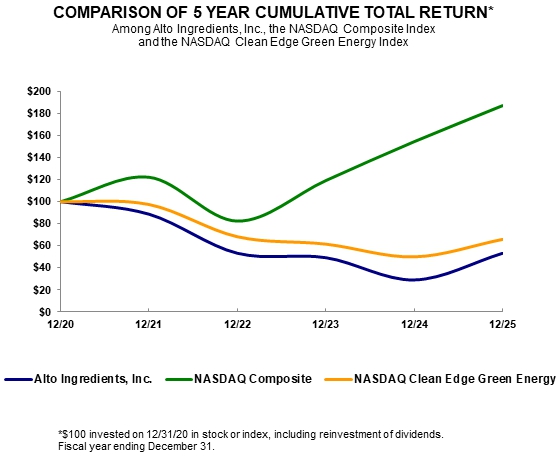
| Years Ended | ||||||||||||||||||||||||
| 12/2020 | 12/2021 | 12/2022 | 12/2023 | 12/2024 | 12/2025 | |||||||||||||||||||
| Alto Ingredients, Inc. | 100.00 | 88.58 | 53.04 | 48.99 | 28.73 | 53.04 | ||||||||||||||||||
| Nasdaq Composite | 100.00 | 122.18 | 82.43 | 119.22 | 154.48 | 187.14 | ||||||||||||||||||
| Nasdaq Clean Edge Green Energy | 100.00 | 97.36 | 68.01 | 61.27 | 49.71 | 65.63 | ||||||||||||||||||
-32-
Dividend Policy
We have never paid cash dividends on our common stock and do not intend to pay cash dividends on our common stock in the foreseeable future. We anticipate that we will retain any earnings for use in the continued development of our business.
Our current and future debt financing arrangements may limit or prevent cash distributions from our subsidiaries to us, depending upon the achievement of specified financial and other operating conditions and our ability to properly service our debt, thereby limiting or preventing us from paying cash dividends. Further, the holders of our outstanding Series B Preferred Stock are entitled to dividends of 7% per annum, payable quarterly in arrears. Accrued and unpaid dividends in respect of our Series B Preferred Stock must be paid prior to the payment of any dividends in respect of shares of our common stock.
For 2025, 2024 and 2023, we declared and paid cash dividends on our outstanding shares of Series B Preferred Stock as they became due.
Recent Sales of Unregistered Securities
None.
Purchases of Equity Securities by the Issuer and Affiliated Purchasers
None.
Item 6. [Reserved]
Not Applicable.
Item 7. Management’s Discussion and Analysis of Financial Condition and Results of Operations.
The following discussion and analysis of our financial condition and results of operations should be read in conjunction with our consolidated financial statements and notes to consolidated financial statements included elsewhere in this report. This discussion contains forward-looking statements, reflecting our plans and objectives that involve risks and uncertainties. Actual results and the timing of events may differ materially from those contained in these forward-looking statements due to a number of factors, including those discussed in the section entitled “Risk Factors” and elsewhere in this report.
Overview
We are a leading producer and distributor of specialty alcohols, renewable fuels and essential ingredients in the United States.
We operate five alcohol production facilities. Three of our production facilities are located in Illinois, one is located in Oregon, and another is located in Idaho. We have an annual alcohol production capacity of 330 million gallons, including both renewable fuels and specialty alcohols ranging from industrial-, pharmaceutical-, and high-quality food- and beverage-grade alcohols. Of this amount, we can produce up to 110 million gallons annually of specialty alcohols, depending on our product mix among high-quality beverage-grade alcohol and other quality specification alcohols. We market and distribute all of the alcohols produced at our facilities as well as alcohols produced by third parties. In 2025, we marketed and distributed approximately 350 million gallons combined of our own produced alcohols as well as fuel-grade ethanol produced by third parties, and over 1.2 million tons of essential ingredients.
We also own and operate a liquid CO2 production facility adjacent to our plant in Oregon for the offtake of CO2 gas from the plant for conversion to liquid CO2 and subsequent sale. In addition, we break bulk and distribute specialty alcohols, produced by us and third parties.
We report our financial and operating performance in three distinct segments:
| ● | Pekin production, which includes the production and sale of alcohols and other products we refer to as “essential ingredients” described below, produced at our three production facilities located in Pekin, Illinois, which we refer to as our Pekin Campus; |
| ● | Marketing and distribution, which includes marketing and merchant trading for company-produced alcohols and essential ingredients on an aggregated basis, and sales of fuel-grade ethanol sourced from third parties; and |
-33-
| ● | Western production, which includes the production and sale of renewable fuels and essential ingredients produced at our Western production facilities, including our liquid CO2 plant, on an aggregated basis, none of which are individually so significant as to be considered a separately reportable segment. |
Our mission is to produce the highest quality, sustainable ingredients that make everyday products better. We intend to accomplish this goal in part by investing in our specialized and higher value specialty alcohol production and distribution infrastructure, expanding production in high-demand essential ingredients, expanding and extending the sale of our products into new regional and international markets, building efficiencies and economies of scale and by capturing a greater portion of the value stream.
Production Segments
We produce specialty alcohols, renewable fuels and essential ingredients, focusing on five key markets: Health, Home & Beauty; Food & Beverage; Industry & Agriculture; Essential Ingredients; and Renewable Fuels. Products for Health, Home & Beauty markets include specialty alcohols used in mouthwash, cosmetics, pharmaceuticals, hand sanitizers, disinfectants and cleaners. Products for Food & Beverage markets include grain neutral spirits used in alcoholic beverages and vinegar, as well as corn germ used for corn oils. Products for Industry & Agriculture markets include alcohols and other products for paint applications, inks, vehicle fluids and fertilizers. Products for Essential Ingredients markets include dried yeast, corn protein meal, corn protein feed, corn germ, distillers grains, gas and liquid CO2 and liquid feed used in commercial animal feed and pet foods. We also sell yeast and gas and liquid CO2 for human consumption. Our products for the Renewable Fuels markets include fuel-grade ethanol and distillers corn oil used as a feedstock for renewable diesel and biodiesel fuels. Our specialty alcohols for the Industry & Agriculture, Food & Beverage and Health, Home & Beauty markets represented approximately 11%, 6% and 2%, respectively, of our sales in 2025 to customers in these three markets.
We produce our alcohols and essential ingredients at our facilities described below. Our production facilities located in Illinois are in the heart of the Corn Belt, benefit from relatively low-cost and abundant feedstock and enjoy logistical advantages that enable us to provide our products to both domestic and international markets via truck, rail or barge. Our production facilities located in Oregon and Idaho are near their respective fuel and feed customers, offering significant timing, product transportation cost and logistical advantages.
All of our production facilities, other than our Magic Valley plant, were operating for all of 2025, other than for scheduled and unscheduled downtimes to address facility repair and maintenance.
In January 2024, we temporarily hot-idled our Magic Valley facility to minimize losses from negative regional crush margins and to expedite the installation of additional equipment to achieve the intended production rate, quality and consistency from our corn oil and high protein system at the facility. We restarted our Magic Valley facility in July 2024 and by October 2024, the facility consistently achieved average ethanol production rates at full capacity, the protein content yield from the plant reached 50% or greater, and we were able to expand our corn oil yields. Increases in regional corn basis and declining market prices for protein and corn oil resulted in overall margin compression, outweighing the economic benefits of our plant improvements. As a consequence, we cold-idled our Magic Valley facility for all of 2025 and through the filing of this report to minimize financial losses. We continue to provide ethanol terminaling services at the plant and may resume operations at the facility if the economic environment in the region sustainably improves.
As market conditions change, we may increase, decrease or idle production at one or more operating facilities or resume operations at any idled facility.
-34-
Marketing and Distribution Segment
We market and distribute all the alcohols and essential ingredients we produce at our facilities. We also market and distribute alcohols produced by third parties.
We have extensive and long-standing customer relationships, both domestic and international, for our specialty alcohols, renewable fuels and essential ingredients. These customers include producers and distributors of ingredients for cosmetics, sanitizers and related products, distilled spirits producers, food products manufacturers, producers of personal health/consumer health and personal care hygiene products, and global trading firms.
Our renewable fuels customers are located throughout the Western and Midwestern United States and consist of integrated oil companies and gasoline marketers who blend fuel-grade ethanol into gasoline. Our customers depend on us to provide a reliable supply of fuel-grade ethanol and manage the logistics and timing of delivery. Our customers collectively require fuel-grade ethanol volumes in excess of the supplies we produce at our facilities. We secure additional fuel-grade ethanol supplies from third-party ethanol producers. We arrange for transportation, storage and delivery of fuel-grade ethanol purchased by our customers through our agreements with third-party service providers in the Western United States as well as in the Midwest from a variety of sources.
We market food-grade essential ingredients to human and pet food markets, our feed products (such as distillers grains) primarily to export markets from our Pekin Campus, and other feed products to dairies and feedlots, in many cases located near our production facilities. These customers use our feed products for livestock as a substitute for corn and other sources of starch and protein. We sell our corn oil to poultry, renewable diesel and biodiesel customers.
See “Note 5 – Segments” to our Notes to Consolidated Financial Statements included elsewhere in this report for financial information about our business segments.
Q4 Financial Review, Current Initiatives and Outlook
Our fourth quarter capped a year of strong execution and was a pivotal milestone in our strategic realignment. Entering the year, we made tactical decisions to focus on opportunities under our control to maximize earnings. We adjusted staffing to align with our current organizational footprint, captured cost savings, invested in the throughput and efficiency of our plants, culled underperforming business activities in our marketing and distribution segment, and maintained operational discipline in support of our revenue diversification efforts.
In the fourth quarter, gross profit increased $16.6 million and net income improved $63.5 million while Adjusted EBITDA grew by $35.6 million compared to the same period in 2024. For the full year, gross profit increased $25.2 million and net income improved $72.4 million while Adjusted EBITDA grew by $53.2 million compared to the full year 2024. These robust improvements were driven by multiple key factors, primarily, increased crush margins, qualified Section 45Z tax credits, strong renewable fuel export sales and our receipt of excess insurance proceeds.
For the fourth quarter, crush margins were $0.23 per gallon compared to $0.08 in the same period in 2024. An increase in renewable fuel export sales at premiums to domestic sales contributed $5 million from both higher volumes and a higher average sales price per gallon. We also realized $2.6 million less in compensation costs for the quarter due to staff reductions implemented earlier in the year, including the impact of idling our Magic Valley plant and a gain on our annual pension valuation adjustment. In addition, the sale of Oregon carbon credits contributed an additional $2.9 million due to improved market pricing.
We continued to benefit in the fourth quarter from our Alto Carbonic acquisition, which contributed $1.4 million in gross profit to our Western Production segment. With the idling of our Magic Valley facility, our Western Production segment achieved positive gross profit for the quarter and for the full year. With high-value liquid CO2 now in our product mix, our essential ingredients return at our Western Production segment improved to 48% in the fourth quarter from 30% for the same period in 2024 and contributed to an increase in our overall 2025 consolidated return of 52% compared to 43% for the full-year 2024. Partially offsetting these improvements was net negative $4.2 million in combined realized and unrealized changes in derivatives at period end.
We made significant progress in determining the amount of Section 45Z transferable tax credits for 2025 and associated incremental earnings. We expect to qualify approximately 90 million gallons of combined production on an annual basis for Section 45Z credits at our Columbia and Pekin dry mill facilities. In the fourth quarter, we recorded $7.5 million, or $0.10 per gallon, net of monetization costs, in Section 45Z credit earnings for the full year. For 2026, with the removal of the indirect land use change (iLUC) from the GREET model, we expect to qualify for $0.20 per gallon at our Columbia and Pekin dry mill facilities and to generate approximately $15 million in total net proceeds. We continue to pursue opportunities to further lower our carbon scores. Our Pekin wet mill and our ICP plant do not currently qualify for these tax credits, but those facilities are advantaged to serve a variety of domestic and export markets with alcohol supplies predominantly sold at a premium to renewable fuel.
-35-
With respect to our efforts to optimize and monetize our Western assets, as previously disclosed, current market conditions, including operational improvements, together with the positive impact of our Alto Carbonic acquisition, have materially changed our calculus for simply selling the facilities. Given our Columbia plant’s improved profitability, we are no longer actively marketing this asset. We continue to evaluate all options for our Magic Valley facility, including selling the plant as well as restarting and capturing Section 45Z credits and monetizing the valuable CO2 the facility would produce.
For 2026, we plan to boost our capital expenditures to approximately $25 million while maintaining strong cost discipline and prioritizing projects with the highest return on investment. Approximately 45% of our capital expenditures budget is earmarked for maintenance projects while the remaining 55% is allocated to optimization projects, including to implement higher production capacity at our Pekin dry mill. Included in the $25 million budget are the costs to complete repairs of our existing damaged Pekin Campus dock and to add a second alcohol loadout dock. We are building the second dock to mitigate future business interruption and enhance our logistical capabilities by expanding throughput and creating redundancy. We expect to begin repairing the original dock and installing the second dock this spring, and we anticipate completing both projects by the end of 2026.
We entered 2026 with a leaner cost structure and a better mix of premium exports and carbon utilization, as well as expanded CO₂ opportunities and potential upside from Section 45Z tax credits. We addressed losses at underperforming assets, removed structural costs and repositioned our portfolio toward higher value and more consistent revenue streams, and we are moving forward with plans to improve our return on assets. Improving our operations should strengthen our ability to capitalize on favorable margin environments, stabilize our business when margins are compressed and ensure that our assets are producing positive returns. In 2026, we intend to focus on factors within our control, driving improved profitability and executing on multiple opportunities to grow earnings.
The first quarter is a seasonally challenging period, and in January 2026, extreme cold weather disrupted river logistics and curtailed production at our Pekin Campus. We took advantage of the downtime to accelerate some of our planned repairs scheduled for the second quarter during our biennial wet mill outage. This has allowed us to defer the remaining work until the spring of 2027 and to recoup January’s lost production volumes in the second quarter. As to additional outages planned for 2026, we expect normal second quarter outages at our Columbia and ICP facilities, consistent with planned outages in 2025. In the second half of 2026, our Pekin dry mill is scheduled for a longer outage to implement a capacity project to increase production at the facility by approximately 8%, further improving the plant’s profitability.
CO2 utilization remains a compelling opportunity as demand for liquid CO2 continues to rise. In 2026, we intend to capitalize further on demand growth in the Pacific Northwest and on our liquid CO2 processing capabilities by increasing our throughput volume and storage capacity. We are also assessing large scale CO2 utilization and sequestration opportunities at our Pekin Campus and we are developing plans to capture more value for our CO2 as rapidly as possible. We have contracted to sell a significant volume of renewable fuel exports for the first half of 2026 and we see more opportunities to expand volumes and premiums in this market. In addition, we are on track for 2026 to match our high-quality alcohol volumes in 2025.
Finally, on the regulatory front, we continue to view E15 as a meaningful long-term demand tailwind for the farming and renewable fuel industries. While permanent nationwide adoption is not yet finalized, the EPA has consistently supported summer E15 sales through waivers, and entering 2026, political momentum has strengthened with renewed Administration and bipartisan Congressional support. Taken together, we believe the trajectory for E15 remains clearly positive and supportive of incremental ethanol demand over time.
Use of Non-GAAP Financial Measures
Management believes that certain financial measures not in accordance with generally accepted accounting principles, or GAAP, are useful measures of operations. Management provides Adjusted EBITDA as a non-GAAP financial measure so that investors will have the same financial information that management uses, which may assist investors in properly assessing our performance on a period-over-period basis.
We define Adjusted EBITDA as unaudited consolidated net income (loss) before interest expense, interest income, unrealized derivative gains and losses, excess insurance proceeds, acquisition-related expense (recoveries), provision or benefit for income taxes, asset impairments, and depreciation and amortization expense.
A table is provided below to reconcile Adjusted EBITDA to its most directly comparable GAAP measure, consolidated net income (loss). Adjusted EBITDA is not a measure of financial performance under GAAP and should not be considered as an alternative to consolidated net income (loss) or any other measure of performance under GAAP, or to cash flows from operating, investing or financing activities as an indicator of cash flows or as a measure of liquidity. Adjusted EBITDA has limitations as an analytical tool and you should not consider this measure in isolation or as a substitute for analysis of our results as reported under GAAP.
-36-
Information reconciling forward-looking Adjusted EBITDA to forward-looking consolidated net income (loss) would require a forward-looking statement of consolidated net income (loss) prepared in accordance with GAAP, which is unavailable to us without unreasonable effort. We are not able to provide a quantitative reconciliation of forward-looking Adjusted EBITDA to forward-looking consolidated net income (loss) because certain items required for reconciliation are uncertain, outside of our control and/or cannot reasonably be predicted, such as net sales, cost of goods sold, unrealized derivative gains and losses, asset impairments and provision (benefit) for income taxes, which we view as the most material components of consolidated net income (loss) that are not presently estimable.
Reconciliation of Adjusted EBITDA to Consolidated Net Income (Loss)
| Three Months Ended December 31, | Years Ended December 31, | |||||||||||||||
| (in thousands) (unaudited) | 2025 | 2024 | 2025 | 2024 | ||||||||||||
| Consolidated net income (loss) | $ | 21,806 | $ | (41,712 | ) | $ | 13,338 | $ | (58,984 | ) | ||||||
| Adjustments: | ||||||||||||||||
| Interest expense, net | 2,425 | 2,474 | 10,765 | 7,644 | ||||||||||||
| Interest income | (175 | ) | (112 | ) | (381 | ) | (689 | ) | ||||||||
| Unrealized derivative (gains) losses | 4,036 | (5,495 | ) | 2,679 | (13,574 | ) | ||||||||||
| Excess insurance proceeds | (6,688 | ) | — | (6,688 | ) | — | ||||||||||
| Acquisition-related expense (recoveries) | — | 5,676 | (460 | ) | 7,701 | |||||||||||
| Asset impairments | 803 | 24,790 | 803 | 24,790 | ||||||||||||
| Provision (benefit) for income taxes | (621 | ) | 173 | (621 | ) | 173 | ||||||||||
| Depreciation and amortization expense | 6,328 | 6,548 | 25,216 | 24,408 | ||||||||||||
| Total adjustments | 6,108 | 34,054 | 31,313 | 50,453 | ||||||||||||
| Adjusted EBITDA | $ | 27,914 | $ | (7,658 | ) | $ | 44,651 | $ | (8,531 | ) | ||||||
2025 Financial Performance Summary
Our consolidated net sales declined by $47.3 million to $0.9 billion for 2025 from $1.0 billion for 2024. Our net income (loss) attributable to common stockholders increased by $72.4 million to $12.1 million for 2025 from a net loss of $60.3 million for 2024.
Factors that contributed to these results of operations for 2025 include:
| ● | Net sales. Our net sales decline of $47.3 million was due to a decline in total gallons of alcohol sold and fewer tons of essential ingredients sold, partially offset by an increase in our average sales price per gallon. |
| ○ | Our average sales price per gallon increased by $0.07, or 4%, to $2.02 for 2025 from $1.95 for 2024. The improvement was primarily driven by higher renewable fuel prices in 2025 largely due to higher gasoline prices. |
-37-
| ○ | Our volume of essential ingredients sold declined by 0.2 million tons, or 14%, to 1.2 million tons for 2025 from 1.4 million tons for 2024 primarily due to lower alcohol production volumes during 2025, as our Magic Valley facility was cold-idled for all of 2025. |
| ○ | Our total gallons of alcohol sold decreased by 35.9 million gallons, or 9%, to 350.1 million gallons for 2025 from 386.0 million gallons for 2024. |
| ● | Our renewable fuel production sales volume declined by 31.0 million gallons, or 17%, to 155.2 million gallons for 2025 from 186.2 million gallons for 2024, primarily due to the cold idling of our Magic Valley facility for all of 2025 resulting in no production from the facility. |
| ● | Our third-party sales volume decreased by 1.4 million gallons, or 1%, to 106.9 million gallons for 2025 from 108.3 million gallons for 2024 primarily due to less volume sold in the market around our Magic Valley facility. |
| ● | Our specialty alcohol production sales volume decreased by 3.5 million gallons, or 4%, to 88.0 million gallons for 2025 from 91.5 million gallons for 2024 primarily due to decreased customer demand for specialty alcohols during the year. |
| ● | Gross Profit. Our gross profit increased $25.2 million to a gross profit of $34.9 million for 2025 from $9.7 million for 2024 due to stronger commodity crush margins from higher ethanol sales prices as well as lower corn costs. Our gross profit and margins were further positively impacted by our acquisition of Kodiak Carbonic and the cold-idling of our Magic Valley facility. |
Sales and Margins
We generate sales by marketing all of the alcohols produced by our three production facilities in Illinois, all of the fuel-grade ethanol produced by our production facilities in Oregon and Idaho, and fuel-grade ethanol purchased from third-party suppliers throughout the United States. We also market essential ingredients produced by our production facilities, including dried yeast, corn protein meal, corn protein feed, corn germ, distillers corn oil and distillers grains and liquid feed used in commercial animal feed and pet foods. We also sell yeast and gas and liquid CO2 for human consumption.
Our profitability is highly dependent on various commodity prices, including the market prices of corn, natural gas and fuel-grade ethanol.
Our consolidated average alcohol sales price improved by 4% to $2.02 per gallon for 2025 compared to $1.95 per gallon for 2024. The average price of fuel-grade ethanol as reported by the Chicago Mercantile Exchange, or CME, also improved by 4% to $1.76 per gallon for 2025 compared to $1.69 per gallon for 2024. Our consolidated average cost of corn declined by 1% to $4.68 per bushel for 2025 from $4.72 per bushel for 2024. The average price of corn as reported by the CME increased 4% to $4.39 per bushel for 2025 from $4.24 per bushel for 2024.
-38-
We believe that our gross profit margins depend primarily on the following key factors:
| ● | the prices of our specialty alcohols and the market price of fuel-grade ethanol, the latter of which is impacted by the price of gasoline and related petroleum products, and government regulations, including government ethanol mandates; |
| ● | the market prices of key production input commodities, such as corn (including corn basis) and natural gas; |
| ● | the market prices of our essential ingredients; |
| ● | key variable costs (other than production input commodities), such as production and other personnel staffing; |
| ● | our ability to anticipate trends in the market and contracted prices of our alcohols, essential ingredients, and costs of key input commodities, and our ability to implement appropriate risk management through hedging and other means, and opportunistic pricing strategies, as well as the financial results of those hedging activities; |
| ● | the proportion of our sales of specialty alcohols to our sales of fuel-grade ethanol produced at our facilities relative to their respective market and contracted prices; and |
| ● | the proportion of our sales of fuel-grade ethanol produced at our facilities to our sales of fuel-grade ethanol produced by unrelated third-parties relative to the market price of fuel-grade ethanol and marketing and distribution fees payable for third-party sales. |
We seek to optimize our gross profit margins by anticipating the factors above and, when resources are available, implementing hedging transactions and taking other actions designed to lock in margins, limit risk and otherwise address these factors. For example, we may seek to reduce inventory levels in anticipation of declining alcohol or essential ingredient prices and increase production and inventory levels in anticipation of rising alcohol or essential ingredient prices. We may also seek to alter our proportion or timing, or both, of purchase and sales commitments.
Our inability to anticipate the factors described above or their relative importance, and adverse movements in the factors themselves, could result in declining or even negative gross profit margins over certain periods of time. Our ability to anticipate these factors or favorable movements in these factors may enable us to generate above-average gross profit margins. However, given the difficulty associated with successfully forecasting any of these factors, we are unable to estimate our future sales or gross profit margins.
Results of Operations
Selected Financial Information
The following selected financial information should be read in conjunction with our consolidated financial statements and notes to our consolidated financial statements included elsewhere in this report, and the other sections of “Management’s Discussion and Analysis of Financial Condition and Results of Operations” contained in this report.
-39-
Certain performance metrics that we believe are important indicators of our results of operations include the following:
| Percentage Change | ||||||||||||||||||||
| Years Ended December 31, | 2025 vs | 2024 vs | ||||||||||||||||||
| 2025 | 2024 | 2023 | 2024 | 2023 | ||||||||||||||||
| Alcohol Sales (gallons in millions) | ||||||||||||||||||||
| Pekin Campus renewable fuel gallons sold | 122.6 | 125.7 | 136.2 | (2 | )% | (8 | )% | |||||||||||||
| Western production renewable fuel gallons sold | 32.6 | 60.5 | 67.0 | (46 | )% | (10 | )% | |||||||||||||
| Third-party renewable fuel gallons sold | 106.9 | 108.3 | 102.6 | (1 | )% | 6 | % | |||||||||||||
| Total renewable fuel gallons sold | 262.1 | 294.5 | 305.8 | (11 | )% | (4 | )% | |||||||||||||
| Specialty alcohol gallons sold | 88.0 | 91.5 | 76.7 | (4 | )% | 19 | % | |||||||||||||
| Total gallons sold | 350.1 | 386.0 | 382.5 | (9 | )% | 1 | % | |||||||||||||
| Sales Price per Gallon | ||||||||||||||||||||
| Pekin Campus | $ | 2.00 | $ | 1.95 | $ | 2.40 | 3 | % | (19 | )% | ||||||||||
| Western production | $ | 2.06 | $ | 1.91 | $ | 2.49 | 8 | % | (23 | )% | ||||||||||
| Marketing and distribution | $ | 2.07 | $ | 2.00 | $ | 2.56 | 3 | % | (22 | )% | ||||||||||
| Total | $ | 2.02 | $ | 1.95 | $ | 2.47 | 4 | % | (21 | )% | ||||||||||
| Alcohol Production (gallons in millions) | ||||||||||||||||||||
| Pekin Campus | 215.3 | 212.4 | 209.7 | 1 | % | 1 | % | |||||||||||||
| Western production | 32.9 | 58.7 | 68.1 | (44 | )% | (14 | )% | |||||||||||||
| Total | 248.2 | 271.1 | 277.8 | (8 | )% | (2 | )% | |||||||||||||
| Corn Cost per Bushel | ||||||||||||||||||||
| Pekin Campus | $ | 4.54 | $ | 4.45 | $ | 6.32 | 2 | % | (30 | )% | ||||||||||
| Western production | $ | 5.62 | $ | 5.73 | $ | 7.45 | (2 | )% | (23 | )% | ||||||||||
| Total | $ | 4.68 | $ | 4.72 | $ | 6.58 | (1 | )% | (28 | )% | ||||||||||
| Average Market Metrics | ||||||||||||||||||||
| PLATTS Ethanol price per gallon | $ | 1.76 | $ | 1.69 | $ | 2.22 | 4 | % | (24 | )% | ||||||||||
| CME Corn cost per bushel | $ | 4.39 | $ | 4.24 | $ | 5.64 | 4 | % | (25 | )% | ||||||||||
| Board corn crush per gallon (1) | $ | 0.19 | $ | 0.18 | $ | 0.21 | 6 | % | (14 | )% | ||||||||||
| Essential Ingredients Sold (in thousands of tons) | ||||||||||||||||||||
| Pekin Campus | ||||||||||||||||||||
| Distillers grains | 337.6 | 336.4 | 332.7 | — | % | 1 | % | |||||||||||||
| CO2 | 192.2 | 188.6 | 182.4 | 2 | % | 3 | % | |||||||||||||
| Corn wet feed | 107.3 | 121.8 | 95.0 | (12 | )% | 28 | % | |||||||||||||
| Corn dry feed | 106.9 | 87.2 | 90.6 | 23 | % | (4 | )% | |||||||||||||
| Corn oil and germ | 78.0 | 75.1 | 73.8 | 4 | % | 2 | % | |||||||||||||
| Syrup and other | 36.4 | 38.6 | 41.2 | (6 | )% | (6 | )% | |||||||||||||
| Corn meal | 36.8 | 35.4 | 36.8 | 4 | % | (4 | )% | |||||||||||||
| Yeast | 24.4 | 23.2 | 25.9 | 5 | % | (10 | )% | |||||||||||||
| Total Pekin Campus | 919.6 | 906.3 | 878.4 | 1 | % | 3 | % | |||||||||||||
| Western Production | ||||||||||||||||||||
| Distillers grains | 235.3 | 394.5 | 459.7 | (40 | )% | (14 | )% | |||||||||||||
| CO2 | 56.5 | 57.7 | 119.1 | (2 | )% | (52 | )% | |||||||||||||
| Syrup and other | 3.5 | 54.8 | 55.5 | (94 | )% | (1 | )% | |||||||||||||
| Corn oil | 4.3 | 7.6 | 8.0 | (43 | )% | (5 | )% | |||||||||||||
| Total Western Production | 299.6 | 514.6 | 642.3 | (42 | )% | (20 | )% | |||||||||||||
| Total Essential Ingredients Sold | 1,219.2 | 1,420.9 | 1,520.7 | (14 | )% | (7 | )% | |||||||||||||
| Essential Ingredients return % (2) | ||||||||||||||||||||
| Pekin Campus Return | 49.3 | % | 49.7 | % | 45.7 | % | (1 | )% | 9 | % | ||||||||||
| Western Production Return | 50.4 | % | 32.0 | % | 33.4 | % | 58 | % | (4 | )% | ||||||||||
| Consolidated Total Return | 49.5 | % | 45.2 | % | 42.4 | % | 10 | % | 7 | % | ||||||||||
| (1) | Assumes corn conversion of 2.80 gallons of alcohol per bushel of corn. |
| (2) | Essential ingredients revenues as a percentage of total corn costs consumed. |
-40-
Year Ended December 31, 2025 Compared to the Year Ended December 31, 2024
| Years Ended December 31, | Dollar | Percentage | Results as a Percentage of Net Sales for the Years Ended December 31, | |||||||||||||||||||||
| 2025 | 2024 | Change | Change | 2025 | 2024 | |||||||||||||||||||
| (dollars in thousands) | ||||||||||||||||||||||||
| Net sales | $ | 917,927 | $ | 965,258 | $ | (47,331 | ) | (4.9 | )% | 100.0 | % | 100.0 | % | |||||||||||
| Cost of goods sold | 883,014 | 955,536 | (72,522 | ) | (7.6 | )% | 96.2 | % | 99.0 | % | ||||||||||||||
| Gross profit | 34,913 | 9,722 | 25,191 | 259.1 | % | 3.8 | % | 1.0 | % | |||||||||||||||
| Selling, general and administrative expenses | (27,208 | ) | (29,736 | ) | 2,528 | 8.5 | % | (3.0 | )% | (3.1 | )% | |||||||||||||
| Acquisition-related recoveries (expenses) | 460 | (7,701 | ) | 8,161 | * | 0.1 | % | (0.8 | )% | |||||||||||||||
| Gain on sale of assets | — | 830 | (830 | ) | (100.0 | )% | — | % | 0.1 | % | ||||||||||||||
| Asset impairments | (803 | ) | (24,790 | ) | 23,987 | (96.8 | )% | (0.1 | )% | (2.6 | )% | |||||||||||||
| Income (loss) from operations | 7,362 | (51,675 | ) | 59,037 | * | 0.8 | % | (5.4 | )% | |||||||||||||||
| Transferable tax credits, net | 7,500 | — | 7,500 | * | 0.8 | % | 0.0 | % | ||||||||||||||||
| Excess insurance proceeds | 6,688 | — | 6,688 | * | 0.7 | % | 0.0 | % | ||||||||||||||||
| Interest expense, net | (10,765 | ) | (7,644 | ) | (3,121 | ) | 40.8 | % | (1.2 | )% | (0.8 | )% | ||||||||||||
| Other income, net | 1,932 | 508 | 1,424 | 280.3 | % | 0.2 | % | 0.1 | % | |||||||||||||||
| Income (loss) before provision (benefit) for income taxes | 12,717 | (58,811 | ) | 71,528 | * | 1.4 | % | (6.1 | )% | |||||||||||||||
| Provision (benefit) for income taxes | (621 | ) | 173 | 794 | * | 0.1 | % | 0.0 | % | |||||||||||||||
| Consolidated net income (loss) | $ | 13,338 | $ | (58,984 | ) | $ | 72,322 | * | 1.5 | % | (6.1 | )% | ||||||||||||
| Preferred stock dividends | (1,265 | ) | (1,269 | ) | 4 | 0.3 | % | (0.1 | )% | (0.1 | )% | |||||||||||||
| Income (loss) attributable to common stockholders | $ | 12,073 | $ | (60,253 | ) | $ | 72,326 | * | 1.4 | % | (6.2 | )% | ||||||||||||
| * | Not meaningful. |
Net Sales
The decline in our consolidated net sales for 2025 as compared to 2024 was due to a decrease in our volume of alcohol sold and lower volumes of essential ingredients sold, partially offset by an increase in our average alcohol sales price per gallon. The decreases in our volumes of alcohol and essential ingredients sold were primarily due to the cold-idling of our Magic Valley facility for all of 2025 and a higher volume of product in transit at the end of the year.
Pekin Campus Production Segment
Net sales of alcohol from our Pekin Campus production segment increased by less than $0.1 million, or 0%, to $415.8 million for 2025 as compared to $415.7 million for 2024. Our total volume of production gallons sold, decreased by 5.2 million gallons, or 2%, to 208.4 million gallons for 2025 as compared to 213.6 million gallons for 2024, due to the timing of shipments at year-end.
At the segment’s average sales price per gallon of $2.00 for 2025, we generated $10.4 million less in net sales from the 5.2 million fewer gallons of alcohol sold in 2025 as compared to 2024. However, an increase of $0.05, or 3%, in the segment’s average sales price per gallon in 2025 as compared to 2024 resulted in a $10.4 million increase in net sales in 2025 as compared to 2024.
Net sales of essential ingredients increased by $5.3 million, or 3%, to $174.6 million for 2025 as compared to $169.3 million for 2024. Our total volume of essential ingredients sold increased by 13,300 tons, or 1%, to 919,600 tons for 2025 from 906,300 tons for 2024. Sales volumes of essential ingredients from our Pekin Campus were higher in 2025 due to timing of shipments. An increase of $3.05, or 2%, in our average sales price per ton in 2025 as compared to 2024 resulted in a $2.8 million increase in net sales as compared to 2024. At our average sales price per ton of $189.86 for 2025, we generated $2.5 million in additional net sales from the 13,300 additional tons of essential ingredients sold in 2025 as compared to 2024.
-41-
Marketing and Distribution Segment
Net sales of renewable fuel from our marketing and distribution segment, excluding intersegment sales, increased by $4.8 million, or 2%, to $221.3 million for 2025 as compared to $216.5 million for 2024.
Our volume of third-party renewable fuel sold reported gross by the segment decreased by 1.4 million gallons, or 1%, to 106.9 million gallons for 2025 as compared to 108.3 million gallons for 2024. The increase of $0.07, or 4%, in our average sales price per gallon in 2025 as compared to 2024 resulted in a $7.7 million increase in net sales in 2025 from our third-party renewable fuel sold by the segment compared to 2024. At the segment’s average sales price per gallon of $2.07 for 2025, net sales were $2.9 million lower as a result of the 1.4 million fewer gallons sold in 2025 as compared to 2024.
Western Production Segment
Net sales of alcohol from our Western production segment declined by $48.1 million, or 42%, to $67.3 million for 2025 as compared to $115.4 million for 2024. Our total volume of gallons sold declined by 27.9 million gallons, or 46%, to 32.6 million gallons for 2025 as compared to 60.5 million gallons for 2024. This decline in sales volume primarily resulted from the cold-idling of our Magic Valley facility for all of 2025. At the segment’s average sales price of $2.06 per gallon for 2025, net sales were $57.5 million lower as a result of the 27.9 million fewer gallons sold in 2025 as compared to 2024. This decrease was partially offset by an increase of $0.15, or 8%, in our average sales price per gallon in 2025 as compared to 2024 resulting in a $9.4 million increase in net sales of alcohol from the segment compared to 2024.
Net sales of essential ingredients declined by $5.4 million, or 15%, to $31.6 million for 2025 as compared to $37.0 million for 2024. Our total volume of essential ingredients sold declined by 215,000 tons, or 42%, to 299,600 tons for 2025 from 514,600 tons for 2024. At our average sales price of $105.31 per ton for 2025, net sales were $22.6 million lower as a result of the 215,000 fewer tons sold in 2025 as compared to 2024. This decline was partially offset by a higher sales price, which increased by $33.50 per ton for 2025. The increase of $33.50, or 47%, in our average sales price per ton in 2025 as compared to 2024 resulted in an increase of $17.2 million in net sales of essential ingredients from the segment compared to 2024.
Corporate and Other Segment
Net sales from our Corporate and other segment, which is comprised of our Eagle Alcohol business, declined by $4.0 million, or 35%, to $7.4 million for 2025 as compared to $11.4 million for 2024.
-42-
Cost of Goods Sold and Gross Profit
Our consolidated gross profit improved to $34.9 million, representing a gross margin of 3.8% for 2025, from $9.7 million, representing a gross margin of 1.0%, for 2024. Our consolidated gross profit improved due to higher overall commodity crush margins, increased export sales at premium prices to domestic renewable fuel and overall cost savings. In 2025, we spent a total of $30.1 million for repairs and maintenance, in line with our annual estimate.
Pekin Campus Production Segment
Our Pekin Campus production segment’s gross profit declined by $3.8 million to a gross profit of $22.1 million from $25.9 million. Of this decrease, $3.2 million is attributable to lower commodity crush margins and $0.6 million is attributable to decreased sales volumes in 2025 as compared to 2024.
Marketing and Distribution Segment
Our marketing and distribution segment’s gross profit improved by $5.1 million to a gross profit of $9.1 million for 2025 from $4.0 million for 2024. Of this increase, $5.2 million is attributable to higher margins from sales of third-party renewable fuel, partially offset by a decrease of $0.1 million attributable to lower marketing volumes of third-party renewable fuel sold reported gross in 2025 as compared to 2024.
Western Production Segment
Our Western production segment’s gross profit improved by $22.3 million to a gross profit of $3.0 million for 2025 as compared to a gross loss of $19.3 million for 2024. Of this improvement, $24.9 million is attributable to significantly higher margins for renewable fuel, partially offset by $2.6 million attributable to lower sales volumes at negative margins in 2025 as compared to 2024.
Corporate and Other Segment
Our Corporate and other segment reported a gross profit of $0.7 million for 2025 and a gross loss of $0.9 million for 2024, primarily from Eagle Alcohol’s business.
Selling, General and Administrative Expenses
Our selling, general and administrative, or SG&A, expenses decreased by $2.5 million to $27.2 million for 2025 as compared to $29.7 million for 2024. SG&A expenses decreased primarily due to lower operating costs, including reduced staff levels, and professional fees.
Acquisition-related Expenses
Our acquisition-related expenses decreased by $8.2 million to a recovery of $0.5 million for 2025 as compared to $7.7 million for 2024. In 2024, we accelerated and accrued all remaining amounts payable in 2025 for our acquisition of Eagle Alcohol. We paid out a final amount in 2025 that was $0.5 million less than the amount we accrued in 2024. We have no further payment obligations for our acquisition of Eagle Alcohol.
-43-
Asset Impairments
We recorded asset impairment charges of $0.8 million for 2025 as compared to $24.8 million for 2024. The 2025 impairments relate to certain abandoned projects. The 2024 impairments reflect $21.4 million for our Magic Valley asset group, as we cold-idled the plant at the end of the year, and $3.4 million for intangible assets of Eagle Alcohol.
Transferable Tax Credits, net
Transferable tax credits, net, for the year ended December 31, 2025, reflect the recognition of $7.5 million of federal tax credits related to Section 45Z clean fuel production.
Excess Insurance Proceeds
In April 2025, our Pekin Campus loading dock was damaged. We filed a claim with our insurer and received gross proceeds of $10.0 million. A portion of the proceeds related to extra costs incurred due to logistical challenges as we made temporary repairs to the dock. The extra costs reimbursed amounted to $3.3 million, with the remaining $6.7 million in proceeds recorded as a gain of excess insurance proceeds. We will use these funds to complete the necessary permanent dock repairs and construct a secondary alcohol loadout dock in 2026.
Interest Expense, net
Interest expense, net, increased by $3.2 million to $10.8 million for 2025 from $7.6 million for 2024. The increase in interest expense, net, is primarily due to higher debt balances, as well as higher interest rates under Kinergy’s line of credit and our term debt.
Year Ended December 31, 2024, Compared to the Year Ended December 31, 2023
An analysis of our financial results comparing 2024 to 2023 can be found under “Management’s Discussion and Analysis of Financial Condition and Results of Operations” in Part II, Item 7 in our Annual Report on Form 10-K for the fiscal year ended December 31, 2024, filed with the Securities and Exchange Commission on March 13, 2025, which is available free of charge on the Securities and Exchange Commission’s website at www.sec.gov.
Liquidity and Capital Resources
During the year ended December 31, 2025, we funded our operations primarily from cash on hand, cash generated from our operating activities, and proceeds from Kinergy’s operating line of credit. In addition to funding our operations, we used our capital resources to continue our capital improvement projects, purchase Kodiak Carbonic, make our final cash payment related to our acquisition of Eagle Alcohol and pay preferred stock dividends.
As of December 31, 2025, we had $23.4 million in cash and cash equivalents and $37.4 million available for borrowing under Kinergy’s operating line of credit. In addition, we have up to an additional $65.0 million that may be available for capital improvement projects under our Orion term loan discussed below, subject to certain conditions. We believe we have sufficient sources of liquidity to meet our anticipated working capital, debt service, capital expenditure and other liquidity needs for at least the next twelve months from the date of this report.
-44-
Quantitative Year-End Liquidity Status
We believe that the following amounts provide insight into our liquidity and capital resources. The following selected financial information should be read in conjunction with our consolidated financial statements and notes to consolidated financial statements included elsewhere in this report, and the other sections of “Management’s Discussion and Analysis of Financial Condition and Results of Operations” contained in this report (dollars in thousands).
| December 31, 2025 | December 31, 2024 | Change | ||||||||||
| Cash, cash equivalents and restricted cash | $ | 25,673 | $ | 36,211 | (29 | )% | ||||||
| Current assets | $ | 155,917 | $ | 153,118 | 2 | % | ||||||
| Property and equipment, net | $ | 198,501 | $ | 214,742 | (8 | )% | ||||||
| Current liabilities | $ | 59,071 | $ | 57,804 | 2 | % | ||||||
| Long-term debt, noncurrent portion | $ | 63,027 | $ | 92,904 | (32 | )% | ||||||
| Working capital | $ | 96,846 | $ | 95,314 | 2 | % | ||||||
| Working capital ratio | 2.64 | 2.65 | (0 | )% | ||||||||
Restricted Net Assets
At December 31, 2025, we had approximately $68.4 million of net assets at our subsidiaries that were not available to be transferred to Alto Ingredients, Inc. in the form of dividends, distributions, loans or advances due to restrictions contained in our subsidiaries’ credit facilities.
Changes in Working Capital and Cash Flows
Working capital increased to $96.8 million at December 31, 2025 from $95.3 million at December 31, 2024 as a result of a $2.8 million increase in current assets, partially offset by a $1.3 million increase in current liabilities.
Current assets increased due to increases in inventories, transferable tax credits, net, and restricted cash, partially offset by decreases in cash and cash equivalents and accounts receivable. Our current liabilities increased due to an increase in the current portion of our long-term debt, partially offset by decreases in accounts payable and accrued liabilities.
Our cash, cash equivalents and restricted cash declined by $10.5 million due to cash used in our financing activities of $16.4 million for payments on Kinergy’s line of credit to reduce interest expense, a principal payment on our term debt and preferred stock dividends, and cash used in our investing activities of $7.4 million for our capital improvement projects, the purchase of Kodiak Carbonic and our final payment to the owners of Eagle Alcohol, partially offset by cash provided by our operating activities of $13.2 million.
Cash provided by (used in) our Operating Activities
We generated $13.2 million in cash from our operating activities during 2025, as compared to using $3.5 million in cash from our operating activities in 2024. Specific factors that contributed significantly to the change in cash generated by our operating activities include:
| ● | an increase of $72.3 million in net income primarily due to higher commodity crush margins; |
| ● | an increase of $3.0 million related to changes in the fair value of our derivative instruments due to changes in commodity prices at December 31, 2025 as compared to December 31, 2024; and |
| ● | an increase of $2.8 million related to accounts receivable balances primarily due to the timing of sales and collections. |
These amounts were partially offset by:
| ● | a decrease of $24.0 million in asset impairments primarily related to an asset impairment in 2024 due to the cold-idling of our Magic Valley facility; |
| ● | a decrease of $17.1 million related to inventories due to the timing of sales; |
| ● | a decrease of $12.8 million related to accounts payable and accrued expenses due to the timing of payments; and |
| ● | a decrease of $7.5 million related to accrued transferable tax credits, net, due to their occurrence in 2025 and none recorded for 2024. |
-45-
Cash used in our Investing Activities
We used $7.4 million of cash in our investing activities for 2025, of which $4.6 million was for additions to property and equipment resulting from our capital improvement projects, $7.3 million was for our acquisition of Kodiak Carbonic and $2.2 million was for our final payment with respect to our acquisition of Eagle Alcohol, partially offset by $6.7 million of excess insurance proceeds.
Cash used in our Financing Activities
Cash used in our financing activities was $16.4 million for 2025, of which we used $10.1 million to pay down Kinergy’s line of credit, $5.0 million to make a principal payment on our term debt and $1.3 million to pay preferred stock dividends.
Kinergy’s Operating Line of Credit
Kinergy maintains an operating line of credit for an aggregate amount of up to $85.0 million. The credit facility matures on November 7, 2027. Interest accrues under the credit facility at a rate equal to (i) the daily Secured Overnight Financing Rate, plus (ii) a specified applicable margin ranging from 1.25% to 1.75%. The credit facility’s monthly unused line fee is 0.25% to 0.375% of the amount by which the maximum credit under the facility exceeds the average daily principal balance during the preceding month. Payments that may be made by Kinergy to Alto Ingredients, Inc. as reimbursement for management and other services provided by Alto Ingredients, Inc. to Kinergy are limited under the terms of the credit facility to $1.5 million per fiscal quarter. The credit facility also includes the accounts receivable of our indirect wholly-owned subsidiary, Alto Nutrients, LLC, or Alto Nutrients, as additional collateral. Payments that may be made by Alto Nutrients to Alto Ingredients, Inc. as reimbursement for management and other services provided by Alto Ingredients, Inc. to Alto Nutrients are limited under the terms of the credit facility to $0.5 million per fiscal quarter. Alto Nutrients markets our essential ingredients and also provides raw material procurement services to our subsidiaries. In addition, the amount of cash distributions that Kinergy or Alto Nutrients may make to us is also limited to up to 75% of excess cash flow.
For all monthly periods in which excess borrowing availability falls below a specified level, Kinergy and Alto Nutrients must collectively maintain a fixed-charge coverage ratio (calculated as a twelve-month rolling earnings before interest, taxes, depreciation and amortization divided by the sum of interest expense, capital expenditures, principal payments of indebtedness, indebtedness from capital leases and taxes paid during such twelve-month rolling period) of at least 1.10 and are prohibited from incurring certain additional indebtedness (other than specific intercompany indebtedness). The obligations of Kinergy and Alto Nutrients under the credit facility are secured by all of our tangible and intangible assets.
We believe Kinergy and Alto Nutrients are in compliance with the fixed-charge coverage ratio covenant as of the filing of this report. The following table sets forth the fixed-charge coverage ratio financial covenant and the actual results for the periods presented:
| Years Ended December 31, | ||||||||
| 2025 | 2024 | |||||||
| Fixed-Charge Coverage Ratio Requirement | 1.10 | 1.10 | ||||||
| Actual | 4.03 | 3.53 | ||||||
| Excess | 2.93 | 2.43 | ||||||
Alto Ingredients, Inc. has guaranteed all of Kinergy’s obligations under the credit facility. As of December 31, 2025, Kinergy had an outstanding balance of $29.6 million and $37.4 million of unused borrowing availability under the credit facility.
Orion Term Loan
On November 7, 2022, we entered into a credit agreement with certain funds managed by Orion Infrastructure Capital, or Lenders, under which the Lenders extended a senior secured credit facility in the amount of up to $125.0 million, or Term Loan. The Term Loan is secured by a first priority lien on certain of our assets and a second priority lien on certain assets of Kinergy and Alto Nutrients. Interest accrues on the unpaid principal amount of the Term Loan at a fixed rate of 10% per annum. The Term Loan matures on November 7, 2028, or earlier upon acceleration.
We must prepay amounts outstanding under the Term Loan on a semi-annual basis beginning with the six-month period ending December 31, 2023 in an amount equal to a percentage of our excess cash flow based on a specified leverage ratio, as follows: (i) if our leverage ratio is greater than or equal to 3.0x, then the mandatory prepayment amount will equal 100% of our excess cash flow, (ii) if our leverage ratio is less than 3.0x and greater than or equal to 1.5x, then the mandatory prepayment amount will equal 50% of our excess cash flow, and (iii) if our leverage ratio is less than 1.5x, then the mandatory prepayment amount will equal 25% of our excess cash flow.
As of December 31, 2025 and 2024, the principal amount outstanding under the Term Loan was $55.0 million and $60.0 million, respectively. In addition, we estimate our excess cash flow payment for the six months ended December 31, 2025 due in March 2026 will be $16.6 million, of which $10.0 million was paid in February 2026.
-46-
Other Cash Obligations
As of December 31, 2025, we had future commitments for certain capital projects totaling $17.5 million. These commitments are scheduled to be satisfied through 2026.
Critical Accounting Estimates
Our discussion and analysis of our financial condition and results of operations is based on our consolidated financial statements, which have been prepared in accordance with accounting principles generally accepted in the United States of America. The preparation of these financial statements requires us to make estimates and judgments that affect the reported amounts of assets and liabilities and disclosure of contingent assets and liabilities at the date of the financial statements and the reported amount of net sales and expenses for each period. The following represents a summary of our critical accounting estimates, defined as those estimates that we believe are the most important to the portrayal of our financial condition and results of operations and that require management’s most difficult, subjective or complex judgments, often as a result of the need to make estimates about the effects of matters that are inherently uncertain.
Impairment of Long-Lived Assets
Our long-lived assets have been primarily associated with our production facilities, reflecting their original cost, adjusted for depreciation and amortization and any subsequent impairment.
We assess the impairment of long-lived assets, including property and equipment, when events or changes in circumstances indicate that the fair value of an asset group could be less than the net book value of the asset group. Generally, we assess long-lived assets for impairment by first determining the forecasted, undiscounted cash flows each asset is expected to generate plus the net proceeds expected from the sale of the asset group. If the total amount of the undiscounted cash flows is less than the carrying value of the asset group, we then determine the fair value of the asset group. When the estimated fair value of the asset group is less than its carrying value, we recognize an impairment expense equal to the difference between the asset group’s carrying value and estimated fair value. Forecasts of future cash flows are estimates based on our experience and knowledge of our operations and the industry in which we operate. These estimates could be significantly affected by future changes in market conditions, the economic environment, including inflation, and the purchasing decisions of our customers. As a result, we recorded asset impairments of $0.8 million, $21.4 million and $0.6 million with respect to various abandoned projects, the cold-idling of our Magic Valley facility and our right of use assets associated with our operating leases for the years ended December 31, 2025, 2024 and 2023, respectively.
We review our intangible assets, including goodwill, with indefinite lives at least annually or more frequently if impairment indicators arise. In our review, we determine the fair value of these assets using market multiples and discounted cash flow modeling and compare it to the net book value of the reporting unit. Any assessed impairments will be recorded permanently and expensed in the period in which the impairment is determined. We performed our annual review of impairment and did not recognize any asset impairments for the year ended December 31, 2025. We performed our annual review of impairment and recognized asset impairments of $3.4 million and $6.0 million against our intangible assets and goodwill for the years ended December 31, 2024 and 2023, respectively.
Valuation Allowance for Deferred Taxes
We account for income taxes under the asset and liability approach, where deferred tax assets and liabilities are determined based on differences between financial reporting and tax bases of assets and liabilities, and are measured using enacted tax rates and laws that are expected to be in effect when the differences reverse. Valuation allowances are established when necessary to reduce deferred tax assets to the amounts expected to be realized.
We evaluate our deferred tax asset balance for realizability. To the extent we believe it is more likely than not that some portion or all of our deferred tax assets will not be realized, we will establish a valuation allowance against the deferred tax assets. Realization of our deferred tax assets is dependent upon future taxable income during the periods in which the associated temporary differences become deductible. We consider the scheduled reversal of deferred tax liabilities, projected future taxable income and tax planning strategies in making this assessment. These changes, if any, may require possible material adjustments to these deferred tax assets, resulting in a reduction in net income or an increase in net loss in the period when such determinations are made.
We had pre-tax consolidated net income of $12.7 million, and net losses of $58.8 million and $27.9 million for the years ended December 31, 2025, 2024 and 2023, respectively. Based on our current and prior results, we do not have sufficient evidence to support a conclusion that we will more likely than not be able to benefit from our remaining deferred tax assets. As such, we have recorded a valuation allowance against our net deferred tax assets.
-47-
Item 7A. Quantitative and Qualitative Disclosures About Market Risk.
We are exposed to various market risks, including changes in commodity prices, as discussed below. Market risk is the potential loss arising from adverse changes in market rates and prices. In the ordinary course of business, we may enter into various types of transactions involving financial instruments to manage and reduce the impact of changes in commodity prices. We do not have material exposure to interest rate risk. We do not expect to have any exposure to foreign currency risk as we conduct all of our transactions in U.S. dollars.
We produce and distribute specialty alcohol, fuel-grade ethanol and essential ingredients. Our business is sensitive to changes in the prices of ethanol and corn. In the ordinary course of business, we may enter into various types of transactions involving financial instruments to manage and reduce the impact of changes in ethanol and corn prices. We do not enter into derivatives or other financial instruments for trading or speculative purposes.
We are subject to market risk with respect to ethanol and corn pricing. Ethanol prices are sensitive to global and domestic ethanol supply; crude-oil supply and demand; crude-oil refining capacity; carbon intensity; government regulation; and consumer demand for alternative fuels. Our ethanol sales are priced using contracts that are either based on a fixed price or an indexed price tied to a specific market, such as Chicago Ethanol (Platts) or the Oil Price Information Service. Under these fixed-priced arrangements, we are exposed to risk of a decrease in the market price of ethanol between the time the price is fixed and the time the alcohol is sold.
We satisfy our physical corn needs, the principal raw material used to produce alcohol and essential ingredients, based on purchases from our corn vendors. Generally, we determine the purchase price of our corn at or near the time we begin to grind. Additionally, we also enter into volume contracts with our vendors to fix the purchase price. As such, we are also subject to market risk with respect to the price of corn. The price of corn is subject to wide fluctuations due to unpredictable factors such as weather conditions, farmer planting decisions, governmental policies with respect to agriculture and international trade and global supply and demand. Under the fixed price arrangements, we assume the risk of a decrease in the market price of corn between the time the price is fixed and the time the corn is utilized.
Essential ingredients are sensitive to various demand factors such as numbers of livestock on feed, prices for feed alternatives and supply factors, primarily production of ethanol co-products by ethanol plants and other sources.
As noted above, we may attempt to reduce the market risk associated with fluctuations in the price of ethanol or corn by employing a variety of risk management and hedging strategies. Strategies include the use of derivative financial instruments such as futures and options executed on the CME and/or the New York Mercantile Exchange, as well as the daily management of physical corn.
These derivatives are not designated for special hedge accounting treatment, and as such, the changes in the fair values of these contracts are recorded on the balance sheet and recognized immediately in cost of goods sold. We recognized net gains of $8.1 million, net gains of $11.0 million and net losses of $8.0 million related to the change in the fair values of these contracts for the years ended December 31, 2025, 2024 and 2023, respectively.
-48-
We prepared a sensitivity analysis as of December 31, 2025 to estimate our exposure to ethanol and corn. Market risk related to these factors was estimated as the potential change in pre-tax income resulting from a hypothetical 10% adverse change in the prices of our expected ethanol and corn volumes. The analysis uses average CME prices for the year and does not factor in future contracted volumes. The results of this analysis for the year ended December 31, 2025, which may differ materially from actual results, are as follows (in millions):
| Commodity | Volume | Unit of Measure | Approximate Adverse Change to Pre-Tax Income | |||||||||
| Ethanol | 262.1 | Gallons | $ | 27.4 | ||||||||
| Corn | 55.4 | Bushels | $ | 24.3 | ||||||||
Item 8. Financial Statements and Supplementary Data.
Reference is made to the financial statements, which begin at page F-1 of this report.
Item 9. Changes in and Disagreements with Accountants on Accounting and Financial Disclosure.
None.
Item 9A. Controls and Procedures.
We conducted an evaluation under the supervision and with the participation of our management, including our Chief Executive Officer and Chief Financial Officer, of the effectiveness of the design and operation of our disclosure controls and procedures. The term “disclosure controls and procedures,” as defined in Rules 13a-15(e) and 15d-15(e) under the Securities Exchange Act of 1934, as amended, or Exchange Act, means controls and other procedures of a company that are designed to ensure that information required to be disclosed by the company in the reports it files or submits under the Exchange Act is recorded, processed, summarized and reported, within the time periods specified in the Securities and Exchange Commission’s rules and forms. Disclosure controls and procedures also include, without limitation, controls and procedures designed to ensure that information required to be disclosed by a company in the reports that it files or submits under the Exchange Act is accumulated and communicated to the company’s management, including its principal executive and principal financial officers, or persons performing similar functions, as appropriate, to allow timely decisions regarding required disclosure. Based on this evaluation, our Chief Executive Officer and Chief Financial Officer concluded as of December 31, 2025 that our disclosure controls and procedures were effective at a reasonable assurance level.
Management’s Report on Internal Control over Financial Reporting
Our management is responsible for establishing and maintaining adequate internal control over financial reporting as defined in Rules 13a-15(f) and 15d-15(f) under the Exchange Act. Our internal control over financial reporting is designed to provide reasonable assurance regarding the reliability of financial reporting and the preparation of financial statements for external purposes in accordance with generally accepted accounting principles. Our internal control over financial reporting includes those policies and procedures that:
| (i) | pertain to the maintenance of records that, in reasonable detail, accurately and fairly reflect the transactions and dispositions of our assets; |
| (ii) | provide reasonable assurance that transactions are recorded as necessary to permit preparation of financial statements in accordance with generally accepted accounting principles, and that our receipts and expenditures are being made only in accordance with authorizations of our management and directors; and |
| (iii) | provide reasonable assurance regarding prevention or timely detection of unauthorized acquisition, use or disposition of our assets that could have a material effect on our financial statements. |
-49-
Because of its inherent limitations, internal control over financial reporting may not prevent or detect misstatements. Also, projections of any evaluation of effectiveness to future periods are subject to the risk that controls may become inadequate because of changes in conditions, or that the degree of compliance with the policies or procedures may deteriorate.
A material weakness is defined by the Public Company Accounting Oversight Board’s Auditing Standard (AS) 2201 as a deficiency, or combination of deficiencies, in internal control over financial reporting, such that there is a reasonable possibility that a material misstatement of the company’s annual or interim financial statements will not be prevented or detected on a timely basis.
Under the supervision and with the participation of our management, including our principal executive officer and principal financial officer, we conducted an evaluation of the effectiveness of our internal control over financial reporting based on the framework set forth in Internal Control — Integrated Framework (2013) issued by the Committee of Sponsoring Organizations of the Treadway Commission. Based on our evaluation under the framework set forth in Internal Control — Integrated Framework (2013), our management concluded that our internal control over financial reporting was effective as of December 31, 2025.
RSM US LLP, an independent registered public accounting firm, has issued an audit report on our internal control over financial reporting as of December 31, 2025. That report is included in Part IV of this report.
Inherent Limitations on the Effectiveness of Controls
Management does not expect that our disclosure controls and procedures or our internal control over financial reporting will prevent or detect all errors and all fraud. A control system, no matter how well conceived and operated, can provide only reasonable, not absolute, assurance that the objectives of the control systems are met. Further, the design of a control system must reflect the fact that there are resource constraints, and the benefits of controls must be considered relative to their costs. Because of the inherent limitations in a cost-effective control system, no evaluation of internal control over financial reporting can provide absolute assurance that misstatements due to error or fraud will not occur or that all control issues and instances of fraud, if any, have been or will be detected.
These inherent limitations include the realities that judgments in decision-making can be faulty and that breakdowns can occur because of a simple error or mistake. Controls can also be circumvented by the individual acts of some persons, by collusion of two or more people, or by management override of the controls. The design of any system of controls is based in part on certain assumptions about the likelihood of future events, and there can be no assurance that any design will succeed in achieving its stated goals under all potential future conditions. Projections of any evaluation of controls effectiveness to future periods are subject to risks. Over time, controls may become inadequate because of changes in conditions or deterioration in the degree of compliance with policies or procedures.
Changes in Internal Control over Financial Reporting
There has been no change in our internal control over financial reporting (as defined in Rules 13a-15(f) and 15d-15(f) under the Exchange Act) during the most recently completed fiscal quarter that has materially affected, or is reasonably likely to materially affect, our internal control over financial reporting.
Item 9B. Other Information.
During the three months ended December 31, 2025,
none of our directors or officers (as defined in Rule 16a-1(f) of the Securities Exchange Act of 1934, as amended) informed us of the
Item 9C. Disclosure Regarding Foreign Jurisdictions that Prevent Inspections.
Not applicable.
-50-
PART III
Item 10. Directors, Executive Officers and Corporate Governance.
The information under the captions “Information about our Board of Directors, Board Committees and Related Matters” appearing in the Proxy Statement, is hereby incorporated by reference.
Item 11. Executive Compensation.
The information under the caption “Executive Compensation and Related Information,” appearing in the Proxy Statement, is hereby incorporated by reference.
Item 12. Security Ownership of Certain Beneficial Owners and Management and Related Stockholder Matters.
The information under the captions “Security Ownership of Certain Beneficial Owners and Management” and “Equity Compensation Plan Information,” appearing in the Proxy Statement, is hereby incorporated by reference.
Item 13. Certain Relationships and Related Transactions, and Director Independence.
The information under the captions “Certain Relationships and Related Transactions” and “Information about our Board of Directors, Board Committees and Related Matters—Director Independence” appearing in the Proxy Statement, is hereby incorporated by reference.
Item 14. Principal Accountant Fees and Services.
The information under the caption “Audit Matters—Principal Accountant Fees and Services,” appearing in the Proxy Statement, is hereby incorporated by reference.
-51-
PART IV
Item 15. Exhibits and Financial Statement Schedules.
(a)(1) Financial Statements
Reference is made to the financial statements listed on and attached following the Index to Consolidated Financial Statements contained on page F-1 of this report.
(a)(2) Financial Statement Schedules
None.
(a)(3) Exhibits
Reference is made to the exhibits listed on the Index to Exhibits.
Item 16. Form 10-K Summary.
None.
-52-
Index to Consolidated Financial Statements
F-1
REPORT OF INDEPENDENT REGISTERED PUBLIC ACCOUNTING FIRM
To the Stockholders and the Board of Directors of Alto Ingredients, Inc.
Opinion on the Financial Statements
We have audited the accompanying consolidated balance sheets of Alto Ingredients, Inc. and its subsidiaries (the Company) as of December 31, 2025 and 2024, the related consolidated statements of operations, comprehensive income (loss), stockholders’ equity and cash flows for each of the three years in the period ended December 31, 2025, and the related notes to the consolidated financial statements (collectively, the financial statements). In our opinion, the financial statements present fairly, in all material respects, the financial position of the Company as of December 31, 2025 and 2024, and the results of its operations and its cash flows for each of the three years in the period ended December 31, 2025, in conformity with accounting principles generally accepted in the United States of America.
We have also audited, in accordance with the standards of the Public Company Accounting Oversight Board (United States) (PCAOB), the Company’s internal control over financial reporting as of December 31, 2025, based on criteria established in Internal Control — Integrated Framework issued by the Committee of Sponsoring Organizations of the Treadway Commission in 2013, and our report dated March 13, 2026, expressed an unqualified opinion on the effectiveness of the Company’s internal control over financial reporting.
Basis for Opinion
These financial statements are the responsibility of the Company’s management. Our responsibility is to express an opinion on the Company’s financial statements based on our audits. We are a public accounting firm registered with the PCAOB and are required to be independent with respect to the Company in accordance with U.S. federal securities laws and the applicable rules and regulations of the Securities and Exchange Commission and the PCAOB.
We conducted our audits in accordance with the standards of the PCAOB. Those standards require that we plan and perform the audit to obtain reasonable assurance about whether the financial statements are free of material misstatement, whether due to error or fraud. Our audits included performing procedures to assess the risks of material misstatement of the financial statements, whether due to error or fraud, and performing procedures that respond to those risks. Such procedures included examining, on a test basis, evidence regarding the amounts and disclosures in the financial statements. Our audits also included evaluating the accounting principles used and significant estimates made by management, as well as evaluating the overall presentation of the financial statements. We believe that our audits provide a reasonable basis for our opinion.
Critical Audit Matter
The critical audit matter communicated below is a matter arising from the current period audit of the financial statements that was communicated or required to be communicated to the audit committee and that: (1) relates to accounts or disclosures that are material to the financial statements and (2) involved our especially challenging, subjective or complex judgments. The communication of critical audit matters does not alter in any way our opinion on the financial statements, taken as a whole, and we are not, by communicating the critical audit matter below, providing separate opinions on the critical audit matter or on the accounts or disclosures to which it relates.
F-2
45Z Transferable Tax Credits
As described in Note 1 to the financial statements, the Company generates and recognizes tax credits associated with Section 45Z of the Internal Revenue Code for domestic clean fuel production. In accordance with IAS 20, the tax incentives are recognized when there is reasonable assurance the Company will comply with the provisions of the incentive and that the incentive will be received. The Company recognized $7,500,000, net of estimated selling costs, as Transferable Tax Credits within the balance sheet and statement of operations as of and for the year ended December 31, 2025.
We identified the accounting for the transferable tax credits as a critical audit matter because of the significant judgments management makes when determining how to account for the transferable tax credits given the significant unusual nature of the credits, as well as when determining eligibility for and estimating the fair value of the tax credits. This required a high degree of auditor judgment when performing audit procedures to evaluate whether management appropriately accounted for the tax credits, determined eligibility and estimated fair value.
Our audit procedures related to the accounting for the transferable tax credits included the following, among others:
| ● | We obtained an understanding of management’s process and internal controls over management’s determination of eligibility, valuation of, and accounting for tax credits and tested the operating effectiveness of the controls. |
| ● | We obtained evidence of the facilities’ approved registrations as clean transportation fuel producers. |
| ● | We compared production and sales volumes to internal production records and sales invoices. |
| ● | We agreed the emissions rates to certifications provided by a qualified third-party certifier or, when certifications were not available, agreed inputs into the 45ZCF-GREET model to internal records and third-party invoices and validated mathematical accuracy. |
| ● | We compared inputs used in the calculation to third party agreements related to the fair value of tax credits. |
/s/ RSM US LLP
We have served as the Company’s auditor since 2015.
Des Moines, Iowa
March 13, 2026
F-3
REPORT OF INDEPENDENT REGISTERED PUBLIC ACCOUNTING FIRM
To the Stockholders and the Board of Directors of Alto Ingredients, Inc.
Opinion on the Internal Control Over Financial Reporting
We have audited Alto Ingredients, Inc.’s (the Company) internal control over financial reporting as of December 31, 2025, based on criteria established in Internal Control — Integrated Framework issued by the Committee of Sponsoring Organizations of the Treadway Commission in 2013. In our opinion, the Company maintained, in all material respects, effective internal control over financial reporting as of December 31, 2025, based on criteria established in Internal Control — Integrated Framework issued by the Committee of Sponsoring Organizations of the Treadway Commission in 2013.
We have also audited, in accordance with the standards of the Public Company Accounting Oversight Board (United States) (PCAOB), the consolidated balance sheets of Alto Ingredients, Inc. and its subsidiaries (the Company) as of December 31, 2025 and 2024, the related consolidated statements of operations, comprehensive income (loss), stockholders’ equity and cash flows for each of the three years in the period ended December 31, 2025, and the related notes to the consolidated financial statements of the Company and our report dated March 13, 2026, expressed an unqualified opinion.
Basis for Opinion
The Company’s management is responsible for maintaining effective internal control over financial reporting and for its assessment of the effectiveness of internal control over financial reporting in the accompanying Management’s Report on Internal Control over Financial Reporting. Our responsibility is to express an opinion on the Company’s internal control over financial reporting based on our audit. We are a public accounting firm registered with the PCAOB and are required to be independent with respect to the Company in accordance with U.S. federal securities laws and the applicable rules and regulations of the Securities and Exchange Commission and the PCAOB.
We conducted our audit in accordance with the standards of the PCAOB. Those standards require that we plan and perform the audit to obtain reasonable assurance about whether effective internal control over financial reporting was maintained in all material respects. Our audit included obtaining an understanding of internal control over financial reporting, assessing the risk that a material weakness exists, and testing and evaluating the design and operating effectiveness of internal control based on the assessed risk. Our audit also included performing such other procedures as we considered necessary in the circumstances. We believe that our audit provides a reasonable basis for our opinion.
Definition and Limitations of Internal Control Over Financial Reporting
A company’s internal control over financial reporting is a process designed to provide reasonable assurance regarding the reliability of financial reporting and the preparation of financial statements for external purposes in accordance with generally accepted accounting principles. A company’s internal control over financial reporting includes those policies and procedures that (1) pertain to the maintenance of records that, in reasonable detail, accurately and fairly reflect the transactions and dispositions of the assets of the company; (2) provide reasonable assurance that transactions are recorded as necessary to permit preparation of financial statements in accordance with generally accepted accounting principles, and that receipts and expenditures of the company are being made only in accordance with authorizations of management and directors of the company; and (3) provide reasonable assurance regarding prevention or timely detection of unauthorized acquisition, use or disposition of the company’s assets that could have a material effect on the financial statements.
Because of its inherent limitations, internal control over financial reporting may not prevent or detect misstatements. Also, projections of any evaluation of effectiveness to future periods are subject to the risk that controls may become inadequate because of changes in conditions, or that the degree of compliance with the policies or procedures may deteriorate.
/s/
March 13, 2026
F-4
ALTO INGREDIENTS, INC.
CONSOLIDATED BALANCE SHEETS
(in thousands, except shares and par value)
| December 31, | ||||||||
| ASSETS | 2025 | 2024 | ||||||
| Current Assets: | ||||||||
| Cash and cash equivalents | $ | $ | ||||||
| Restricted cash | ||||||||
| Accounts receivable, net of allowance for credit losses of $ | ||||||||
| Inventories | ||||||||
| Transferable tax credits, net | ||||||||
| Derivative instruments | ||||||||
| Other current assets | ||||||||
| Total current assets | ||||||||
| Property and equipment, net | ||||||||
| Other Assets: | ||||||||
| Right of use operating lease assets, net | ||||||||
| Intangible assets, net | ||||||||
| Other assets | ||||||||
| Total other assets | ||||||||
| Total Assets | $ | $ | ||||||
The accompanying notes are an integral part of these consolidated financial statements.
F-5
ALTO INGREDIENTS, INC.
CONSOLIDATED BALANCE SHEETS (CONTINUED)
(in thousands, except shares and par value)
| December 31, | ||||||||
| LIABILITIES AND STOCKHOLDERS’ EQUITY | 2025 | 2024 | ||||||
| Current Liabilities: | ||||||||
| Accounts payable | $ | $ | ||||||
| Accrued liabilities | ||||||||
| Current portion – long-term debt | ||||||||
| Current portion – operating leases | ||||||||
| Derivative instruments | ||||||||
| Other current liabilities | ||||||||
| Total current liabilities | ||||||||
| Long-term debt, net | ||||||||
| Operating leases, net of current portion | ||||||||
| Other liabilities | ||||||||
| Total Liabilities | ||||||||
| Commitments and contingencies (Notes 1, 9, 10, 11 and 15) | ||||||||
| Stockholders’ Equity: | ||||||||
| Preferred stock, $ | ||||||||
| Series A: | ||||||||
| Series B: | ||||||||
| Common stock, $ | ||||||||
| Non-voting common stock, $ | ||||||||
| Additional paid-in capital | ||||||||
| Accumulated other comprehensive income | ||||||||
| Accumulated deficit | ( | ) | ( | ) | ||||
| Total stockholders’ equity | ||||||||
| Total Liabilities and Stockholders’ Equity | $ | $ | ||||||
The accompanying notes are an integral part of these consolidated financial statements.
F-6
ALTO INGREDIENTS, INC.
CONSOLIDATED STATEMENTS OF OPERATIONS
(in thousands, except per share data)
| Years Ended December 31, | ||||||||||||
| 2025 | 2024 | 2023 | ||||||||||
| Net sales | $ | $ | $ | |||||||||
| Cost of goods sold | ||||||||||||
| Gross profit | ||||||||||||
| Selling, general and administrative expenses | ( | ) | ( | ) | ( | ) | ||||||
| Acquisition-related recoveries (expenses) | ( | ) | ( | ) | ||||||||
| Gain (loss) on sale of assets | ( | ) | ||||||||||
| Asset impairments | ( | ) | ( | ) | ( | ) | ||||||
| Income (loss) from operations | ( | ) | ( | ) | ||||||||
| Transferable tax credits, net | ||||||||||||
| Excess insurance proceeds | ||||||||||||
| Income from cash grant | ||||||||||||
| Interest expense, net | ( | ) | ( | ) | ( | ) | ||||||
| Other income, net | ||||||||||||
| Income (loss) before provision (benefit) for income taxes | ( | ) | ( | ) | ||||||||
| Provision (benefit) for income taxes | ( | ) | ||||||||||
| Consolidated net income (loss) | $ | $ | ( | ) | $ | ( | ) | |||||
| Preferred stock dividends | $ | ( | ) | $ | ( | ) | $ | ( | ) | |||
| Income (loss) attributable to common stockholders | $ | $ | ( | ) | $ | ( | ) | |||||
| Income (loss) per share, basic | $ | $ | ( | ) | $ | ( | ) | |||||
| Income (loss) per share, diluted | $ | $ | ( | ) | $ | ( | ) | |||||
| Weighted-average shares outstanding, basic | ||||||||||||
| Weighted-average shares outstanding, diluted | ||||||||||||
The accompanying notes are an integral part of these consolidated financial statements.
F-7
ALTO INGREDIENTS, INC.
CONSOLIDATED STATEMENTS OF COMPREHENSIVE INCOME (LOSS)
(in thousands)
| Years Ended December 31, | ||||||||||||
| 2025 | 2024 | 2023 | ||||||||||
| Consolidated net income (loss) | $ | $ | ( | ) | $ | ( | ) | |||||
| Other comprehensive income – net gain arising during the period on defined benefit pension plans | ||||||||||||
| Total comprehensive income (loss) | $ | $ | ( | ) | $ | ( | ) | |||||
The accompanying notes are an integral part of these consolidated financial statements.
F-8
ALTO INGREDIENTS, INC.
CONSOLIDATED STATEMENTS OF STOCKHOLDERS’ EQUITY
(in thousands)
| Preferred Stock | Common Stock and Non-Voting Common | Additional Paid-In | Accumulated | Accumulated Other Comprehensive | ||||||||||||||||||||||||||||
| Shares | Amount | Shares | Amount | Capital | Deficit | Income | Total | |||||||||||||||||||||||||
| Balances, December 31, 2022 | $ | $ | $ | $ | ( | ) | $ | $ | ||||||||||||||||||||||||
| Stock-based compensation | — | — | ||||||||||||||||||||||||||||||
| Restricted stock issued to employees and directors, net of cancellations and tax | — | ( | ) | ( | ) | |||||||||||||||||||||||||||
| Stock repurchases | — | ( | ) | ( | ) | ( | ) | ( | ) | |||||||||||||||||||||||
| Pension plan adjustment | — | — | ||||||||||||||||||||||||||||||
| Preferred stock dividends | — | — | ( | ) | ( | ) | ||||||||||||||||||||||||||
| Net loss | — | — | ( | ) | ( | ) | ||||||||||||||||||||||||||
| Balances, December 31, 2023 | $ | $ | $ | $ | ( | ) | $ | $ | ||||||||||||||||||||||||
| Stock-based compensation | — | — | ||||||||||||||||||||||||||||||
| Restricted stock issued to employees and directors, net of cancellations and tax | — | ( | ) | ( | ) | |||||||||||||||||||||||||||
| Pension plan adjustment | — | — | ||||||||||||||||||||||||||||||
| Preferred stock dividends | — | — | ( | ) | ( | ) | ||||||||||||||||||||||||||
| Net loss | — | — | ( | ) | ( | ) | ||||||||||||||||||||||||||
| Balances, December 31, 2024 | $ | $ | $ | $ | ( | ) | $ | $ | ||||||||||||||||||||||||
| Stock-based compensation | — | — | ||||||||||||||||||||||||||||||
| Restricted stock issued to employees and directors, net of cancellations and tax | — | ( | ) | ( | ) | |||||||||||||||||||||||||||
| Shares vested for Eagle Alcohol | — | — | ||||||||||||||||||||||||||||||
| Pension plan adjustment | — | — | — | |||||||||||||||||||||||||||||
| Preferred stock dividends | — | — | ( | ) | ( | ) | ||||||||||||||||||||||||||
| Net income | — | — | ||||||||||||||||||||||||||||||
| Balances, December 31, 2025 | $ | $ | $ | $ | ( | ) | $ | $ | ||||||||||||||||||||||||
The accompanying notes are an integral part of these consolidated financial statements.
F-9
ALTO INGREDIENTS, INC.
CONSOLIDATED STATEMENTS OF CASH FLOWS
(in thousands)
| For the Years Ended December 31, | ||||||||||||
| 2025 | 2024 | 2023 | ||||||||||
| Operating Activities: | ||||||||||||
| Consolidated net income (loss) | $ | $ | ( | ) | $ | ( | ) | |||||
| Adjustments to reconcile consolidated net income (loss) to cash provided by (used in) operating activities: | ||||||||||||
| Depreciation and amortization of intangibles | ||||||||||||
| Asset impairments | ||||||||||||
| Transferable tax credits, net, generated | ( | ) | ||||||||||
| (Gain) loss on sale of assets | ( | ) | ||||||||||
| Inventory valuation | ||||||||||||
| Losses (gains) on derivative instruments | ( | ) | ( | ) | ||||||||
| Amortization of deferred financing costs | ||||||||||||
| Amortization of debt discounts | ||||||||||||
| Stock-based compensation | ||||||||||||
| Credit loss expense (recovery) | ( | ) | ||||||||||
| Changes in operating assets and liabilities, net of business acquisition: | ||||||||||||
| Accounts receivable | ||||||||||||
| Inventories | ( | ) | ||||||||||
| Other current assets | ||||||||||||
| Operating leases | ( | ) | ( | ) | ( | ) | ||||||
| Accounts payable and accrued expenses | ( | ) | ( | ) | ||||||||
| Net cash provided by (used in) operating activities | $ | $ | ( | ) | $ | |||||||
| Investing Activities: | ||||||||||||
| Additions to property and equipment | $ | ( | ) | $ | ( | ) | $ | ( | ) | |||
| Deferred purchase price payments for Eagle Alcohol | ( | ) | ( | ) | ( | ) | ||||||
| Proceeds from sale of assets | ||||||||||||
| Purchase of Kodiak Carbonic, net of cash acquired | ( | ) | ||||||||||
| Excess insurance proceeds | ||||||||||||
| Net cash used in investing activities | $ | ( | ) | $ | ( | ) | $ | ( | ) | |||
| Financing Activities: | ||||||||||||
| Net (payments on) proceeds from Kinergy’s line of credit | $ | ( | ) | $ | $ | |||||||
| Principal payments on term debt | ( | ) | ||||||||||
| Stock repurchases | ( | ) | ||||||||||
| Debt issuance costs | ( | ) | ||||||||||
| Preferred stock dividend payments | ( | ) | ( | ) | ( | ) | ||||||
| Net cash (used in) provided by financing activities | $ | ( | ) | $ | $ | |||||||
| Net decrease in cash, cash equivalents and restricted cash | ( | ) | ( | ) | ( | ) | ||||||
| Cash, cash equivalents and restricted cash at beginning of period | ||||||||||||
| Cash, cash equivalents and restricted cash at end of period | $ | $ | $ | |||||||||
The accompanying notes are an integral part of these consolidated financial statements.
F-10
ALTO INGREDIENTS, INC.
CONSOLIDATED STATEMENTS OF CASH FLOWS
(in thousands)
| For the Years Ended December 31, | ||||||||||||
| 2025 | 2024 | 2023 | ||||||||||
| Reconciliation of total cash, cash equivalents and restricted cash: | ||||||||||||
| Cash and cash equivalents | $ | $ | $ | |||||||||
| Restricted cash | ||||||||||||
| Total cash, cash equivalents and restricted cash | $ | $ | $ | |||||||||
| Supplemental Information: | ||||||||||||
| Interest paid (net of capitalized interest) | $ | $ | $ | |||||||||
| Capitalized interest | $ | $ | $ | |||||||||
| Income tax refunds (payments) | $ | $ | $ | ( | ) | |||||||
The accompanying notes are an integral part of these consolidated financial statements.
F-11
ALTO INGREDIENTS, INC.
NOTES TO CONSOLIDATED FINANCIAL STATEMENTS
| 1. | ORGANIZATION AND SIGNIFICANT ACCOUNTING POLICIES. |
Organization and Business – The consolidated financial statements include, for all periods presented, the accounts of Alto Ingredients, Inc., a Delaware corporation (“Alto Ingredients”), and its direct and indirect wholly-owned subsidiaries (collectively, the “Company”), including Kinergy Marketing LLC, an Oregon limited liability company (“Kinergy”), Alto Nutrients, LLC, a California limited liability company (“Alto Nutrients”), Alto Op Co., a Delaware corporation, Alto Pekin, LLC, a Delaware limited liability company (“Alto Pekin”), Alto ICP, LLC, a Delaware limited liability company (“ICP”), and the Company’s production facilities in Oregon and Idaho and Eagle Alcohol Company LLC, a Missouri limited liability company (“Eagle Alcohol”).
As discussed in Note 2, on January 1, 2025, the
Company’s wholly-owned subsidiary, Alto Carbonic, LLC (“Alto Carbonic”), acquired Kodiak Carbonic, LLC, a beverage-grade
liquid CO2 processor, for $
The Company produces and distributes specialty alcohols, renewable fuels and essential ingredients. The Company also markets fuel-grade ethanol produced by third parties. The Company’s production facilities in Pekin, Illinois are located in the heart of the Corn Belt. The Company’s two production facilities in Boardman, Oregon and Burley, Idaho are located in close proximity to both feed and fuel-grade ethanol customers.
The Company has a combined alcohol production capacity of
The Company focuses on Health, Home & Beauty; Food & Beverage; Industry & Agriculture; Essential Ingredients; and Renewable Fuels markets. Products for the Health, Home & Beauty market include specialty alcohols used in mouthwash, cosmetics, pharmaceuticals, hand sanitizers, disinfectants and cleaners. Products for the Food & Beverage markets include grain neutral spirits used in alcoholic beverages and vinegar as well as corn germ used for corn oils. Products for Industry & Agriculture markets include alcohols and other products for paint applications, inks, vehicle fluids and fertilizers. Products for Essential Ingredients markets include gas and liquid CO2, dried yeast, corn protein meal, corn protein feed, corn germ, and distillers grains and liquid feed used in commercial animal feed and pet foods. Products for Renewable Fuels markets include fuel-grade ethanol and distillers corn oil used as a feedstock for renewable diesel and biodiesel fuels.
F-12
ALTO INGREDIENTS, INC.
NOTES TO CONSOLIDATED FINANCIAL STATEMENTS
The Company’s production facilities, other
than its Magic Valley plant located in Burley, Idaho, were operating for all periods presented subject to scheduled and unscheduled downtimes
to address facility repair and maintenance. In January 2024, the Company temporarily hot-idled its Magic Valley facility to minimize losses
from negative regional crush margins and to expedite the installation of additional equipment to achieve the intended production rate,
quality and consistency from the Company’s corn oil and high protein system at the facility. The Company restarted its Magic Valley
facility in July 2024 and by October 2024, the facility consistently achieved average ethanol production rates at full capacity, the protein
content yield from the plant reached
Basis of Presentation – The consolidated financial statements and related notes have been prepared in accordance with accounting principles generally accepted in the United States (“GAAP”) and include the accounts of the Company. All significant intercompany accounts and transactions have been eliminated in consolidation.
Segments – A segment is a component of an enterprise that engages in business activities from which it may earn revenues and incur expenses, the operating results of which are regularly reviewed by the enterprise’s chief operating decision maker (“CODM”) to make decisions about resources to be allocated to the segment and assess its performance, and for which discrete financial information is available. The Company determines and discloses its segments in accordance with the Financial Accounting Standards Board’s (“FASB”) Accounting Standards Codification (“ASC”) Section 280, Segment Reporting, which defines how to determine segments. The Company has adopted the guidance issued under ASU 2023-07, Segment Reporting (Topic 280): Improvements to Reportable Segment Disclosures, which enhances disclosures about the Company’s segments. The Company’s CODM is the Company’s executive committee, which is led by the Company’s Chief Executive Officer (“CEO”) and includes its Chief Financial Officer, Chief Operating Officer, Chief Commercial Officer and Chief Legal Officer (“Executive Committee”). The CODM manages and assesses the performance of its reportable segments by its gross profit (loss). As part of the Executive Committee’s review of segment-level performance, each member of the Executive Committee reviews the gross profit of the Company’s reportable segments and provides expertise and analysis from their respective areas which drive the evaluation of the performance of the Company’s reportable segments and allocation of resources to those segments. Even though the CEO has the authority to override the other members for strategic or other reasons, key decisions are made jointly by the Executive Committee.
The Company reports financial and operating performance
in
Cash and Cash Equivalents – The Company considers all highly-liquid investments with an original maturity of three months or less to be cash equivalents. The Company maintains its accounts at several financial institutions. These cash balances regularly exceed amounts insured by the Federal Deposit Insurance Corporation; however, the Company does not believe it is exposed to any significant credit risk on these balances.
F-13
ALTO INGREDIENTS, INC.
NOTES TO CONSOLIDATED FINANCIAL STATEMENTS
Restricted Cash – The Company’s restricted cash comprises cash collateral balances held in derivative brokerage accounts.
Accounts Receivable and Allowance for Credit Losses – Trade accounts receivable are presented at original invoice amount, net of the allowance for credit losses. The Company sells specialty alcohols to large consumer product companies, sells fuel-grade ethanol to gasoline refining and distribution companies, sells essential ingredients to animal feed customers, including distillers grains and other feed co-products to dairy operators and animal feedlots and corn oil to poultry and renewable diesel and biodiesel customers, in each case generally without requiring collateral. Due to a limited number of customers, the Company had significant concentrations of credit risk from sales as of December 31, 2025 and 2024, as described below.
The carrying amount of accounts receivable is reduced by an allowance for credit losses that reflects the Company’s best estimate of the amounts that will not be collected. The Company regularly reviews accounts receivable and based on assessments of current customer creditworthiness, estimates the portion, if any, of the customer balance that will not be collected.
Of the accounts receivable balance, approximately
$
Concentration Risks – Credit risk represents the accounting loss that would be recognized at the reporting date if counterparties failed completely to perform as contracted. Concentrations of credit risk, whether on- or off-balance sheet, that arise from financial instruments exist for groups of customers or counterparties when they have similar economic characteristics that would cause their ability to meet contractual obligations to be similarly affected by changes in economic or other conditions described below. Financial instruments that subject the Company to credit risk consist of cash balances maintained in excess of federal depository insurance limits and accounts receivable which have no collateral or security. The Company has not experienced any significant losses in such accounts.
The Company sells specialty alcohols to consumer
product companies and fuel-grade ethanol to gasoline refining and distribution companies.
| Years Ended December 31, | ||||||||||||
| 2025 | 2024 | 2023 | ||||||||||
| Customer A | % | % | % | |||||||||
The Company had accounts receivable due from this
customer totaling $
F-14
ALTO INGREDIENTS, INC.
NOTES TO CONSOLIDATED FINANCIAL STATEMENTS
The Company purchases corn, its largest cost component
in producing alcohols, from its suppliers.
| Years Ended December 31, | ||||||||||||
| 2025 | 2024 | 2023 | ||||||||||
| Supplier A | % | % | % | |||||||||
| Supplier B | % | % | % | |||||||||
As of December 31, 2025, approximately
Inventories – Inventories
consisted primarily of bulk ethanol, specialty alcohols, corn, essential ingredients and unleaded fuel, and are valued at the lower of
cost or net realizable value, with cost determined on a first-in, first-out basis. Inventory is net of valuation adjustments of $
| December 31, | ||||||||
| 2025 | 2024 | |||||||
| Finished goods | $ | $ | ||||||
| Raw materials | ||||||||
| Work in progress | ||||||||
| Other | ||||||||
| Total | $ | $ | ||||||
Property and Equipment – Property
and equipment are stated at cost.
| Buildings | ||
| Facilities and plant equipment | ||
| Other equipment, vehicles and furniture |
The cost of normal maintenance and repairs is charged to operations as incurred. Significant capital expenditures that increase the life of an asset are capitalized and depreciated over the estimated remaining useful life of the asset. The cost of property and equipment sold, or otherwise disposed of, and the related accumulated depreciation or amortization are removed from the accounts, and any resulting gains or losses are reflected in current operations.
Intangible Assets – The Company
amortizes intangible assets with definite lives using the straight-line method over their estimated lives of
F-15
ALTO INGREDIENTS, INC.
NOTES TO CONSOLIDATED FINANCIAL STATEMENTS
Leases – The Company accounts for leases under ASC Topic 842, Leases (“ASC 842”), whereby lessees are required to recognize the following for all leases (other than short-term leases for which the Company has elected the recognition exemption) at the commencement date: (1) a lease liability, which is a lessee’s obligation to make lease payments arising from a lease, measured as the present value of the lease payments; and (2) a “right of use” asset, which is an asset that represents the lessee’s right to use the specified asset for the lease term. See Note 10 for further information.
Derivative Instruments and Hedging Activities – Derivative transactions, which can include exchange-traded futures contracts, options and futures positions on the New York Mercantile Exchange or the Chicago Mercantile Exchange, are recorded on the balance sheet as assets and liabilities based on the derivative’s fair value. Changes in the fair value of derivative contracts are recognized currently in income unless specific hedge accounting criteria are met. If derivatives meet those criteria, and hedge accounting is elected, effective gains and losses are deferred in accumulated other comprehensive income (loss) and later recorded together with the hedged item in consolidated income (loss). For derivatives designated as a cash flow hedge, the Company formally documents the hedge and assesses the effectiveness with associated transactions. The Company has designated and documented contracts for the physical delivery of commodity products to and from counterparties as normal purchases and normal sales.
Revenue Recognition – The Company recognizes revenue under ASC Section 606, Revenue from Contracts with Customers (“ASC 606”). The provisions of ASC 606 include a five-step process by which an entity will determine revenue recognition, depicting the transfer of goods or services to customers in amounts reflecting the payment to which an entity expects to be entitled in exchange for those goods or services. ASC 606 requires the Company to apply the following steps: (1) identify the contract with the customer; (2) identify the performance obligations in the contract; (3) determine the transaction price; (4) allocate the transaction price to the performance obligations in the contract; and (5) recognize revenue when, or as, the Company satisfies the performance obligation.
The Company recognizes revenue primarily from sales of alcohols and essential ingredients.
The Company has five production facilities from
which it produces and sells alcohols to its customers through Kinergy. Kinergy enters into back-to-back sales contracts with its customers
under exclusive intercompany sales agreements with each of the Company’s five production facilities. Kinergy also acts as a principal
when it purchases third party fuel-grade ethanol which it resells to its customers. The Company’s balances of accounts receivable,
net of allowance for credit losses, were $
The Company has five production facilities from which it produces and sells essential ingredients to its customers through Alto Nutrients. Alto Nutrients enters into sales contracts with essential ingredient customers under exclusive intercompany sales agreements with each of the Company’s five production facilities.
F-16
ALTO INGREDIENTS, INC.
NOTES TO CONSOLIDATED FINANCIAL STATEMENTS
The Company recognizes revenue from sales of alcohols and essential ingredients at the point in time when the customer obtains control of the products, which typically occurs upon delivery depending on the terms of the underlying contracts. In some instances, the Company enters into contracts with customers that contain multiple performance obligations to deliver volumes of alcohols or essential ingredients over a contractual period of less than 12 months. The Company allocates the transaction price to each performance obligation identified in the contract based on relative standalone selling prices and recognizes the related revenue as control of each individual product is transferred to the customer in satisfaction of the corresponding performance obligations.
Shipping and Handling Costs – The Company accounts for shipping and handling costs relating to contracts with customers as costs to fulfill its promise to transfer its products. Accordingly, the costs are classified as a component of cost of goods sold in the accompanying consolidated statements of operations.
Selling Costs – Selling costs associated with the Company’s product sales are classified as a component of selling, general and administrative expenses in the accompanying consolidated statements of operations.
Stock-Based Compensation – The Company accounts for the cost of employee services received in exchange for the award of equity instruments based on the fair value of the award, determined on the date of grant. The expense is recognized over the period during which an employee is required to provide services in exchange for the award. The Company accounts for forfeitures as they occur. The Company recognizes stock-based compensation expense as a component of either cost of goods sold or selling, general and administrative expenses in the consolidated statements of operations.
Goodwill – Goodwill represents the excess of cost of an acquired entity over the net of the amounts assigned to net assets acquired and liabilities assumed. Annually, or more frequently, if indications of impairment arise, the Company performs a review for impairment. This review includes the determination of each reporting unit’s fair value using market multiples and discounted cash flow modeling. The estimates of future cash flows are judgments based on management’s experience and knowledge of the Company’s operations and the industries in which the Company operates. These estimates can be significantly affected by future changes in market conditions, the economic environment, including inflation, and capital spending decisions of the Company’s customers. Any assessed impairments will be permanent and expensed in the period in which the impairment is determined. If the Company determines through its assessment process that any of its goodwill requires impairment charges, the charges will be recorded in asset impairment expenses in the consolidated statements of operations.
The Company performed its annual review of impairment
of goodwill and recognized an asset impairment loss of $
Impairment of Long-Lived Assets – The Company assesses the impairment of long-lived assets, including property and equipment, internally developed software and purchased intangibles subject to amortization, when events or changes in circumstances indicate that the fair value of assets could be less than their net book value. In such event, the Company assesses long-lived assets for impairment by first determining the forecasted, undiscounted cash flows the asset group is expected to generate plus the net proceeds expected from the sale of the asset group. If this amount is less than the carrying value of the asset, the Company will then determine the fair value of the asset group. When the estimated fair value of the asset group is less than its carrying value, the Company recognizes an impairment expense equal to the difference between the asset group’s carrying value and estimated fair value. Forecasts of future cash flows are judgments based on the Company’s experience and knowledge of its operations and the industries in which it operates. These forecasts could be significantly affected by future changes in market conditions, the economic environment, including inflation, and purchasing decisions of the Company’s customers.
F-17
ALTO INGREDIENTS, INC.
NOTES TO CONSOLIDATED FINANCIAL STATEMENTS
The Company’s annual assessment resulted
in an asset impairment of $
Deferred Financing Costs –
Deferred financing costs are costs incurred to obtain debt financing, including all related fees, and are amortized as interest expense
over the term of the related financing using the straight-line method, which approximates the effective interest rate method. Amortization
of deferred financing costs, included in interest expense, net, in the accompanying consolidated statements of operations, was approximately
$
Provision or Benefit for Income Taxes – Income taxes are accounted for under the asset and liability approach, where deferred tax assets and liabilities are determined based on differences between financial reporting and tax basis of assets and liabilities and are measured using enacted tax rates and laws that are expected to be in effect when the differences reverse. Valuation allowances are established when necessary to reduce deferred tax assets to the amounts expected to be realized.
The Company accounts for uncertainty in income taxes using a two-step approach to recognizing and measuring uncertain tax positions. The first step is to evaluate the tax position for recognition by determining whether it is more likely than not that the position will be sustained on audit, including resolution of related appeals or litigation processes, if any. The second step is to measure the tax benefit as the largest amount which is more than 50% likely of being realized upon ultimate settlement. An uncertain tax position is considered effectively settled on completion of an examination by a taxing authority if certain other conditions are satisfied. Should the Company incur interest and penalties relating to tax uncertainties, such amounts would be classified as a component of interest expense, net, and other income (expense), net, respectively. Deferred tax assets and liabilities are classified as noncurrent in the Company’s consolidated balance sheets.
The Company files a consolidated federal
income tax return. This return includes all wholly owned subsidiaries as well as the Company’s pro-rata share of taxable
income from pass-through entities, if any, in which the Company owns less than
F-18
ALTO INGREDIENTS, INC.
NOTES TO CONSOLIDATED FINANCIAL STATEMENTS
Income (Loss) Per Share – Basic income (loss) per share is computed on the basis of the weighted-average number of shares of common stock outstanding during the period. Preferred dividends are deducted from net income (loss) attributed to Alto Ingredients, Inc. and are considered in the calculation of income (loss) attributable to common stockholders in computing basic income (loss) per share. Common stock equivalents to preferred stock are considered participating securities and are also included in this calculation when dilutive.
The following tables compute basic and diluted income (loss) per share (in thousands, except per share data):
| Year Ended December 31, 2025 | ||||||||||||
| Income Numerator | Shares Denominator | Per-Share Amount | ||||||||||
| Consolidated net income | $ | |||||||||||
| Less: Preferred stock dividends | ( | ) | ||||||||||
| Basic income per share: | ||||||||||||
| Income attributable to common stockholders | $ | $ | ||||||||||
| Add: Dilutive securities | ||||||||||||
| Diluted income per share: | ||||||||||||
| Income attributable to common stockholders | $ | $ | ||||||||||
| Year Ended December 31, 2024 | ||||||||||||
| Loss Numerator | Shares Denominator | Per-Share Amount | ||||||||||
| Consolidated net loss | $ | ( | ) | |||||||||
| Less: Preferred stock dividends | ( | ) | ||||||||||
| Basic and diluted loss per share: | ||||||||||||
| Loss attributable to common stockholders | $ | ( | ) | $ | ( | ) | ||||||
F-19
ALTO INGREDIENTS, INC.
NOTES TO CONSOLIDATED FINANCIAL STATEMENTS
| Year Ended December 31, 2023 | ||||||||||||
| Loss Numerator | Shares Denominator | Per-Share Amount | ||||||||||
| Consolidated net loss | $ | ( | ) | |||||||||
| Less: Preferred stock dividends | ( | ) | ||||||||||
| Basic and diluted loss per share: | ||||||||||||
| Loss attributable to common stockholders | $ | ( | ) | $ | ( | ) | ||||||
There were an aggregate of
Financial Instruments – The carrying values of cash and cash equivalents, restricted cash, accounts receivable, derivative instruments, accounts payable and accrued liabilities are reasonable estimates of their fair values because of the short maturity of these items. The Company believes the carrying value of its long-term debt instruments are not considered materially different than fair value.
Business Combinations – Business acquisitions are accounted for in accordance with ASC Section 805, Business Combinations. ASC 805 requires the reporting entity to identify the acquirer, determine the acquisition date, recognize and measure the identifiable tangible and intangible assets acquired and liabilities assumed and recognize and measure goodwill or a gain from the purchase. Assets acquired and liabilities assumed are recorded at their fair values and the excess of the purchase price over the amounts assigned is recorded as goodwill. Adjustments to fair value assessments are recorded to goodwill over the measurement period (not longer than twelve months).
Income from Cash Grant –
For the year ended December 31, 2023, the Company received $
Transferable Tax Credits, net – The Company generates and recognizes tax credits under Section 45Z of the Internal Revenue Code for domestic clean fuel production. The Company accounts for these tax credits under IAS 20 - Accounting for Government Grants and Disclosure of Government Assistance. In accordance with IAS 20, the tax credits are recognized when there is reasonable assurance the Company will comply with the applicable provisions of the Internal Revenue Code and that the tax credits will be received.
F-20
ALTO INGREDIENTS, INC.
NOTES TO CONSOLIDATED FINANCIAL STATEMENTS
For the year ended December 31, 2025, the Company’s
Pekin dry mill and Columbia facilities both qualified for these tax credits. The Company recognized $
Excess Insurance Proceeds –
In April 2025, the Company’s Pekin Campus loading dock was damaged, in which it filed a claim with its insurer and received gross
proceeds of $
Employment-related Benefits – Employment-related benefits associated with pensions and postretirement health care are expensed based on actuarial analysis. The recognition of expense is affected by estimates made by management, such as discount rates used to value certain liabilities, investment rates of return on plan assets, increases in future wage amounts and future health care costs. Discount rates are determined based on a spot yield curve that includes bonds with maturities that match the expected timing of benefit payments under the plan.
Share Repurchase Program –
On September 12, 2022, the Company announced a share repurchase program under which it may repurchase up to $
Nonvoting Common Stock – In
2015, the Company issued nonvoting common stock convertible at a holder’s election into voting common stock. As of December 31,
2025, an aggregate of
F-21
ALTO INGREDIENTS, INC.
NOTES TO CONSOLIDATED FINANCIAL STATEMENTS
Estimates and Assumptions – The preparation of the consolidated financial statements in conformity with GAAP requires management to make estimates and assumptions that affect the reported amounts of assets and liabilities and disclosure of contingent assets and liabilities at the date of the financial statements and the reported amounts of revenues and expenses during the reporting period. Significant estimates are required as part of determining net realizable value of inventory, long-lived asset impairments, goodwill impairment, valuation allowances on deferred income taxes and the potential outcome of future tax consequences of events recognized in the Company’s financial statements or tax returns, and the valuation of assets acquired and liabilities assumed as a result of business combinations. Actual results and outcomes may materially differ from management’s estimates and assumptions.
Recent Accounting Pronouncements – In December 2023, the FASB issued ASU 2023-09, Income Taxes (Topic 740) – Improvements to Income Tax Disclosures to enhance the transparency and usefulness of income tax disclosures. ASU 2023-09 updates disclosure requirements for the reconciliation of tax expense from continuing operations and modifies other income tax-related disclosures. The Company adopted ASU 2023-09 as of December 31, 2025 on a prospective basis.
In November 2024, the FASB issued ASU 2024-03, Income Statement – Reporting Comprehensive Income – Expense Disaggregation Disclosures (Subtopic 220-40), which provides clarity in assessing an entity’s performance and prospects for future cash flows by disclosure of more detailed information about the types of expenses in commonly presented expense captions. ASU 2024-03 is effective for the Company’s fiscal year ended December 31, 2027. Early adoption is permitted. The Company is currently evaluating the impact of this ASU.
Subsequent Events – Management evaluates, as of each reporting period, events or transactions that occur after the balance sheet date through the date that the financial statements are issued for either disclosure or adjustment to the consolidated financial results.
| 2. | ACQUISITION OF KODIAK CARBONIC. |
On January 1, 2025, Alto Carbonic purchased
Alto Carbonic’s unaudited net sales and
net income for the year ended December 31, 2025 were $
The following table presents the Company’s unaudited pro forma combined financial information assuming the acquisition occurred on January 1, 2023 (dollars in thousands except per share amounts):
| Years Ended December 31, | ||||||||||||
| 2025 | 2024 | 2023 | ||||||||||
| Net sales – pro forma | $ | $ | $ | |||||||||
| Net income (loss) attributable to common stockholders – pro forma | $ | $ | ( | ) | $ | ( | ) | |||||
| Basic and diluted net income (loss) per share – pro forma | $ | $ | ( | ) | $ | ( | ) | |||||
F-22
ALTO INGREDIENTS, INC.
NOTES TO CONSOLIDATED FINANCIAL STATEMENTS
The supplemental pro forma financial information presented above is for illustrative purposes only, does not include the pro forma adjustments that would be required under Regulation S-X of the Exchange Act for pro forma financial information, is not necessarily indicative of the financial position or results of operations that would have been realized if the Kodiak Carbonic acquisition had been completed on January 1, 2023, does not reflect synergies that might have been achieved, nor is it indicative of future operating results or financial position. The pro forma adjustments are based upon currently available information and certain assumptions that the Company believes are reasonable under the circumstances.
The purchase price allocation is as follows (in thousands):
| Cash and equivalents | $ | |||
| Accounts receivable | ||||
| Inventories | ||||
| Other assets | ||||
| Total current assets | ||||
| Property and equipment | ||||
| Total tangible assets | $ | |||
| Current liabilities | $ | |||
| Total liabilities | $ | |||
| Net tangible assets acquired | $ | |||
| Customer relationships | ||||
| Total Purchase Price | $ |
For the identifiable intangible assets, the Company
has estimated
F-23
ALTO INGREDIENTS, INC.
NOTES TO CONSOLIDATED FINANCIAL STATEMENTS
| 3. | ACQUISITION OF EAGLE ALCOHOL. |
On January 14, 2022, the Company purchased
As part of the Company’s original allocation
of purchase price for its acquisition of Eagle Alcohol, the Company recorded a customer relationships intangible asset of $
| 4. | INTERCOMPANY AGREEMENTS. |
The Company, directly or through one of its subsidiaries, has entered into the following management and marketing agreements:
Affiliate Management Agreement – Alto Ingredients entered into an Affiliate Management Agreement (“AMA”) with its operating subsidiaries under which Alto Ingredients agreed to provide operational, administrative and staff support services. These services generally include, but are not limited to, administering the subsidiaries’ compliance with their credit agreements and performing billing, collection, record keeping and other administrative and ministerial tasks. Alto Ingredients agreed to supply all labor and personnel required to perform its services under the AMA, including the labor and personnel required to operate and maintain the production facilities and marketing activities. These services are billed at a predetermined amount per subsidiary each month plus out of pocket costs such as employee wages and benefits.
The AMAs had an initial term of one year and have automatic successive one year renewal periods. Alto Ingredients may terminate the AMA, and any subsidiary may terminate the AMA, at any time by providing at least 90 days prior notice of termination.
Alto Ingredients recorded revenues of approximately
$
Ethanol Marketing Agreements
– Kinergy entered into separate marketing agreements with each of the Company’s production facilities which granted Kinergy
the exclusive right to purchase, market and sell the alcohols produced at those facilities.
F-24
ALTO INGREDIENTS, INC.
NOTES TO CONSOLIDATED FINANCIAL STATEMENTS
Kinergy recorded revenues of
approximately $
Corn Procurement and Handling Agreements – Alto Nutrients entered into separate corn procurement and handling agreements with each of the Company’s production facilities. Under the terms of the corn procurement and handling agreements, each facility appointed Alto Nutrients as its exclusive agent to solicit, negotiate, enter into and administer, on its behalf, corn supply arrangements to procure the corn necessary to operate the facility. Alto Nutrients also provides grain handling services including, but not limited to, receiving, unloading and conveying corn into the facility’s storage and, in the case of whole corn delivered, processing and hammering the whole corn.
Under these agreements, Alto
Nutrients receives a fee of $
Essential Ingredients
Marketing Agreements – Alto Nutrients entered into separate marketing agreements with each of the Company’s production
facilities (except for the Company’s Magic Valley facility), which grant Alto Nutrients the exclusive right to market, purchase
and sell the various essential ingredients produced at each facility.
Alto Nutrients recorded revenues
of approximately $
F-25
ALTO INGREDIENTS, INC.
NOTES TO CONSOLIDATED FINANCIAL STATEMENTS
| 5. | SEGMENTS. |
The Company reports its financial and operating
performance in
Included in income (loss) before provision (benefit)
for income taxes are management fees charged by Alto Ingredients to each of the segments. The Pekin Campus production segment incurred
$
During the normal course of business, the segments do business with each other. The preponderance of this activity occurs when the Company’s marketing and distribution segment markets alcohol produced by the production segments for a marketing fee. These intersegment activities are considered arms’-length transactions. Consequently, although these transactions impact segment performance, they do not impact the Company’s consolidated results since all revenues and corresponding costs are eliminated upon consolidation.
For the years ended December 31, 2025, 2024 and
2023, capital expenditures incurred by the Pekin Campus segment were approximately $
F-26
ALTO INGREDIENTS, INC.
NOTES TO CONSOLIDATED FINANCIAL STATEMENTS
The following tables set forth certain financial data for the Company’s operating segments (in thousands):
| Years Ended December 31, | ||||||||||||
| Net Sales | 2025 | 2024 | 2023 | |||||||||
| Pekin Campus Production, recorded as gross: | ||||||||||||
| Alcohol sales | $ | $ | $ | |||||||||
| Essential ingredient sales | ||||||||||||
| Intersegment sales | ||||||||||||
| Total Pekin Campus sales | ||||||||||||
| Marketing and distribution: | ||||||||||||
| Alcohol sales, gross | $ | $ | $ | |||||||||
| Intersegment sales | ||||||||||||
| Total marketing and distribution sales | ||||||||||||
| Western production, recorded as gross: | ||||||||||||
| Alcohol sales | $ | $ | $ | |||||||||
| Essential ingredient sales | ||||||||||||
| Intersegment sales | ( | ) | ||||||||||
| Total Western production sales | ||||||||||||
| Corporate and other | ||||||||||||
| Intersegment eliminations | ( | ) | ( | ) | ( | ) | ||||||
| Net sales as reported | $ | $ | $ | |||||||||
| Cost of goods sold: | ||||||||||||
| Pekin Campus production | $ | $ | $ | |||||||||
| Marketing and distribution | ||||||||||||
| Western production | ||||||||||||
| Corporate and other | ||||||||||||
| Intersegment eliminations | ( | ) | ( | ) | ( | ) | ||||||
| Cost of goods sold as reported | $ | $ | $ | |||||||||
| Gross profit (loss): | ||||||||||||
| Pekin Campus production | $ | $ | $ | |||||||||
| Marketing and distribution | ||||||||||||
| Western production | ( | ) | ( | ) | ||||||||
| Corporate and other | ( | ) | ||||||||||
| Intersegment eliminations | ( | ) | ( | ) | ( | ) | ||||||
| $ | $ | $ | ||||||||||
Income (loss) before provision (benefit) for income taxes: | ||||||||||||
| Pekin Campus production | $ | $ | $ | ( | ) | |||||||
| Marketing and distribution | ||||||||||||
| Western production | ( | ) | ( | ) | ( | ) | ||||||
| Corporate and other | ( | ) | ( | ) | ( | ) | ||||||
| $ | $ | ( | ) | $ | ( | ) | ||||||
| Asset impairments: | ||||||||||||
| Pekin Campus production | $ | $ | $ | |||||||||
| Western production | ||||||||||||
| Corporate and other | ||||||||||||
| $ | $ | $ | ||||||||||
Depreciation and amortization expense: | ||||||||||||
| Pekin Campus production | $ | $ | $ | |||||||||
| Western production | ||||||||||||
| Corporate and other | ||||||||||||
| $ | $ | $ | ||||||||||
| Interest expense, net of capitalized interest: | ||||||||||||
| Pekin Campus production | $ | $ | $ | ( | ) | |||||||
| Marketing and distribution | ||||||||||||
| Western production | ||||||||||||
| Corporate and other | ||||||||||||
| $ | $ | $ | ||||||||||
F-27
ALTO INGREDIENTS, INC.
NOTES TO CONSOLIDATED FINANCIAL STATEMENTS
The following table sets forth the Company’s total assets by operating segment (in thousands):
| December 31, 2025 | December 31, 2024 | |||||||
| Total assets: | ||||||||
| Pekin Campus production | $ | |||||||
| Marketing and distribution | ||||||||
| Western production | ||||||||
| Corporate and other | ||||||||
| $ | $ | |||||||
| 6. | PROPERTY AND EQUIPMENT. |
Property and equipment consisted of the following (in thousands):
| December 31, | ||||||||
| 2025 | 2024 | |||||||
| Facilities and plant equipment | $ | $ | ||||||
| Land | ||||||||
| Other equipment, vehicles and furniture | ||||||||
| Construction in progress | ||||||||
| Accumulated depreciation | ( | ) | ( | ) | ||||
| $ | $ | |||||||
Depreciation expense was $
The Company’s property and equipment are substantially pledged as collateral under the Company’s Term Loan.
| 7. | INTANGIBLE ASSETS. |
Intangible assets, including goodwill, consisted of the following (in thousands):
| December 31, 2025 | December 31, 2024 | |||||||||||||||||||||||||||
| Useful Life (Years) | Gross | Accumulated Amortization/ Impairment | Net Book Value | Gross | Accumulated Amortization/ Impairment | Net Book Value | ||||||||||||||||||||||
| Non-Amortizing: | ||||||||||||||||||||||||||||
| Kinergy tradename | $ | $ | $ | $ | $ | $ | ||||||||||||||||||||||
| Amortizing: | ||||||||||||||||||||||||||||
| Alto Carbonic customer relationships | ( | ) | ||||||||||||||||||||||||||
| Eagle Alcohol customer relationships | ( | ) | ( | ) | ||||||||||||||||||||||||
| Eagle Alcohol tradename | ( | ) | ( | ) | ||||||||||||||||||||||||
| Total intangible assets | $ | $ | ( | ) | $ | $ | $ | ( | ) | $ | ||||||||||||||||||
F-28
ALTO INGREDIENTS, INC.
NOTES TO CONSOLIDATED FINANCIAL STATEMENTS
Kinergy Tradename – The
Company recorded a tradename of $
Alto Carbonic Customer
Relationships – The Company recorded customer relationships of $
Eagle Alcohol Customer
Relationships – The Company recorded customer relationships of $
Eagle Alcohol Tradename
– The Company recorded a tradename of $
Amortization expense associated with intangible
assets totaled $
The expected amortization expense relating to amortizable intangible assets in each of the five years after December 31, 2025 are (in thousands):
| Years Ended December 31, | Amount | ||||
| 2026 | $ | ||||
| 2027 | |||||
| 2028 | |||||
| 2029 | |||||
| 2030 | |||||
| Thereafter | |||||
| Total | $ | ||||
| 8. | DERIVATIVES. |
The business and activities of the Company expose it to a variety of market risks, including risks related to changes in commodity prices. The Company monitors and manages these financial exposures as an integral part of its risk management program. This program recognizes the unpredictability of financial markets and seeks to reduce the potentially adverse effects that market volatility could have on operating results.
Commodity Risk – Cash Flow Hedges – The Company uses derivative instruments to protect cash flows from fluctuations caused by volatility in commodity prices for periods of up to twelve months in order to protect gross profit margins from potentially adverse effects of market and price volatility on alcohol sales and purchase commitments where the prices are set at a future date and/or if the contracts specify a floating or index-based price. In addition, the Company hedges anticipated sales of alcohol to minimize its exposure to the potentially adverse effects of price volatility. These derivatives may be designated and documented as cash flow hedges and effectiveness is evaluated by assessing the probability of the anticipated transactions and regressing commodity futures prices against the Company’s purchase and sales prices. Ineffectiveness, which is defined as the degree to which the derivative does not offset the underlying exposure, is recognized immediately in cost of goods sold. For the years ended December 31, 2025, 2024 and 2023, the Company did not designate any of its derivatives as cash flow hedges.
F-29
ALTO INGREDIENTS, INC.
NOTES TO CONSOLIDATED FINANCIAL STATEMENTS
Commodity Risk – Non-Designated Hedges
– The Company uses derivative instruments to lock in prices for certain amounts of corn and alcohols by entering into exchange-traded
futures contracts or options for those commodities. These derivatives are not designated for hedge accounting treatment. The changes in
fair value of these contracts are recorded on the balance sheet and recognized immediately in cost of goods sold. The Company recognized
net gains of $
Non-Designated Derivative Instruments
–
| As of December 31, 2025 | ||||||||||||
| Assets | Liabilities | |||||||||||
| Type of Instrument | Balance Sheet Location | Fair Value | Balance Sheet Location | Fair Value | ||||||||
| Cash collateral balance | Restricted cash | $ | ||||||||||
| Commodity contracts | Derivative instruments | $ | Derivative instruments | $ | ||||||||
| As of December 31, 2024 | ||||||||||||
| Assets | Liabilities | |||||||||||
| Type of Instrument | Balance Sheet Location | Fair Value | Balance Sheet Location | Fair Value | ||||||||
| Cash collateral balance | Restricted cash | $ | ||||||||||
| Commodity contracts | Derivative instruments | $ | Derivative instruments | $ | ||||||||
The above amounts represent the gross balances of the contracts; however, the Company does have a right of offset with each of its derivative brokers, but the Company’s intent is to close out positions individually, therefore the positions are reported at gross.
The classification and amounts of the Company’s recognized gains (losses) for its derivatives not designated as hedging instruments are as follows (in thousands):
| Realized Gains (Losses) | ||||||||||||||
| Statements of | For the Years Ended December 31, | |||||||||||||
| Type of Instrument | Operations Location | 2025 | 2024 | 2023 | ||||||||||
| Commodity contracts | Cost of goods sold | $ | $ | ( | ) | $ | ||||||||
| $ | $ | ( | ) | $ | ||||||||||
F-30
ALTO INGREDIENTS, INC.
NOTES TO CONSOLIDATED FINANCIAL STATEMENTS
| Unrealized Gains (Losses) | ||||||||||||||
| Statements of | For the Years Ended December 31, | |||||||||||||
| Type of Instrument | Operations Location | 2025 | 2024 | 2023 | ||||||||||
| Commodity contracts | Cost of goods sold | $ | ( | ) | $ | $ | ( | ) | ||||||
| $ | ( | ) | $ | $ | ( | ) | ||||||||
| 9. | DEBT. |
Long-term borrowings are summarized as follows (in thousands):
| December 31, 2025 | December 31, 2024 | |||||||
| Kinergy line of credit | $ | $ | ||||||
| Orion term loan | ||||||||
| Less unamortized debt discount | ( | ) | ( | ) | ||||
| Less unamortized debt financing costs | ( | ) | ( | ) | ||||
| Less current portion | ( | ) | ||||||
| Long-term debt | $ | $ | ||||||
Kinergy Line of Credit
– Kinergy has an operating line of credit for an aggregate amount of up to $
If the monthly excess borrowing availability of
Kinergy and Alto Nutrients falls below certain thresholds, they are collectively required to maintain a fixed-charge coverage ratio (calculated
as a twelve-month rolling earnings before interest, taxes, depreciation and amortization divided by the sum of interest expense, capital
expenditures, principal payments of indebtedness, indebtedness from capital leases and taxes paid during such twelve-month rolling period)
of at least
F-31
ALTO INGREDIENTS, INC.
NOTES TO CONSOLIDATED FINANCIAL STATEMENTS
The obligations of Kinergy and
Alto Nutrients under the credit facility are secured by first-priority security interests in all of their assets in favor of the lender.
Alto Ingredients has guaranteed all of Kinergy’s obligations under the line of credit. As of December 31, 2025, Kinergy had $
Orion Term Loan – On November
7, 2022, the Company entered into a credit agreement with certain funds managed by Orion Infrastructure Capital (collectively, the “Lenders”),
and OIC Investment Agent, LLC, as administrative agent and collateral agent (“OIC”), under which the Lenders agreed to extend
a senior secured credit facility in the amount of up to $
The Lenders agreed to advance to the Company up
to $
On November 23, 2022, the Company received its
initial funding of $
The Company must prepay amounts outstanding under
the Term Loan on a semi-annual basis beginning with the six-month period ended December 31, 2023 in an amount equal to a percentage of
the Company’s excess cash flow based on a specified leverage ratio, as follows: (i) if the leverage ratio is greater than or equal
to 3.0x, then the mandatory prepayment amount will equal
The terms and conditions of the Term Loan also contain customary and other representations, warranties, covenants and obligations, including events of default, and other terms and conditions.
Registration Rights Agreement - On November 7, 2022, the Company entered into a registration rights agreement with the Lenders and agreed to register for resale with the Securities and Exchange Commission the shares of common stock issued to the Lenders under the Term Loan. The related registration statement has been declared effective by the Securities and Exchange Commission.
Maturities of Long-term Debt –
| December 31: | ||||
| 2026 | $ | |||
| 2027 | ||||
| 2028 | ||||
| $ | ||||
F-32
ALTO INGREDIENTS, INC.
NOTES TO CONSOLIDATED FINANCIAL STATEMENTS
| 10. | LEASES. |
The Company leases equipment and land for certain
of its facilities. Operating lease right of use assets and liabilities are recognized at commencement date based on the present value
of lease payments over the lease term. The Company uses an estimated incremental borrowing rate, unless an implicit rate is readily determinable,
as the discount rate for each lease in determining the present value of lease payments. For the years ended December 31, 2025 and 2024,
the Company’s weighted-average discount rate was approximately
Upon the adoption of ASC 842, the Company elected the following practical expedients allowable under the guidance: not to reassess whether any expired or existing contracts are or contain leases; not to reassess the lease classification for any expired or existing leases; not to reassess initial direct costs for any existing leases; not to separately identify lease and non-lease components; and not to evaluate historical land easements. Additionally, the Company elected the short-term lease exemption policy, applying the requirements of ASC 842 to only long-term (greater than 1 year) leases.
The Company determines if an arrangement is a
lease or contains a lease at inception. The Company’s leases have remaining lease terms of approximately
Leases consist of the following (in thousands):
| December 31, | ||||||||||
| Classification | 2025 | 2024 | ||||||||
| Assets Operating | $ | $ | ||||||||
| Liabilities Operating - Current | $ | $ | ||||||||
| Operating - Noncurrent | $ | $ | ||||||||
F-33
ALTO INGREDIENTS, INC.
NOTES TO CONSOLIDATED FINANCIAL STATEMENTS
The Components of lease costs were as follows (in thousands):
| Years Ended December 31, | ||||||||||||
| 2025 | 2024 | 2023 | ||||||||||
| Fixed lease cost | $ | $ | $ | |||||||||
| Variable lease cost | ||||||||||||
| Total lease cost | $ | $ | $ | |||||||||
The following table summarizes the remaining maturities of the Company’s operating lease liabilities, assuming all land lease extensions are taken, as of December 31, 2025 (in thousands):
| Year Ended: | Equipment | Land Related | ||||||
| 2026 | $ | $ | ||||||
| 2027 | ||||||||
| 2028 | ||||||||
| 2029 | ||||||||
| 2030 | ||||||||
| 2031-76 | ||||||||
| Less imputed interest | ( |
) | ( |
) | ||||
| Total present value of lease liabilities | $ | $ | ||||||
| 11. | PENSION PLANS. |
Retirement Plan - The Company sponsors a defined benefit pension plan (the “Retirement Plan”) that is noncontributory, and covers only “grandfathered” unionized employees at its Alto Pekin production facilities. Benefits are based on a prescribed formula based upon the employee’s years of service. Employees hired after November 1, 2010, are not eligible to participate in the Retirement Plan. The Company uses a December 31st measurement date for its Retirement Plan. The Company’s funding policy is to make the minimum annual contribution required by applicable regulations.
F-34
ALTO INGREDIENTS, INC.
NOTES TO CONSOLIDATED FINANCIAL STATEMENTS
Information related to the Retirement Plan as of and for the years ended December 31, 2025 and 2024 is presented below (dollars in thousands):
| 2025 | 2024 | |||||||
| Changes in plan assets: | ||||||||
| Fair value of plan assets, beginning | $ | $ | ||||||
| Actual gains | ||||||||
| Benefits paid | ( | ) | ( | ) | ||||
| Company contributions | ||||||||
| Participant contributions | ||||||||
| Fair value of plan assets, ending | ||||||||
| Less: projected accumulated benefit obligation | ||||||||
| Funded status, overfunded (underfunded) | $ | $ | ||||||
| Amounts recognized in the consolidated balance sheets: | ||||||||
| Other assets | $ | $ | ||||||
| Other liabilities | $ | $ | ||||||
| Accumulated other comprehensive income | $ | ( | ) | $ | ( | ) | ||
| Assumptions used in computation of benefit obligations: | ||||||||
| Discount rate | % | % | ||||||
| Expected long-term return on plan assets | % | % | ||||||
| Rate of compensation increase | ||||||||
| Years Ended December 31, | ||||||||||||
| 2025 | 2024 | 2023 | ||||||||||
| Components of net periodic benefit costs are as follows: | ||||||||||||
| Service cost | $ | $ | $ | |||||||||
| Interest cost | ||||||||||||
| Amortization of net (gains) losses | ( | ) | ||||||||||
| Expected return on plan assets | ( | ) | ( | ) | ( | ) | ||||||
| Net periodic cost (benefit) | $ | ( | ) | $ | $ | |||||||
The Company does not expect to make any contributions
in the year ending December 31, 2026. Net periodic benefit for 2026 is estimated to be approximately $
The following table summarizes the expected benefit payments for the Company’s Retirement Plan for each of the next five fiscal years and in the aggregate for the five fiscal years thereafter (in thousands):
| December 31: | ||||
| 2026 | $ | |||
| 2027 | ||||
| 2028 | ||||
| 2029 | ||||
| 2030 | ||||
| 2031-35 | ||||
| $ | ||||
F-35
ALTO INGREDIENTS, INC.
NOTES TO CONSOLIDATED FINANCIAL STATEMENTS
See Note 16 for discussion of the Retirement Plan’s fair value disclosures.
Historical and future expected returns of multiple asset classes were analyzed to develop a risk-free real rate of return and risk premiums for each asset class. The overall rate for each asset class was developed by combining a long-term inflation component, the risk-free real rate of return, and the associated risk premium. A weighted-average rate was developed based on those overall rates and the target asset allocation of the Retirement Plan.
The Company’s pension committee is responsible
for overseeing the investment of pension plan assets. The pension committee is responsible for determining and monitoring the appropriate
asset allocations and for selecting or replacing investment managers, trustees, and custodians. The Retirement Plan’s current investment
target allocations are
Postretirement Plan - The Company also sponsors a health care plan and life insurance plan (the “Postretirement Plan”) that provides postretirement medical benefits and life insurance to certain “grandfathered” unionized employees at its Alto Pekin production facilities. Employees hired after December 31, 2000, are not eligible to participate in the Postretirement Plan. The plan is contributory, with contributions required at the same rate as active employees. Benefit eligibility under the plan reduces at age 65 from a defined benefit to a defined dollar cap based upon years of service.
Information related to the Postretirement Plan as of December 31, 2025 and 2024 is presented below (dollars in thousands):
| 2025 | 2024 | |||||||
| Amounts at the end of the year: | ||||||||
| Accumulated/projected benefit obligation | $ | $ | ||||||
| Fair value of plan assets | ||||||||
| Funded status, underfunded | $ | ( | ) | $ | ( | ) | ||
| Amounts recognized in the consolidated balance sheets: | ||||||||
| Accrued liabilities | $ | ( | ) | $ | ( | ) | ||
| Other liabilities | $ | ( | ) | $ | ( | ) | ||
| Accumulated other comprehensive income | $ | ( | ) | $ | ( | ) | ||
| Discount rate used in computation of benefit obligations | % | % | ||||||
F-36
ALTO INGREDIENTS, INC.
NOTES TO CONSOLIDATED FINANCIAL STATEMENTS
| Years Ended December 31, | ||||||||||||
| 2025 | 2024 | 2023 | ||||||||||
| Components of net periodic benefit costs are as follows: | ||||||||||||
| Service cost | $ | $ | $ | |||||||||
| Interest cost | ||||||||||||
| Amortization of prior service cost | ( | ) | ( | ) | ||||||||
| Net periodic benefit cost | $ | $ | $ | |||||||||
| Amounts recognized in the plan for the year: | ||||||||||||
| Participant contributions | $ | $ | $ | |||||||||
| Benefits paid | $ | $ | $ | |||||||||
The Company expects to recognize $
The following table summarizes the expected benefit payments for the Company’s Postretirement Plan for each of the next five fiscal years and in the aggregate for the five fiscal years thereafter (in thousands):
| December 31: | ||||
| 2026 | $ | |||
| 2027 | ||||
| 2028 | ||||
| 2029 | ||||
| 2030 | ||||
| 2031-2035 | ||||
| $ | ||||
For purposes of determining the cost and obligation
for pre-Medicare postretirement medical benefits, a
| 12. | INCOME TAXES. |
The Company recorded a provision (benefit) for income taxes as follows (in thousands):
| Years Ended December 31, | ||||||||||||
| 2025 | 2024 | 2023 | ||||||||||
| Current provision (benefit) | $ | ( | ) | $ | $ | |||||||
| Deferred provision | ||||||||||||
| Total | $ | ( | ) | $ | $ | |||||||
F-37
ALTO INGREDIENTS, INC.
NOTES TO CONSOLIDATED FINANCIAL STATEMENTS
On
July 4, 2025, the One Big Beautiful Bill Act (“OBBBA”) was enacted in the U.S. The OBBBA includes significant tax provisions,
such as the permanent extension of certain expiring provisions of the Tax Cuts and Jobs Act of 2017, modifications to the international
tax framework and the restoration of favorable tax treatment for certain business provisions. The legislation has multiple effective
dates, with certain provisions effective in 2025 and others becoming effective in subsequent years. The OBBBA includes several provisions
that impact the timing and magnitude of certain tax deductions, including restoring
A reconciliation of the differences between the United States statutory federal income tax rate and the effective tax rate, as provided in the consolidated statements of operations, is as follows for the year ended December 31, 2025 (dollars in thousands):
| Statutory rate | $ | % | ||||||
| State income taxes, net of federal benefit* | ||||||||
| Change in valuation allowance | ( | ) | ( | ) | ||||
| Nontaxable or nondeductible items | ||||||||
| Transferable tax credits, net | ( | ) | ( | ) | ||||
| Stock-based compensation | ||||||||
| Nondeductible items | ||||||||
| Change in unrecognized tax benefits | ( | ) | ( | ) | ||||
| Other adjustments | ||||||||
| Capital loss expiration | ||||||||
| Deferred true up adjustments | ( | ) | ( | ) | ||||
| Other | ( | ) | ( | ) | ||||
| Effective rate | $ | ( | ) | ( | )% |
| * |
A reconciliation of the differences between the United States statutory federal income tax rate and the effective tax rate as provided in the consolidated statements of operations for the years ended December 31, 2024 and 2023 is as follows:
| 2024 | 2023 | |||||||
| Statutory rate | % | % | ||||||
| State income taxes, net of federal benefit | ||||||||
| Change in valuation allowance | ( | ) | ( | ) | ||||
| Stock-based compensation | ( | ) | ( | ) | ||||
| Non-deductible items | ( | ) | ||||||
| Other | ( | ) | ||||||
| Effective rate | ( | )% | ( | )% | ||||
F-38
ALTO INGREDIENTS, INC.
NOTES TO CONSOLIDATED FINANCIAL STATEMENTS
Deferred income taxes are provided using the asset and liability method to reflect temporary differences between the financial statement carrying amounts and the tax bases of assets and liabilities using presently enacted tax rates and laws. The components of deferred income taxes included in the consolidated balance sheets were as follows (in thousands):
| December 31, | ||||||||
| 2025 | 2024 | |||||||
| Deferred tax assets: | ||||||||
| Net operating loss carryforwards | $ | $ | ||||||
| Capital loss | ||||||||
| Disallowed interest | ||||||||
| R&D, energy and AMT credits | ||||||||
| Derivatives | ||||||||
| Intangibles | ||||||||
| Pension liability | ||||||||
| Railcar contracts | ||||||||
| Stock-based compensation | ||||||||
| Allowance for credit losses and other assets | ||||||||
| Other | ||||||||
| Total gross deferred tax assets | ||||||||
| Less: valuation allowance | ( | ) | ( | ) | ||||
| Total deferred tax assets, net of valuation allowance | ||||||||
| Deferred tax liabilities: | ||||||||
| Property and equipment | ( | ) | ( | ) | ||||
| Derivatives | ( | ) | ||||||
| Other | ( | ) | ( | ) | ||||
| Total deferred tax liabilities | ( | ) | ( | ) | ||||
| Net deferred tax liabilities, included in other liabilities | $ | ( | ) | $ | ( | ) | ||
A portion of the Company’s net operating
loss carryforwards is subject to provisions of the tax law that limit the use of losses incurred by a corporation prior to the date certain
ownership changes occur. These limitations also apply to certain depreciation deductions associated with assets on hand at the time of
the ownership change and otherwise allowable during the five-year period following the ownership change. As the five-year limitation period
lapsed in 2019, these disallowed deductions are reflected in property and equipment in the schedule above but continue to be subject to
the annual limitation that applies to the pre-change net operating losses. Due to the limitation on the use of net operating losses and
depreciation deductions, a significant portion of these carryforwards will expire regardless of whether the Company generates future taxable
income. After reducing these net operating loss carryforwards for the amount which will expire due to this limitation, the Company had
remaining federal net operating loss carryforwards of approximately $
| Tax Years | Federal | State | ||||||
| 2026–2030 | $ | $ | ||||||
| 2031–2035 | ||||||||
| 2036–2040 | ||||||||
| 2041 and after* | ||||||||
| Total NOLs | $ | $ | ||||||
| * |
F-39
ALTO INGREDIENTS, INC.
NOTES TO CONSOLIDATED FINANCIAL STATEMENTS
Approximately $
In assessing whether the deferred tax assets are realizable, a more likely than not standard is applied. If it is determined that it is more likely than not that deferred tax assets will not be realized, a valuation allowance must be established against the deferred tax assets. The ultimate realization of deferred tax assets is dependent upon the generation of future taxable income during the periods in which the associated temporary differences become deductible. Management considers the scheduled reversal of deferred tax liabilities, projected future taxable income and tax planning strategies in making this assessment.
A valuation allowance was established in the amount
of $
For the year ended December 31, 2025, the Company
recorded a decrease in valuation allowance of $
Unrecognized Tax Benefits
A reconciliation of the beginning balance and the ending balance of gross unrecognized tax benefits, before interest and penalties, for the period presented is as follows (in thousands):
| December 31, | ||||||||
| 2025 | 2024 | |||||||
| Unrecognized tax benefits at beginning of year | $ | $ | ||||||
| Increases related to current-year tax positions | ||||||||
| Decreases related to current-year tax positions | ||||||||
| Increases related to prior year tax positions | ||||||||
| Decreases related to prior year tax positions | ||||||||
| Decreases related to expiration of prior year tax positions | ( | ) | ||||||
| Decreases related to settlements of prior year tax positions | ||||||||
| Unrecognized tax benefits at end of year | $ | $ | ||||||
F-40
ALTO INGREDIENTS, INC.
NOTES TO CONSOLIDATED FINANCIAL STATEMENTS
The Company recorded unrecognized
tax benefits for uncertain tax positions of approximately $
The Company is subject to income tax in the United States federal jurisdiction and various state jurisdictions and has identified its federal tax return and tax returns in state jurisdictions below as “major” tax filings. These jurisdictions, along with the years still open to audit under the applicable statutes of limitation, are as follows:
| Jurisdiction | Tax Years | |
| Federal | ||
| Alabama | ||
| Arizona | ||
| Arkansas | ||
| California | ||
| Colorado | ||
| Connecticut | ||
| Georgia | ||
| Idaho | ||
| Illinois | ||
| Indiana | ||
| Iowa | ||
| Kansas | ||
| Louisiana | ||
| Michigan | ||
| Minnesota | ||
| Mississippi | ||
| Missouri | ||
| Nebraska | ||
| New Mexico | ||
| Oklahoma | ||
| Oregon | ||
| Pennsylvania | ||
| Rhode Island | ||
| South Carolina | ||
| Tennessee | ||
| Texas |
However, because the Company had net operating losses and credits carried forward in several of the jurisdictions, including the United States federal and California jurisdictions, certain items attributable to closed tax years are still subject to adjustment by applicable taxing authorities through an adjustment to tax attributes carried forward to open years.
F-41
ALTO INGREDIENTS, INC.
NOTES TO CONSOLIDATED FINANCIAL STATEMENTS
| 13. | PREFERRED STOCK. |
The Company has
Series A Preferred Stock –
The Company has authorized
Upon any issuance, the Series A Preferred Stock
would rank senior in liquidation and dividend preferences to the Company’s common stock. Holders of Series A Preferred Stock would
be entitled to quarterly cumulative dividends payable in arrears in cash in an amount equal to
The holders of Series A Preferred Stock would have a liquidation preference over the holders of the Company’s common stock equivalent to the purchase price per share of the Series A Preferred Stock plus any accrued and unpaid dividends on the Series A Preferred Stock. A liquidation would be deemed to occur upon the happening of customary events, including transfer of all or substantially all of the Company’s capital stock or assets or a merger, consolidation, share exchange, reorganization or other transaction or series of related transactions, unless holders of 66 2/3% of the Series A Preferred Stock vote affirmatively in favor of or otherwise consent to such transaction.
Series B Preferred Stock –
The Company has authorized
The Series B Preferred Stock
ranks senior in liquidation and dividend preferences to the Company’s common stock. Holders of Series B Preferred Stock are entitled
to quarterly cumulative dividends payable in arrears in cash in an amount equal to
F-42
ALTO INGREDIENTS, INC.
NOTES TO CONSOLIDATED FINANCIAL STATEMENTS
As of December 31, 2025, the
Series B Preferred Stock was convertible into
The holders of Series B Preferred
Stock vote together as a single class with the holders of the Company’s common stock on all actions to be taken by the Company’s
stockholders. Each share of Series B Preferred Stock entitles the holder to approximately
In 2008, the Company entered into Letter Agreements with Lyles United LLC (“Lyles United”) and other purchasers under which the Company expressly waived its rights under the Certificate of Designations relating to the Series B Preferred Stock to make dividend payments in additional shares of Series B Preferred Stock in lieu of cash dividend payments without the prior written consent of Lyles United and the other purchasers.
Registration Rights Agreement
– In connection with the sale of its Series B Preferred Stock, the Company entered into a registration rights agreement with Lyles
United. The registration rights agreement is effective until the holders of the Series B Preferred Stock, and their affiliates, as a group,
own less than
F-43
ALTO INGREDIENTS, INC.
NOTES TO CONSOLIDATED FINANCIAL STATEMENTS
| 14. | STOCK-BASED COMPENSATION. |
On June 16, 2016, the Company’s shareholders
approved its 2016 Stock Incentive Plan, which authorizes the issuance of incentive stock options and non-qualified stock options, restricted
stock, restricted stock units, stock appreciation rights, direct stock issuances and other stock-based awards to the Company’s officers,
directors or key employees or to consultants that do business with the Company initially for up to an aggregate of
Restricted Stock –
| Number of Shares | Weighted- Average Grant Date Fair Value Per Share | |||||||
| Unvested at December 31, 2023 | $ | |||||||
| Issued | $ | |||||||
| Vested | ( | ) | $ | |||||
| Canceled | ( | ) | $ | |||||
| Unvested at December 31, 2024 | $ | |||||||
| Issued | $ | |||||||
| Vested | ( | ) | $ | |||||
| Canceled | ( | ) | $ | |||||
| Unvested at December 31, 2025 | $ | |||||||
The fair value of the common stock at vesting
aggregated $
| Years Ended December 31, | ||||||||||||
| 2025 | 2024 | 2023 | ||||||||||
| Employees | $ | $ | $ | |||||||||
| Non-employees | ||||||||||||
| Total stock-based compensation expense | $ | $ | $ | |||||||||
Employee grants typically have a two or three-year
vesting schedule, while non-employee grants have a one-year vesting schedule. At December 31, 2025, the total compensation expense related
to unvested awards which had not been recognized was $
F-44
ALTO INGREDIENTS, INC.
NOTES TO CONSOLIDATED FINANCIAL STATEMENTS
| 15. | COMMITMENTS AND CONTINGENCIES. |
Commitments – The following is a description of significant commitments at December 31, 2025:
Sales Commitments – At December
31, 2025, the Company had entered into sales contracts with its major customers to sell certain quantities of alcohol and essential ingredients.
The Company had open alcohol indexed-price contracts for
Purchase Commitments – At
December 31, 2025, the Company had indexed-price purchase contracts to purchase
Contingencies – The following is a description of significant contingencies at December 31, 2025:
Litigation – The Company is subject to various claims and contingencies in the ordinary course of its business, including those related to litigation, business transactions, environmental matters, employee-related matters, and others. When the Company is aware of a claim or potential claim, it assesses the likelihood of any loss or exposure. If it is probable that a loss will result and the amount of the loss can be reasonably estimated, the Company will record a liability for the loss. If the loss is not probable or the amount of the loss cannot be reasonably estimated, the Company discloses the claim if the likelihood of a potential loss is reasonably possible, and the amount involved could be material. While the Company can provide no assurances, the Company does not expect that any of its pending legal proceedings will have a material financial impact on the Company’s operating results.
16. FAIR VALUE MEASUREMENTS.
The fair value hierarchy prioritizes the inputs used in valuation techniques into three levels, as follows:
| ● | Level 1 – Observable inputs – unadjusted quoted prices in active markets for identical assets and liabilities; |
| ● | Level 2 – Observable inputs other than quoted prices included in Level 1 that are observable for the asset or liability through corroboration with market data; and |
| ● | Level 3 – Unobservable inputs – includes amounts derived from valuation models where one or more significant inputs are unobservable. For fair value measurements using significant unobservable inputs, a description of the inputs and the information used to develop the inputs is required along with a reconciliation of Level 3 values from the prior reporting period. |
Pooled Separate Accounts – Pooled separate accounts invest primarily in domestic and international stocks, commercial paper or single mutual funds. The net asset value is used as a practical expedient to determine fair value for these accounts. Each pooled separate account provides for redemptions by the Retirement Plan at reported net asset values per share, with little to no advance notice requirement, therefore these funds are classified within Level 2 of the valuation hierarchy.
F-45
ALTO INGREDIENTS, INC.
NOTES TO CONSOLIDATED FINANCIAL STATEMENTS
Derivative Instruments – The Company’s derivative instruments consist of commodity positions. The fair values of the commodity positions are based on quoted prices on the commodity exchanges and are designated as Level 1 inputs.
Transferable Tax Credits – Transferable tax credits consist of the Company’s estimated net proceeds from the sale of credits. The fair value is based on estimates of, among others, actual gallons qualified for sale, gross tax credit per gallon, sales discount, broker fees and insurance costs and are designated as Level 3 inputs. See Note 1 for additional information.
Long-Lived Assets – Long-lived assets consist of the Company’s estimated fair value associated with its Magic Valley facility. See Note 1 for additional information. The fair value of the long-lived assets are based on present value of estimated future cash flows and are designated as Level 3 inputs.
The following table summarizes recurring fair value measurements by level at December 31, 2025 (in thousands):
| Benefit Plan | ||||||||||||||||||||
| Fair | Percentage | |||||||||||||||||||
| Value | Level 1 | Level 2 | Level 3 | Allocation | ||||||||||||||||
| Assets: | ||||||||||||||||||||
| Derivative financial instruments | $ | $ | $ | $ | ||||||||||||||||
| Transferable tax credits | — | — | ||||||||||||||||||
| Defined benefit plan assets(1) | ||||||||||||||||||||
| (pooled separate accounts): | ||||||||||||||||||||
| Large U.S. Equity(2) | % | |||||||||||||||||||
| Small/Mid U.S. Equity(3) | % | |||||||||||||||||||
| International Equity(4) | % | |||||||||||||||||||
| Fixed Income(5) | % | |||||||||||||||||||
| $ | $ | $ | $ | |||||||||||||||||
| Liabilities: | ||||||||||||||||||||
| Derivative financial instruments | $ | $ | $ | $ | ||||||||||||||||
The following table summarizes recurring fair value measurements by level at December 31, 2024 (in thousands):
| Benefit Plan | ||||||||||||||||||||
| Fair | Percentage | |||||||||||||||||||
| Value | Level 1 | Level 2 | Level 3 | Allocation | ||||||||||||||||
| Assets: | ||||||||||||||||||||
| Derivative financial instruments | $ | $ | $ | $ | ||||||||||||||||
| Defined benefit plan assets(1) | ||||||||||||||||||||
| (pooled separate accounts): | ||||||||||||||||||||
| Large U.S. Equity(2) | % | |||||||||||||||||||
| Small/Mid U.S. Equity(3) | % | |||||||||||||||||||
| International Equity(4) | % | |||||||||||||||||||
| Fixed Income(5) | % | |||||||||||||||||||
| $ | $ | $ | $ | |||||||||||||||||
| Liabilities: | ||||||||||||||||||||
| Derivative financial instruments | $ | $ | $ | $ | ||||||||||||||||
F-46
ALTO INGREDIENTS, INC.
NOTES TO CONSOLIDATED FINANCIAL STATEMENTS
The following table summarizes nonrecurring fair value measurements by level at December 31, 2024 (in thousands):
| Fair | ||||||||||||||||
| Value | Level 1 | Level 2 | Level 3 | |||||||||||||
| Assets: | ||||||||||||||||
| Long-lived assets – Magic Valley | $ | $ | $ | $ | ||||||||||||
| (1) |
| (2) |
| (3) |
| (4) |
| (5) |
F-47
INDEX TO EXHIBITS
-53-
INDEX TO EXHIBITS
-54-
INDEX TO EXHIBITS
-55-
INDEX TO EXHIBITS
| Where Located | ||||||||||||
| Exhibit Number | Description* | Form | File Number | Exhibit Number | Filing Date | Filed Herewith | ||||||
| 19.1 | Policy Statement on Insider Trading and Other Prohibited Trading Activities | 10-K | 000-21467 | 19.1 | 03/13/2025 | |||||||
| 21.1 | Subsidiaries of the Registrant | 10-K | 000-21467 | 21.1 | 03/13/2025 | |||||||
| 23.1 | Consent of Independent Registered Public Accounting Firm | X | ||||||||||
| 31.1 | Certification Required by Rule 13a-14(a) of the Securities Exchange Act of 1934, as amended, as Adopted Pursuant to Section 302 of the Sarbanes-Oxley Act of 2002 | X | ||||||||||
| 31.2 | Certification Required by Rule 13a-14(a) of the Securities Exchange Act of 1934, as amended, as Adopted Pursuant to Section 302 of the Sarbanes-Oxley Act of 2002 | X | ||||||||||
| 32.1 | Certification of Chief Executive Officer and Chief Financial Officer Pursuant to 18 U.S.C. Section 1350, as Adopted Pursuant to Section 906 of the Sarbanes-Oxley Act of 2002 | X | ||||||||||
| 97.1 | Alto Ingredients, Inc. Dodd-Frank Clawback Policy | 10-K | 000-21467 | 97.1 | 03/14/2024 | |||||||
| 101.INS | Inline XBRL Instance Document | X | ||||||||||
| 101.SCH | Inline XBRL Taxonomy Extension Schema | X | ||||||||||
| 101.CAL | Inline XBRL Taxonomy Extension Calculation Linkbase | X | ||||||||||
| 101.DEF | Inline XBRL Taxonomy Extension Definition Linkbase | X | ||||||||||
| 101.LAB | Inline XBRL Taxonomy Extension Label Linkbase | X | ||||||||||
| 101.PRE | Inline XBRL Taxonomy Extension Presentation Linkbase | X | ||||||||||
| 104 | Cover Page Interactive Data File (formatted as Inline XBRL with applicable taxonomy extension information contained in Exhibits 101) | X | ||||||||||
| (#) | A contract, compensatory plan or arrangement to which a director or executive officer is a party or in which one or more directors or executive officers are eligible to participate. |
| (*) | Certain of the agreements filed as exhibits contain representations and warranties made by the parties thereto. The assertions embodied in such representations and warranties are not necessarily assertions of fact, but a mechanism for the parties to allocate risk. Accordingly, investors should not rely on the representations and warranties as characterizations of the actual state of facts or for any other purpose at the time they were made or otherwise. |
-56-
SIGNATURES
Pursuant to the requirements of Section 13 or 15(d) of the Securities Exchange Act of 1934, the Registrant has duly caused this report to be signed on its behalf by the undersigned, thereunto duly authorized on this 13th day of March, 2026.
| ALTO INGREDIENTS, INC. | |
| /s/ BRYON T. MCGREGOR | |
| Bryon T. McGregor | |
| President and Chief Executive Officer |
Pursuant to the requirements of the Securities Exchange Act of 1934, this report has been signed below by the following persons on behalf of the Registrant and in the capacities and on the dates indicated.
| Signature | Title | Date | ||
| /s/ GILBERT E. NATHAN | Chair of the Board and Director | March 13, 2026 | ||
| Gilbert E. Nathan | ||||
| /s/ DIANNE S. NURY | Vice-Chair of the Board and Director | March 13, 2026 | ||
| Dianne S. Nury | ||||
| /s/ BRYON T. MCGREGOR | President, Chief Executive Officer | March 13, 2026 | ||
| Bryon T. McGregor | (Principal Executive Officer) and Director | |||
| /s/ ROBERT R. OLANDER | Chief Financial Officer | March 13, 2026 | ||
| Robert R. Olander | (Principal Financial and Accounting Officer) | |||
| /s/ MARIA G. GRAY | Director | March 13, 2026 | ||
| Maria G. Gray | ||||
| /s/ ALAN R. TANK | Director | March 13, 2026 | ||
| Alan R. Tank |
-57-